
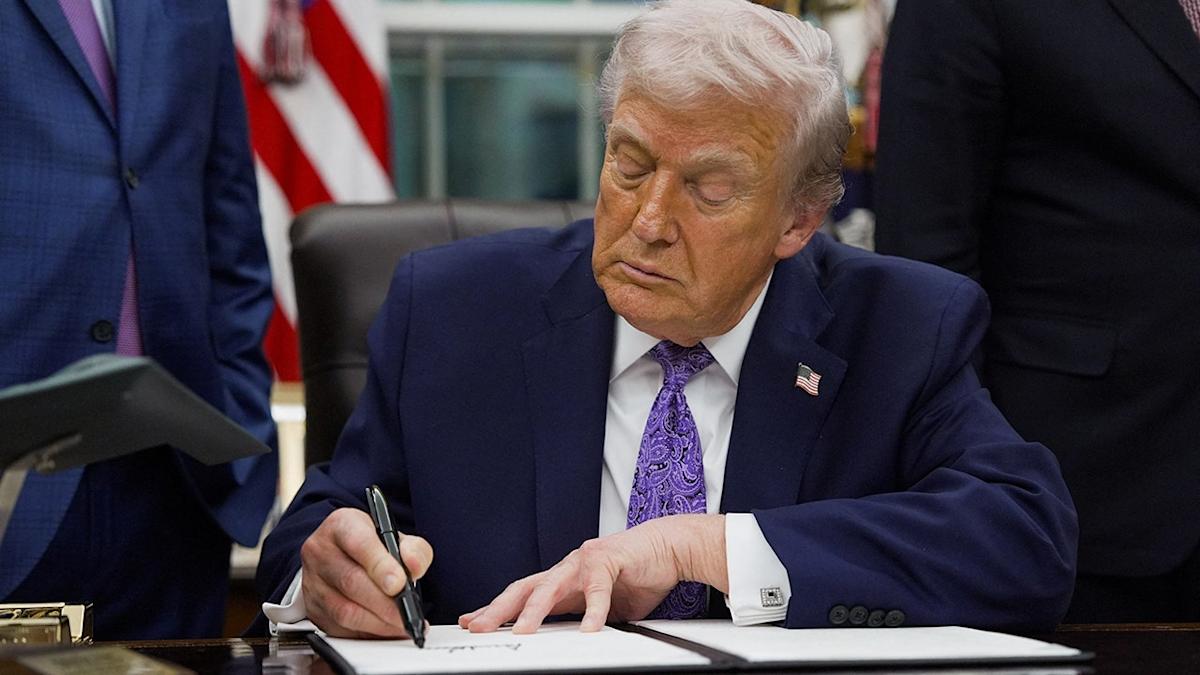
President Donald Trump signed into law the final repeal of the Caesar Syria Civilian Protection Act, ending the most sweeping US sanctions imposed on Syria since 2019. The repeal was included in the 2026 Department of Defense budget, approved this month by both chambers of Congress, and took effect immediately upon the president’s signature Friday, December 19, according to both Reuters and SANA.
The Caesar Act, passed by Congress in 2019 during Trump’s first term, targeted the former regime of Bashar al-Assad and its allies over documented human rights abuses. Named after the pseudonym of a Syrian military photographer who defected and smuggled out images of tortured detainees, the law imposed secondary sanctions on foreign governments, companies and individuals involved in Assad’s energy, aviation, finance and reconstruction sectors. The FBI confirmed the authenticity of the images, which were presented to US lawmakers in 2014.
The repeal, described by US officials as “unconditional,” removes the threat of automatic reimposition of sanctions. However, the defense law requires the White House to submit reports to Congress every four years assessing whether the Syrian government continues to combat terrorism, curb drug trafficking, protect minorities and pursue regional peace. If two consecutive reports are negative, the president may consider targeted sanctions on individuals, excluding restrictions on exports.
Regional and International Reactions
Damascus welcomed the move, calling it a “critical step” toward economic recovery. Presidential media adviser Ahmad Zaidan said on X that Syria is now positioned to attract investment after years of economic isolation.
Regional allies echoed that view. Saudi Arabia’s Foreign Ministry said the repeal supports stability, reconstruction and refugee returns, while Jordan’s Foreign Ministry described it as an important step toward regional security and recovery. Both praised Trump’s role in advancing the decision.
In Washington, Rep. Joe Wilson and Sen. Jeanne Shaheen called the repeal a “historic moment” and a once-in-a-generation opportunity. In a joint video message, they said sanctions meant to isolate the Assad regime had become a barrier to reconstruction after its fall, arguing that economic growth is now essential to counter extremism and promote stability.
Implications for Refugees and Rebuilding
International organizations see the repeal as a potential catalyst for recovery, though challenges remain. Karolina Lindholm Billing, the UN refugee agency’s representative in Lebanon, told the AP the move could encourage refugee returns and unlock investment. About 400,000 Syrian refugees have returned from Lebanon since Assad’s ouster in December 2024, though roughly one million remain there, including 636,000 registered with the agency.
Over one million refugees returned from neighboring countries, and nearly two million internally displaced Syrians went back to their homes, the agency said. Returnees receive $600 per family, but many face destroyed housing and limited job prospects.
The World Bank estimates Syria’s reconstruction costs at $216 billion. Billing said current aid remains modest compared with the needs and warned that without large-scale investment and job creation, returns may not be sustainable. As donors weigh next steps, the repeal removes a major legal barrier, but Syria’s recovery will depend on security, governance and sustained international engagement.