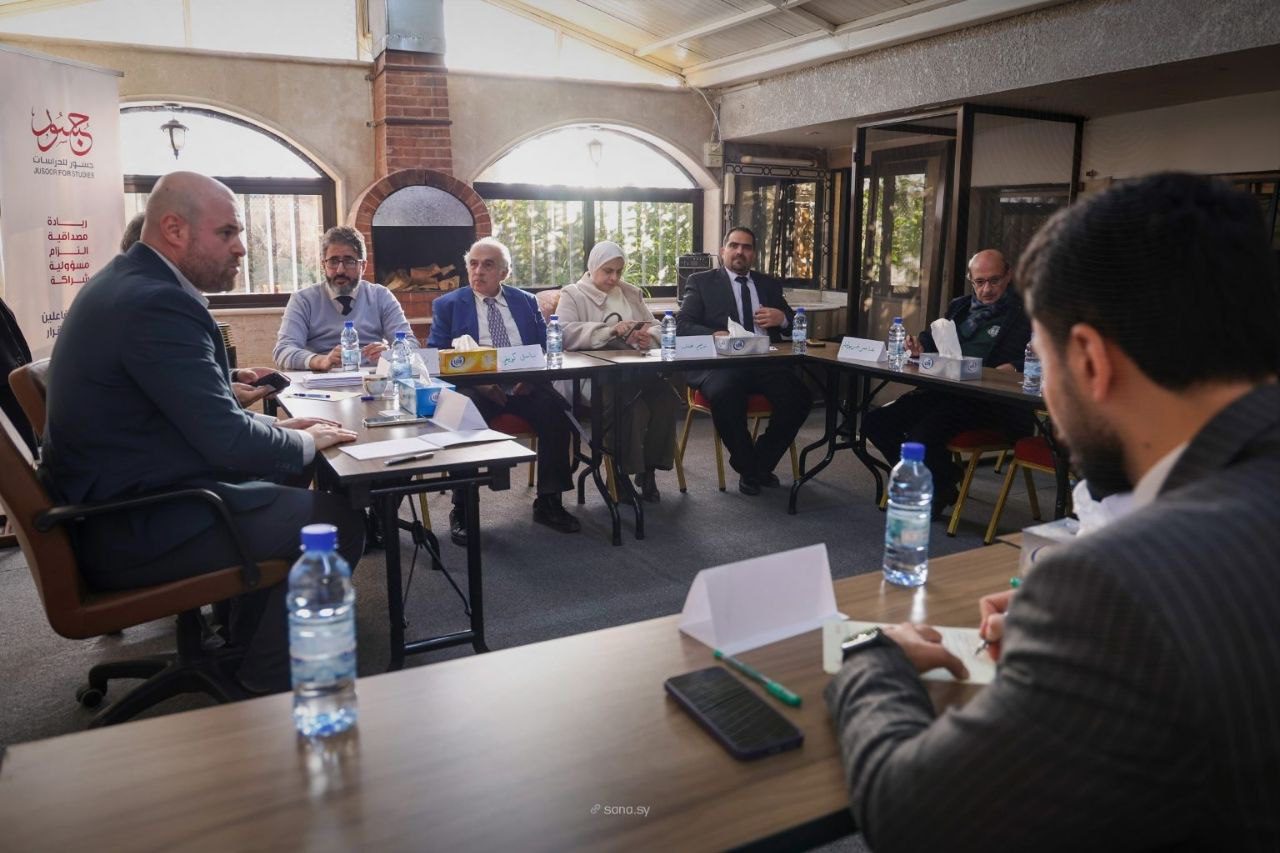
 The Jusoor Center for Studies in Damascus organized a dialogue session bringing together economists, business leaders, and decision-makers to examine the current state of the Syrian economy and the challenges it faces. The discussion aimed to outline practical pathways for recovery and long-term economic advancement.
From Production to Governance
Participants stressed the need to develop a new economic model aligned with Syria’s shift toward openness, while prioritizing support for productive sectors, particularly agriculture and renewable energy, due to their central role in job creation and sustainable growth. The discussion also highlighted the importance of small and medium-sized enterprises, noting their flexibility and capacity to adapt to changing economic conditions.
From Corruption to Economic Identity
The session addressed several structural challenges, most notably the need to attract Syrian talent from abroad by creating a competitive and transparent economic environment. Participants emphasized combating corruption through effective governance frameworks, deterrent legislation, and clear accountability mechanisms.
Enhancing competitiveness was another key theme, with recommendations including combating dumping practices, regulating financing mechanisms, supporting production inputs and energy access, applying selective customs tariffs, and expanding vocational training to strengthen affected sectors. Economic researcher Hassan Ghurra underscored the importance of engaging experts and civil society in shaping economic policy, noting that this inclusive approach was a core objective of launching the dialogue forum.
Investment Opportunities: Foundations and Requirements
Economic expert Razi Muhiuddin highlighted that Syria possesses substantial investment potential, citing its strategic geographic location, relatively low labor costs, availability of raw materials, and position along international trade routes. He noted that investment efforts should target local capital, Syrians living abroad, as well as Arab and foreign investors.
However, Muhiuddin emphasized that primary challenges lie in defining Syria’s economic identity for the next phase. This includes clarifying the nature of market competition, determining whether reform should focus on restructuring existing institutions or establishing new systems, and adopting a clear governance model that defines the partnership between the public and private sectors.
Dialogue for the Future
The meeting forms part of the Jusoor Center’s ongoing research and policy dialogue efforts since its establishment in 2016. Participants agreed that despite the complexity of the challenges facing the Syrian economy, recovery remains achievable if a national consensus is built around clear priorities.
The discussion concluded that a successful recovery path must begin with an honest assessment of economic realities and a clear definition of the desired economic identity, enabling Syria’s latent resources and capacities to be transformed into effective drivers of growth.