
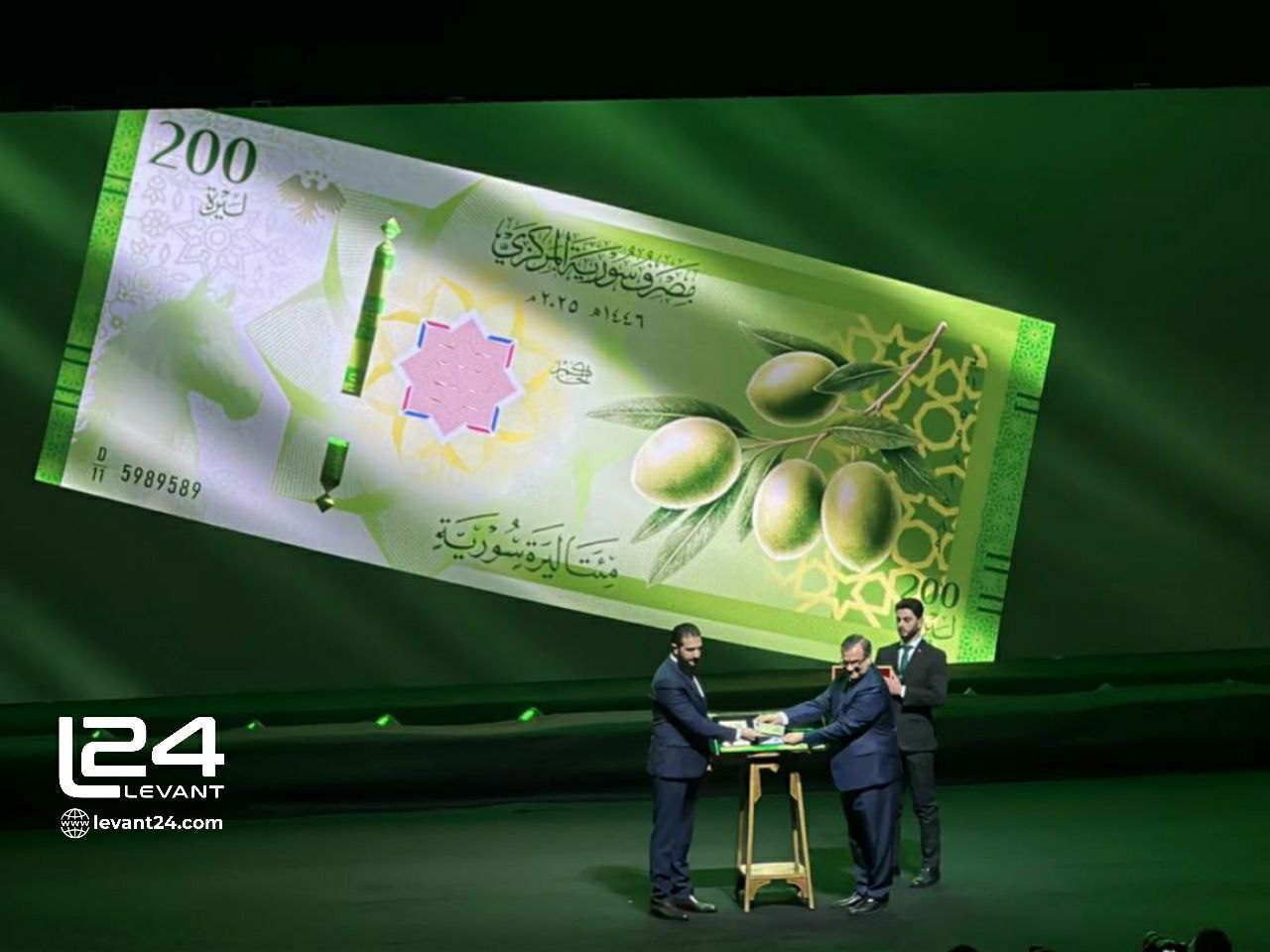
 In the presence of President Ahmad al-Sharaa and his wife, Syria officially launched its new national currency at a ceremony held in the Damascus Conference Palace. Officials described the move as a deliberate break with past practices and a technical step within a broader effort to restore confidence, modernize institutions, and open a new economic phase.
A Strategic Vision for Monetary Reform
Presidential advisor Abdullah al-Shammaa explained that the currency reform was developed according to international standards and informed by field visits to central banks abroad. The strategy rests on five pillars: price stability through sound monetary policy, a balanced exchange market, a resilient banking sector, secure digital payment systems, and gradual international financial integration. Together, these pillars aim to reposition the Central Bank as a core institution of stability and public trust.
A Technical Adjustment Not a Cure-All
President Sharaa stressed that the removal of two zeros from the currency, whereby 5,000 old Syrian pounds equal 50 new ones, is a technical measure intended to simplify transactions, not an economic miracle. Sustainable improvement, he emphasized, depends on expanding production, reducing unemployment, and rehabilitating the banking sector.
He urged citizens to avoid panic-driven currency exchanges, noting that the transition period will last 90 days, extendable if needed, during which both currencies will circulate simultaneously and prices will be displayed in both denominations.
Confidence, Identity, and Institutional Symbolism
Linking monetary stability to public trust, Sharaa noted that years of economic erosion had weakened confidence in the national currency and driven deposits out of banks. The new banknotes, he said, reflect a renewed national identity, one centered on institutions rather than individuals, drawing symbolism from Syria’s geography, environment, and shared heritage.
This message resonated with citizens. Mona, a schoolteacher, said the absence of personal portraits was “a positive shift that reinforces the idea of the state as institutions, not personalities,” adding that the inclusion of the Umayyad Mosque treasury connects the currency to Syria’s historical depth.
Practical Benefits and Safeguards
The Central Bank (CBS) stressed reforms aim to simplify daily financial transactions and better regulate the money supply, without altering the real exchange rate. The new currency is expected to encourage broader use of the Syrian pound (SYP) in everyday commerce, supported by a public awareness campaign explaining the transition process and its safeguards.
For shop owners like Abu Ali, a grocer in Damascus, the change carries immediate practical value. Handling large volumes of cash daily, he said the reduced number of zeros will make accounting, pricing, and transactions significantly easier.
Design Rooted in Nature and Security
Design team director Wassim Qaddoura explained that the new banknotes incorporate symbols of Syria’s agricultural and natural identity, including wheat, olives, the Damask rose, and the Arabian gazelle. Color schemes were selected to clearly differentiate denominations, while the obverse features the Central Bank and the Umayyad Mosque treasury, underscoring monetary sovereignty and continuity. Advanced security features have been integrated to combat counterfeiting and align the currency with modern international standards.
Public Expectations and Cautious Optimism
Among younger Syrians, the new currency carries symbolic weight. Yassir, an engineering student, described it as “a sign of progress and change,” saying the design fosters a renewed sense of belonging. Others, like Ruqaya Suleiman, stressed that the reform’s success depends on parallel economic policies, noting that currency change must be accompanied by measures ensuring stability and growth.
Overall, the launch of the new SYP represents both a practical monetary adjustment and a symbolic reset, reflecting broader ambitions for institutional reform, economic recovery, and restored public confidence.