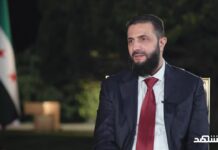
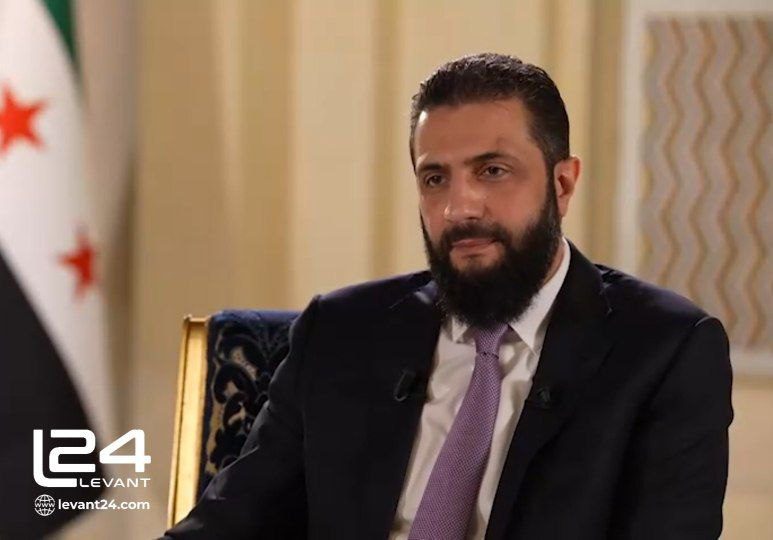
In exclusive clips from an unaired Shams TV interview Syrian President Ahmad al-Sharaa covers a broad range of issues. In the videos, provided to Levant24 by the Syrian government, the President sought to sharply distinguish between Syria’s Kurdish population and the Syrian Democratic Forces (SDF), framing the SDF as a political and military project tied to the PKK rather than a representative of Kurdish society in Syria.
“The Kurdish people are a part of Syria’s situation,” Sharaa said, pointing to Kurdish communities integrated into Damascus, Aleppo and other cities, as well as Kurdish representation in senior government posts, including the Ministry of Education. He rejected what he described as attempts to confine Syrian Kurdish communities to “a factional, partisan condition, armed and with external affiliations,” a reference to PKK-linked leadership based in Iraq’s Qandil Mountains.
Throughout the interview, Sharaa emphasized that Kurdish rights are a constitutional matter rooted in citizenship, not an outcome of armed struggle. He argued that participation in state institutions, from parliament to the army, offers lasting protection for Kurdish political and cultural rights, while continued alignment with the SDF isolates Kurdish communities from reconstruction, development and education.
Integration Over Confrontation
Sharaa said talks with SDF commander Mazloum Abdi began shortly after the fall of the Assad regime, with the central premise that Kurdish rights did not require bloodshed. “If you are fighting for the rights of Kurdish society, then you do not need to spill a single drop of blood,” he said.
According to Sharaa, the proposed integration of SDF forces into the Syrian military was designed to preserve Kurdish rights while restoring state authority. He stressed that integration was never about dissolving Kurdish fighters but about placing armed groups under a unified legal framework. He also rejected claims that the SDF speaks for all segments of Kurdish communities, noting internal divisions within the SDF and Kurdish society and the participation of many Kurds in the revolution external of the SDF.
Sharaa said the March 10 agreement offered the SDF a clear path into political life, but accused the group of repeatedly boycotting national processes, including the Syrian National Conference, the formation of the government and the constitutional declaration.
Violence and Responsibility
The president accused the SDF of violations and carrying out attacks against civilians in northern Syria, including bombings in markets in Azaz, Bab and Afrin. He said recent violence in Aleppo’s Sheikh Maqsoud and Ashrafieh neighborhoods stemmed from SDF actions, arguing the incidents “would not have happened without the SDF’s attacks.”
According to figures from the Aleppo Health Directorate, 105 civilians were wounded and 24 were killed, including women and children, as a result of SDF attacks and violations in Aleppo this week. Despite the violence, Sharaa said the government has shown patience and remained committed to the March 10 agreement, placing responsibility for further escalation on the SDF. “The ball is in their court,” he said, adding that Syria would not abandon its obligations.
Sheikh Maqsoud and the Path Forward
Sharaa highlighted what he described as the return of normal life to Sheikh Maqsoud and Ashrafieh, with Kurdish residents living under state protection and enjoying full citizenship rights. He framed this as evidence that coexistence under state authority is possible and preferable to continued armed control.
Addressing concerns about threats, Sharaa said his remarks were not intended as warnings but as an explanation of Syria’s current reality. “I am not threatening,” he said. “I am explaining reality, offering advice, and clarifying contexts.”
He linked the SDF issue to broader regional stability, arguing that reconstruction, border control and economic recovery depend on a single state authority. Integration, he said, remains the only viable option for both Kurdish communities and Syria as a whole.