
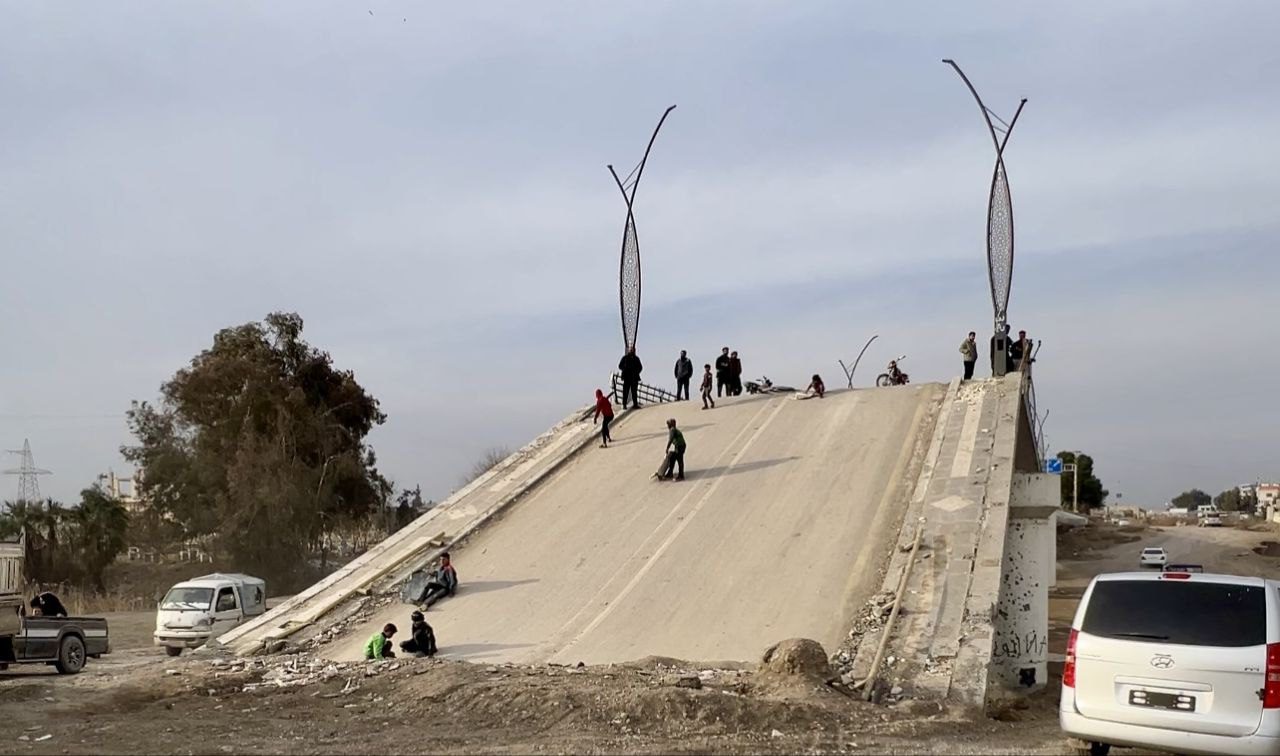
 Raqqa Governorate includes around 134 bridges which, together with the central road network, form the backbone of economic, service, and social mobility. These bridges are vital lifelines connecting cities and countryside across both banks of the Euphrates River. The road network itself consists of 12 main axes linking the governorate with surrounding regions, making connectivity essential to daily life and economic stability.
Raqqa’s Historic and Vital Lifelines
Rashid Bridge, known as the New Raqqa Bridge, stands as one of the most important landmarks in the governorate. Located at the southern entrance of Raqqa city on the Euphrates River, it was built in the 1960s under Yugoslav technical supervision. The bridge consists of 14 spans, stretches 526 meters in length, and is 12 meters wide. For decades, it served as the primary connection between Raqqa and other Syrian governorates.
Mansour Bridge, or the Old Raqqa Bridge, dates back to 1942 when it was built by British forces during World War II. It functioned as a key crossing point for military movements from Iraq to the Levant and measures approximately 630 meters in length.
Maadan Bridge lies on the Euphrates near the town of Maadan, about 55 kilometers east of Raqqa city. Opened in 2005, the bridge is 550 meters long and played a significant role in linking rural areas with the city, stimulating agricultural and commercial activity.
Bridges and Roads as Military Targets
Raqqa’s bridge and road infrastructure suffered extensive destruction due to intense bombardment during years of conflict, particularly during operations against ISIS and airstrikes carried out by the international coalition. Over 66 bridges were either partially or completely destroyed, including several major crossings. Rashid Bridge was fully destroyed in early 2017 and later renovated in 2024.
In January of 2026, locals staged an uprising against the SDF, with tribal fighters taking control of several areas. Following a Jan. 18 agreement with Damascus, stipulating the withdrawal of their forces, the SDF detonated vital bridges at the city’s entrances. This resulted in near-total paralysis of movement between the two banks of the Euphrates. Maadan Bridge and several others sustained heavy damage, forcing residents to rely on river ferries that fail to meet basic daily transportation needs.
Rehabilitation Efforts and the Priority of Reconnection
During his recent visit to Raqqa, Minister of Transport Dr. Yarab Badr confirmed that reconnecting the two banks of the Euphrates River is the government’s top priority due to its direct impact on citizens’ daily lives and on economic and service activity.
Dr. Badr stated that the two main bridges in Raqqa city were destroyed just before the SDF’s withdrawal, with the intent of cutting communication between the riverbanks. He emphasized that the government has treated this issue as a national priority and has developed several alternatives to restore the bridges to service.
Condemnation of SDF Bridge Destruction
Commenting on the destruction of bridges in Raqqa, Fadel Abdulghani, Director of the Syrian Network for Human Rights (SNHR), told Levant24 that “this action constitutes a flagrant violation of international humanitarian law as well as war crimes for which individual criminal liability must be pursued.”
Abdulghani added that the SDF’s targeting of these critical structures during its withdrawal represented a disproportionate and unnecessary military tactic. He stressed that by severing vital lifelines, civilians were unlawfully deprived of access to essential services, including hospitals, while safe movement was severely restricted, deepening the humanitarian crisis and prolonging displacement.
Restoring safe movement remains a cornerstone of Raqqa’s recovery, enabling residents to move freely once again and supporting the revival of economic and service activity throughout the governorate and its surrounding areas.