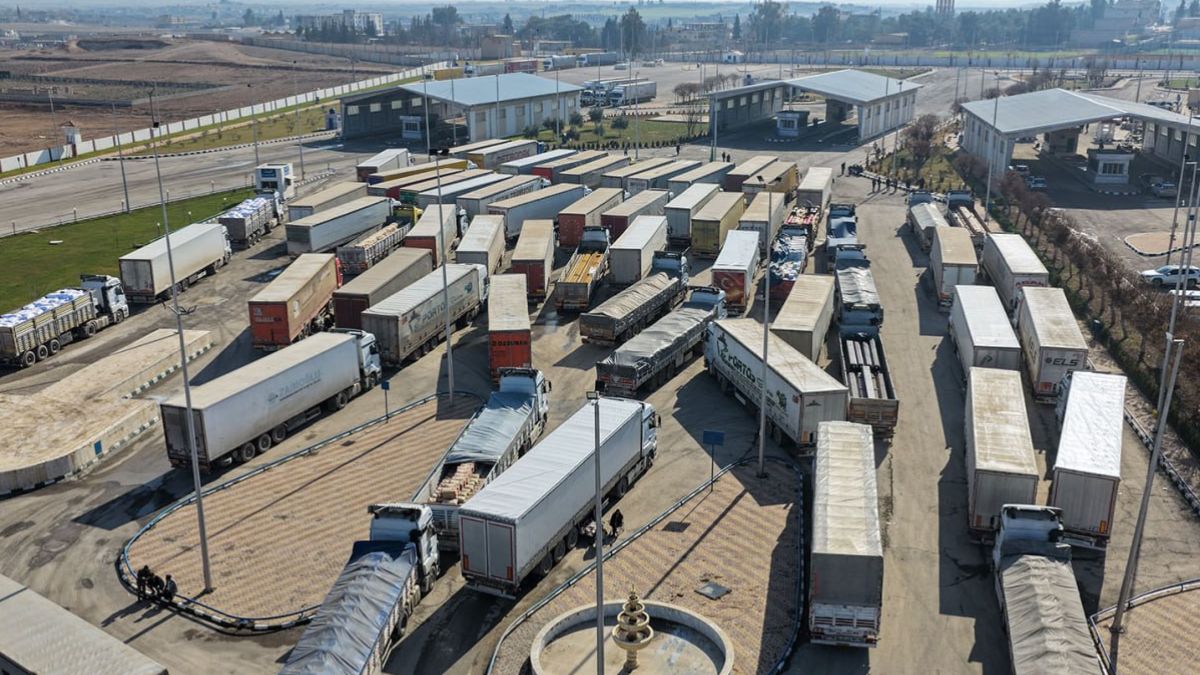
 Syria has implemented a decision to prohibit non-Syrian cargo trucks from entering its territory through land border crossings, a move officials describe as a reciprocal response to long-standing restrictions imposed on Syrian transport by neighboring countries. The decision took effect Feb. 7, causing immediate congestion as hundreds of trucks were stranded at border crossings with Jordan, Lebanon, and Turkey.
The Syrian General Authority for Borders and Customs (GABC) issued the resolution, allowing foreign trucks to transit Syrian territory but prohibiting them from loading or unloading cargo inside the country.
Mazen Alloush, the authority’s director of relations, said the move followed extensive protests and demands from Syrian transport workers, noting that thousands of families rely solely on trucking for their livelihoods. “This decision is not directed against the Lebanese or Jordanian people,” Alloush said. “It applies to all neighboring countries and aims primarily to activate and employ the Syrian transport fleet.”
Unjust Restrictions Afflicting Syrian Freight Transport
Muhammad Kishour, president of the International Union of Goods Transport Companies in Syria, said Syrian trucks have long faced discriminatory practices. While Syrian vehicles are permitted to deliver goods to Lebanon and Jordan, they are systematically prevented from returning with cargo.
“Lebanese trucks enter Syria loaded and leave loaded,” Kishour said. “Syrian trucks are allowed to transport goods to Lebanon but are not permitted to return with a load. This is not an official Lebanese government decision but is enforced by the Lebanese Truck Owners’ Syndicate at the borders, particularly for refrigerated trucks. The same applies to Jordan.”
Kishour thanked the Syrian government for adopting what he described as a long-overdue reciprocal measure, arguing that the national transport fleet has been “deprived of work” while foreign carriers benefit from transporting Syrian goods, bolstering their own economies at Syria’s expense.
Border Ban and Drug Trafficking Concerns Disrupt Trade
Kishour also pointed to additional barriers imposed by neighboring countries, including persistent accusations linking Syrian truck drivers to drug trafficking. “To this day, the stigma from the era of the Assad regime remains,” he said. “We are collectively accused of drug trafficking, and we are working to overcome these problems.”
In a statement to Levant24, Riyad al-Sayrafi, head of the Shipping, Transport and Transit Committee at the Damascus Chamber of Commerce, warned that the decision has caused significant disruption to freight and commercial activity.
He said requiring cargo transfers at border points has strained logistics, noting that transfer zones lack adequate infrastructure, labor and loading equipment. As a result, some goods have spoiled, transport costs have surged, and prices in local markets have risen.
Sayrafi added that congestion at border crossings has intensified, with waiting times potentially exceeding 20 days, placing additional burdens on drivers and traders. He noted cargo transfer fees from the Nasib crossing to Damascus have increased from about $400 to nearly $1,000, in addition to $50 for each day of delay.
He cautioned that maintaining the decision in its current form could disrupt supply chains and deepen economic pressures, calling for a review that balances security considerations with the smooth movement of trade and transport.
A Double-Edged Sword for the Transport Sector
Syrian authorities frame the decision as an economic necessity designed to establish fair competition and redirect freight revenues toward domestic transporters, offering relief to a sector battered by years of conflict and economic hardship.
However, business representatives warn of unintended consequences, including delays, rising costs and market disruptions. In the short term, the measure has caused significant logistical bottlenecks at key border crossings, presenting a new challenge to regional trade flows as Syria seeks to reclaim its share of cross-border haulage activity.