 The EU is studying a restructuring of its sanctions regime on Syria, seeking to align its policy with Syria’s current transitional phase following the fall of the Assad regime. According to an unofficial report circulated by the EU’s diplomatic service and reviewed by the outlet Euractiv, the proposed approach would shift sanctions away from broadly targeting figures associated with the former regime toward a framework more closely tied to managing Syria’s political and economic transition.
Proposed Adjustments
The European proposal includes redirecting sanctions toward armed groups, individuals responsible for human rights violations, actors involved in reconstruction-related corruption, and drug trafficking networks. The report stresses the need to “adapt the sanctions system” in line with the EU’s decision to resume more effective political and economic engagement with Syria.
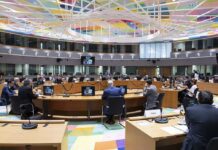
While discussions are expected to take place at a technical level within EU institutions, the current 375 sanctions targeting individuals linked to Assad regime leadership would remain in place during the initial phase, without immediate amendment.
According to the document’s authors, the existing sanctions framework is increasingly viewed as a legacy of a previous phase and may discourage potential investors concerned about legal and compliance risks.
Gradual Engagement with Damascus
In parallel, the EU’s diplomatic service signaled the possibility of removing Syria’s Ministries of Interior and Defense from the sanctions list to facilitate cooperation with the new authorities. This potential adjustment forms part of a gradual European re-engagement with Damascus. In January, Ursula von der Leyen, President of the European Commission, visited Damascus and announced financial support totaling €620 million for 2026 and 2027.
EU foreign ministers are also discussing the possible reactivation of the trade provisions in the 1978 cooperation agreement between the European Economic Community and Syria, which had been suspended more than a decade ago.
The evolving European approach reflects an effort to recalibrate relations in a manner that supports stability during the transitional phase while encouraging economic recovery, seen as a key pillar for the success of any future political process.