Before dawn on July 11, gunmen ambushed a vegetable truck on the Damascus–Suwayda highway, assaulted its Druze driver, and stole his cargo. Within hours, retaliatory kidnappings against Bedouins followed. Within days, more than 100 people were dead and hundreds wounded.
But the violence was not simply a cycle of tribal revenge. It was a symptom of a deeper reality: in Suwayda, armed authority no longer flows clearly from the state. Instead, power is fragmented among militias, local strongmen, and religious figures who command loyalty, territory, and revenue streams of their own.
At the center of this fragmented order stands Sheikh Hikmat al-Hijri. One of Syria’s three senior Druze spiritual leaders, Hijri has, over the past decade, evolved from a religious authority into a political and military patron whose influence now shapes much of the province’s security landscape. Armed factions have emerged around his network, drawing in local fighters, former regime personnel, and men seeking protection or income in an increasingly lawless environment.
The July escalation exposed the central unresolved question of the province: who governs Suwayda today? The Syrian state, civil movements, or armed networks sustained by smuggling, patronage, and increasingly, foreign leverage? In 2026, Suwayda is less of a sectarian flashpoint than a test case of whether the state can reabsorb armed peripheries without triggering renewed war.
The Ghost of the Regime
Suwayda, a predominantly Druze province bordering Jordan, historically maintained a degree of local autonomy while remaining formally under Damascus. The Druze, a small religious minority with a strong communal structure, often relied on local notables and religious authorities to mediate disputes and settle internal issues.
During the nearly 14-year revolution, that balance slowly shifted. Foreign penetration, selective patronage, and tolerated smuggling hollowed out formal institutions while empowering informal brokers. These were conditions that ultimately allowed figures like Hijri to accumulate both legitimacy and coercive power.
“The loyalist–opposition binary under the fallen regime divided local society and created a third group that stood somewhere in between,” said Lamis, a Suwayda resident who spoke to Levant24 under a pseudonym. “After the regime’s fall, the opposition was supposed to assume major responsibility, but that did not happen. Rapid developments imposed a de facto authority in the governorate.”
That de facto authority is Hijri, who transitioned beyond religious stewardship in 2012 as the regime weakened and local armed formations proliferated. Following Assad’s fall in 2024 his influence consolidated further through armed factions that later operated under the banner of the “National Guard.”
Suleiman Abdulbaqi, a Druze and head of the Internal Security Forces in Suwayda, argues that Hijri’s rise reflects continuity of Assad-era systems rather than rupture. “For over 55 years, this system flowed through people’s veins,” Abdulbaqi told Levant24.
“Anyone previously involved in bloodshed sheltered under Hikmat al-Hijri’s cloak solely to protect themselves and their families,” he said. This includes many officers of the Assad regime who now fill the ranks of Hijri’s National Guard.
Dr. Kinan Masoud, a Suwayda native now living abroad, offered a similar assessment: the Assad regime “fragmented society, empowered the worst elements, institutionalized informants, corruption and drug networks, all inherited by today’s gangs.” The fall of Assad removed the center but not the structure. Suwayda’s current fragmentation is an evolution of the old security–patronage ecosystem, now operating without central arbitration.
Armed Authority and the Economics of Control
Suwayda’s strategic geography compounds the problem. The province sits astride smuggling corridors connecting Syria to Jordan and, by extension, Gulf markets. Under Assad, narcotics trafficking, weapon smuggling, kidnapping, and extortion became embedded in local power hierarchies.
“Money talks,” Lamis said. “Anyone providing financial support to any group plays a key role in repositioning forces and changing loyalties.” Control over checkpoints and trade routes translates into coercive leverage. Abdulbaqi accused factions aligned with Hijri of monopolizing access in and out of the province and imposing levies on residents.
Masoud described recurring Druze–Bedouin clashes as “kidnapping and counter-kidnapping, masked as sectarian conflict but, in reality, gang disputes over profit shares.” The July escalation accelerated this dynamic. Online narratives alleging a government-led “genocide” proliferated rapidly, deepening distrust of Damascus.
Independent monitors reported a complex network of groups responsible for the violence. Nevertheless, the perception of collective threat reshaped public attitudes. Before July, Masoud estimated Hijri had roughly 20% of public support. After the clashes, that figure doubled to around 40%. “Under existential threat, people lean toward Druze gangs because they do not kill ‘without reason,’” he said. Fear, not ideology alone, consolidated Hijri’s position.
Fragmented Currents Within Suwayda
Reductive portrayals often frame issues in terms of “the Druze.” In reality, four distinct currents are visible. First is Hijri’s camp, combining religious authority, armed capacity, and, according to critics, foreign allegiances and financial networks linked to smuggling. Second are remnants of the former Assad system who repositioned themselves under new patronage, namely Hijri’s National Guard.
Third is a broader segment of the population, wary of the new government but uneasy about confrontation and foreign entanglement. Fourth is a smaller educated elite advocating negotiated political solutions without external sponsorship.
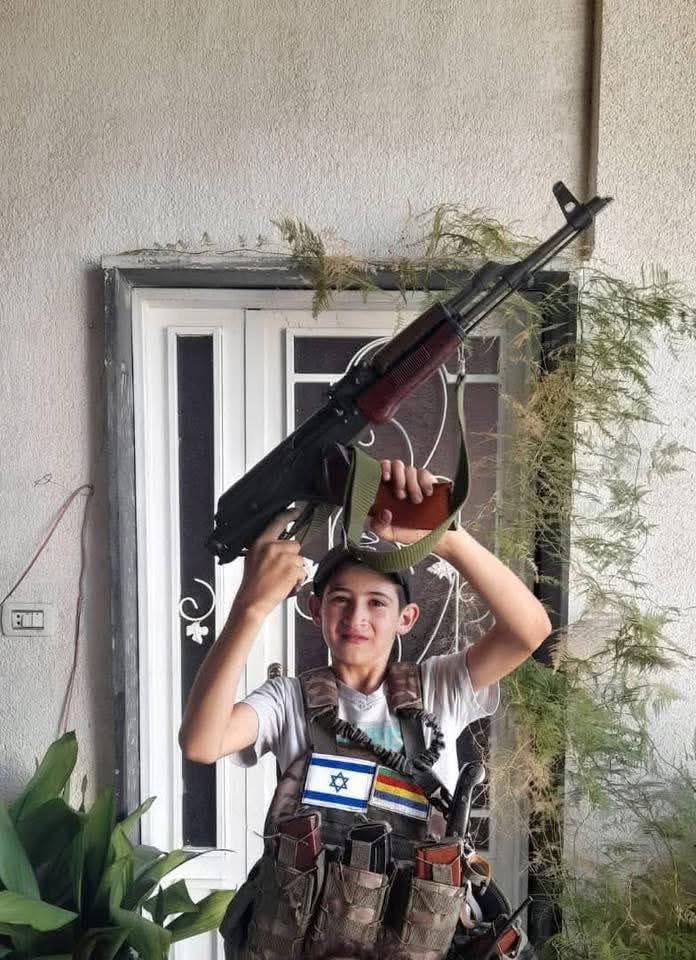
“There are several different actors with differing orientations,” Lamis said. “The unifying demand among the main power centers in Suwayda is to distance themselves from the new Syrian government. However, they differ among themselves between those who support Israel and those who oppose it.”
Israeli Involvement and Strategic Leverage
Israeli airstrikes during the July clashes introduced a regional dimension. As Syrian forces advanced toward Suwayda, Israeli drones struck military convoys. Each collapsed ceasefire was followed by renewed strikes.
Israeli officials publicly frame such operations as aimed at protecting “the Druze.” Critics argue the practical effect has been to deter Damascus from forcefully reasserting control and to strengthen Hijri’s bargaining position. Sheikh Laith al-Balous, a prominent Druze figure supporting reintegration, mentioned to Levant24 Hijri’s role in relation to Israel, wherein Hijri said, “We made a deal with Israel, and we are the right hand of Israel.” While Israel frames its actions as efforts to “protect the Druze,” its intervention appears driven by broader strategic calculations.
For years, despite documented attacks on Druze communities by Hezbollah-linked groups, Assad regime forces, ISIS, and criminal networks, Israel refrained from military or political intervention in Suwayda. Its more recent activism coincides not only with “Druze vulnerability,” but with the collapse of centralized Syrian authority.
Post-Assad Israeli policy focuses on preventing the reconstitution of a strong Syrian state, entrenching a demilitarized buffer zone stretching from the Golan toward Damascus, preserving freedom of aerial operations, and limiting Iranian and Turkish influence in the south.
“Protecting the Druze” may be part of the narrative, but the timing and scope of Israeli engagement suggest a strategy aimed at shaping southern Syria’s security architecture to constrain Damascus’ sovereignty. Israeli interference, even if limited or tactical, alters local calculations, raising the cost of direct state intervention while reinforcing armed autonomy.
Reintegration or Entrenchment?
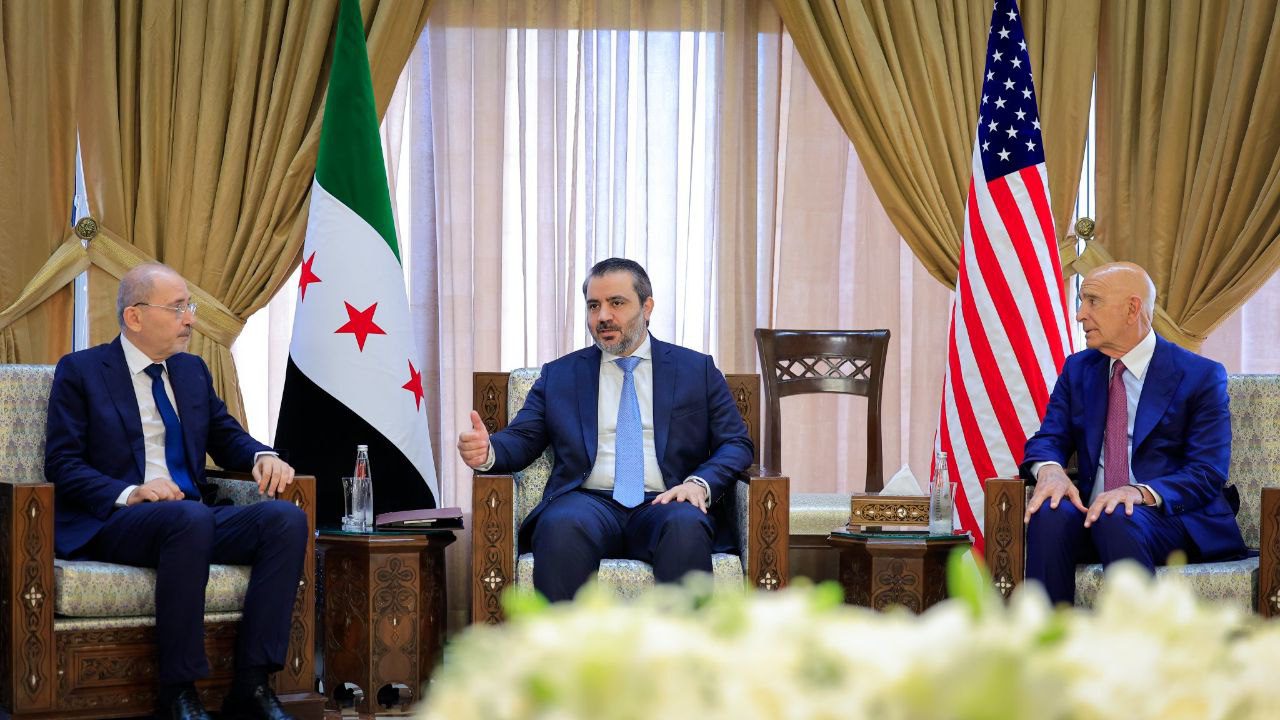
Damascus pursues incremental reintegration rather than immediate confrontation. Abdulbaqi said nearly 400 Suwayda residents have joined the Internal Security Forces, with plans to expand recruitment and facilitate the return of displaced families under security guarantees.
The approach hinges on rebuilding service provision, integrating local recruits into national structures, and gradually reestablishing a state monopoly over force. Yet the risks are evident. If negotiations stall, Abdulbaqi acknowledged that “decisive intervention” remains possible, a scenario that could trigger escalation and potentially draw in additional regional actors.
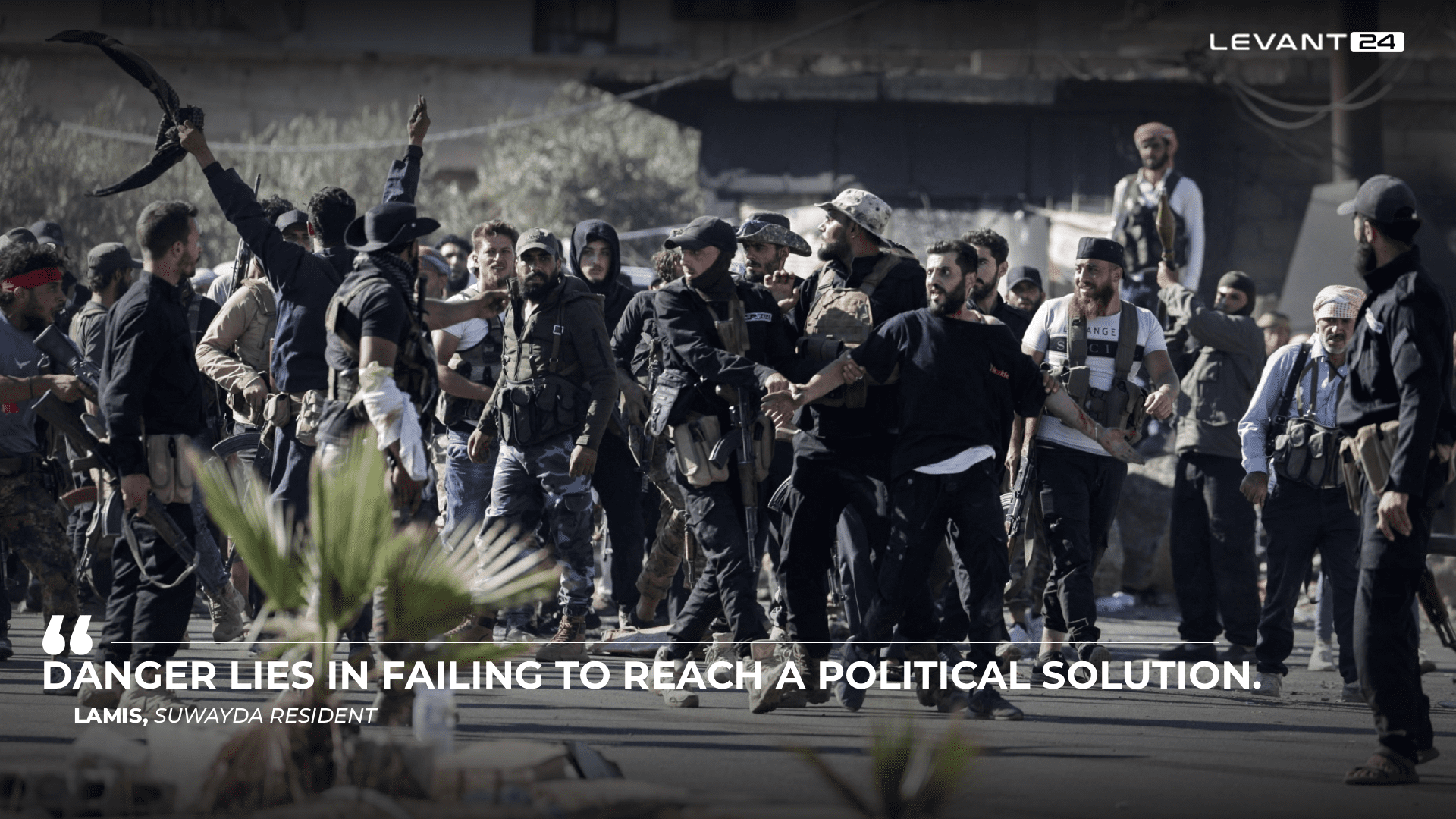
“The greatest danger lies in failing to reach a political solution,” Lamis warned, describing the current environment as dominated by armed ideological actors and dependent on international intervention beyond local control.
The outcome may depend less on rhetorical commitments to unity than on whether Damascus can offer tangible governance: security, accountability for abuses, economic stabilization, and credible political inclusion.
A Barometer for Syria’s Transition
Suwayda’s trajectory carries implications beyond its borders. If the province reintegrates through negotiated security arrangements and institutional rebuilding, it may provide a template for stabilizing other armed peripheries. If it hardens into an armed enclave sustained by smuggling revenues and external leverage, it risks becoming a semi-permanent pressure point in Syria’s south.
The July truck ambush did not create Suwayda’s crisis. It illuminated it. The province now sits at an inflection point between negotiated integration and entrenched fragmentation. Whether 2026 becomes the year Suwayda moves back toward institutional governance, or further into militia-managed autonomy, will signal whether Syria’s post-Assad order can consolidate authority without reproducing the coercive systems that fractured it in the first place.