
A recent ordinance issued by the Damascus Governorate has triggered widespread debate after restricting where and how alcohol can be sold and consumed in the Syrian capital. Officials stressed, however, that alcohol has not been banned either in Damascus or across Syria.
Decision No. 311 prohibits the serving of alcoholic drinks in restaurants and nightclubs while limiting the sale of sealed beverages to specific neighborhoods, including Bab Touma, Qassaa and Bab Sharqi. The measure also imposes distance requirements between alcohol retailers and places of worship, schools and cemeteries.
In an official clarification, the governorate said the decision aims to “maintain security and stability and preserve civil peace and public morals,” adding that it “does not interfere with the personal freedoms of citizens” and is “purely regulatory within the framework of the law.”
Authorities also noted that the policy builds on existing legislation, including Legislative Decree 180 of 1952 and subsequent regulations issued in 1998, 2010, 2013 and 2018. The move followed complaints about disturbances linked to nightlife venues, unlicensed alcohol sales and reports of sales to minors.
Critics Raise Concerns Over Implementation
Community leaders and residents have criticized the ordinance, particularly in the neighborhoods designated for alcohol sales. The Bab Touma neighborhood committee said the decision was issued “without sufficient study or consultation with the local community,” calling it a violation of constitutional principles guaranteeing equality and prohibiting discrimination. They warned concentrating alcohol sales in specific areas could “reinforce social segregation and undermine the coexistence” that has long defined Damascus.
George Nabil Istifan, the committee’s legal spokesperson, told Syria TV the group does not oppose regulation but objects to the approach taken. “We are against selling by the cup in the public street, and several letters were sent regarding this issue, but the decision came far from what we were proposing,” he said. Istifan also questioned the feasibility of the 75-meter distance requirement, describing it as “an almost impossible condition” that could effectively limit licensing.
Other voices echoed similar concerns. The Archdiocese of Bosra, Hauran and Jabal al-Arab said while understanding complaints, “addressing any violation or transgression of the law should not be done by imposing collective restrictions or by curtailing the personal freedoms guaranteed by the constitution.”
Social and Economic Impact
Some residents argue the ordinance risks reshaping the city’s social fabric. Joseph, a resident of Bab Touma, told Syria TV, “the decision is wrong, it indicates the government makes its decisions in accordance with a certain segment of society.” Another resident, Ghassan, said alcohol consumption “is a purely personal matter,” not limited to any group.
Business owners also expressed economic concerns. A restaurant owner in Old Damascus, who declined to be identified, said restrictions could harm tourism and force establishments to close or operate informally. “This decision is killing local and foreign tourism.” Similarly, a liquor store owner said the measure threatens long-standing livelihoods, noting many customers come from across the city rather than from the designated neighborhoods.
Legal Debate and Public Protests Emerge
Legal experts questioned the scope of the governorate’s authority. Muhammad al-Abdullah, executive director of the Syrian Center for Justice and Accountability, said Syrian law regulates but does not prohibit alcohol. He argued imposing restrictions through an administrative decision could exceed legal authority. “The law permits the trade and consumption of alcoholic beverages,” Abdullah said, adding broader prohibitions would require legislative action rather than administrative measures.
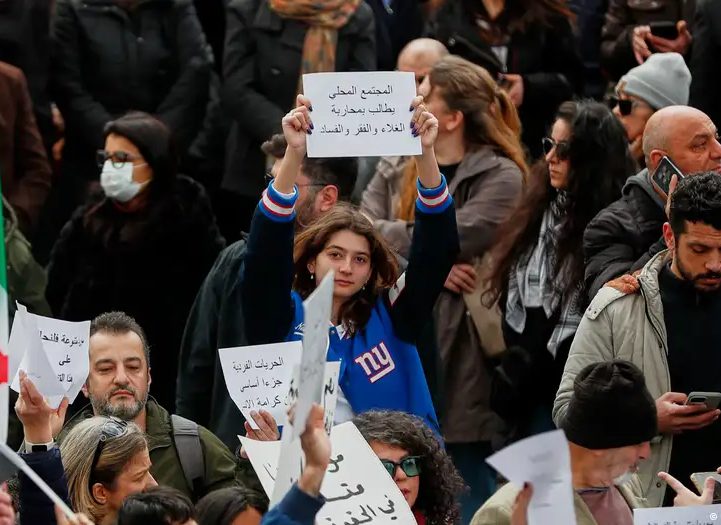
The controversy prompted public demonstrations. Dozens of activists gathered in Bab Touma for a peaceful sit-in, calling for the ordinance’s repeal and emphasizing the importance of coexistence and individual freedoms. Many participants stressed such freedoms are enshrined in the Syrian constitution, while others stressed the debate extends beyond alcohol to broader questions of governance and rights.
However, not all groups oppose the ordinances, there have been counter demonstrations, with people taking to the streets supporting the efforts and demanding stricter restrictions on alcohol. Anti-alcohol groups have planned protests for the coming Friday, March 27.
International Regulatory Practices
While the decision sparked local concern, regulations governing alcohol sales are common worldwide. Many countries impose zoning rules restricting sales near schools or places of worship, often within distances ranging from 100 to 500 meters. Time-based restrictions are also widespread, with over half of countries limiting hours of sale.
In the US, local jurisdictions known as “dry counties” prohibit alcohol sales entirely, while European countries such as Sweden and Finland restrict stronger beverages to state-run stores with limited hours. In France, certain shops cannot sell alcohol on Sundays, and in parts of Italy, late-night sales face municipal limits.
Regional examples also illustrate similar approaches. Egypt restricts alcohol sales to designated areas and bans them during Ramadan, while Jordan enforces licensing rules and zoning requirements. In contrast, some countries in the Middle East, including Saudi Arabia and Yemen, enforce full prohibition.
Against this backdrop, Syrian officials maintain the ordinance aligns with cultural and international norms regulating, rather than banning alcohol. However, ongoing debate within the city, with groups both for and against limiting current policies on alcohol, suggests the manner of implementation, rather than the concept of regulation itself, remains the central point of contention.