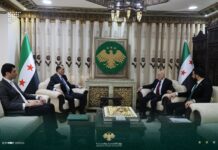
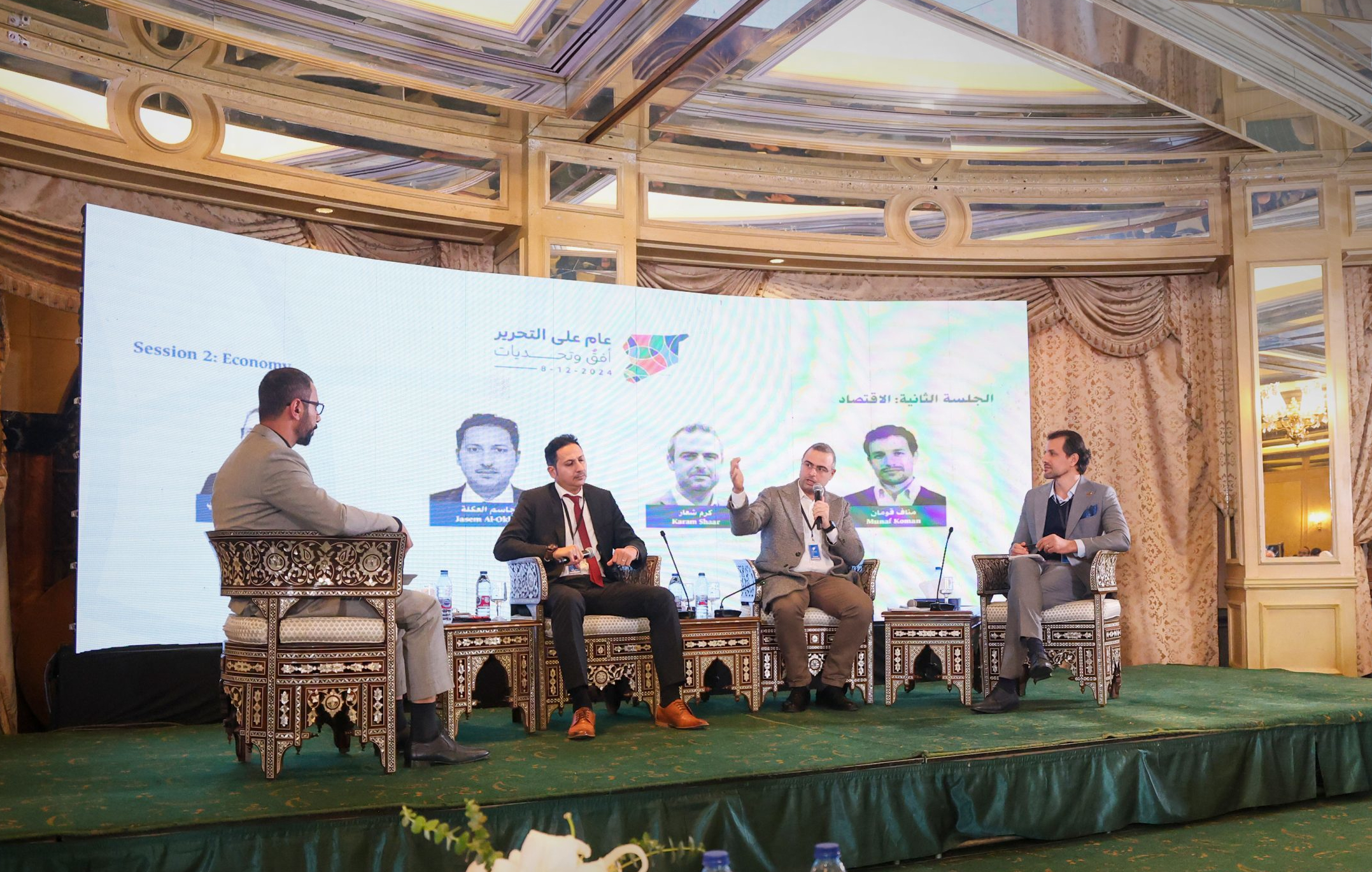
The forum titled “A Year After Liberation: Prospects and Challenges,” organized by the Ministry of Information at Al-Sham Hotel in Damascus, brought together researchers and specialists to discuss key economic issues shaping Syria’s post-liberation recovery phase. The event comes at a transitional moment marked by intertwined political, economic, and social challenges, as Syria seeks to define the contours of recovery after years of conflict, sanctions, and institutional collapse.
Participants examined the heavy legacy left by the Assad regime, including widespread infrastructure destruction, the erosion of the national currency, the loss of human capital through emigration, and the disruption of production and trade networks. The forum served as a platform to exchange perspectives on the prospects and constraints facing Syria’s economic recovery in the post-Assad era.
Gradual Transformations in the Absence of Comprehensive Vision
During an expanded dialogue session, economic and political affairs specialist Karam Shaar, Non-Resident Senior Fellow at the New Lines Institute, described the Syrian economy as undergoing gradual transformations after years of isolation.
He noted that while it remains premature to fully assess outcomes, some positive indicators emerged, including the unification of exchange rates, a relative decline in prices, the opening of state economic institutions to market actors, and renewed attention to investment following decades of rigid restrictions.
Shaar argued that the central challenge is not in partial reforms, but in the absence of a comprehensive economic vision and a clearly defined identity for the national economy. He called for unified government orientations and policy coherence, particularly on issues of taxation, reconstruction, and public–private partnerships.
He stressed the need to balance market-oriented reforms with the social role of the state, emphasizing the protection of vulnerable groups, fair income distribution, and the promotion of institutional efficiency based on competence rather than political or personal loyalties.
Lifting Sanctions as a Gateway to Reconnection
Associate Professor of Finance at UK-based Anglia Ruskin University, Dr. Jassim al-Okla, focused on the economic implications of lifting international sanctions, describing this development as a decisive factor in reconnecting Syria with regional and global markets.
He noted that Syria’s return to the SWIFT banking system would facilitate financial transfers and trade, improve the operating environment for companies, and enhance the attractiveness of the country to foreign investors, with positive spillovers across the wider economy.
Dr. Okla emphasized the next phase requires deep reforms in monetary, fiscal, and banking policies, alongside updates to legislative frameworks, while taking into account shifts in the global economic landscape. He called for developing an economic model tailored to Syria’s specific realities, prioritizing infrastructure rehabilitation, liquidity management, and the development of the insurance sector as a pillar of financial stability.
Agriculture as a Foundation for Balanced Development
Economic researcher and Executive Advisor for Infrastructure and Reconstruction Affairs at the Ministry of Economy, Munaf Quman, argued economic reform should begin with restoring the agricultural sector’s role. He described agriculture as a historical pillar of the national economy, essential for job creation, food security, and reducing living costs.
Quman highlighted the importance of supporting small and medium-sized enterprises and investing in human capital, noting that Syria possesses significant scientific and professional expertise that was sidelined during years of conflict. He called for protecting local industry and directing investments toward rural areas to achieve balanced development and prevent excessive concentration of economic activity in major cities.
The forum concluded that Syria’s recovery requires integrated economic planning, sectoral prioritization, and policy coherence to translate early stabilization indicators into sustainable and inclusive growth.