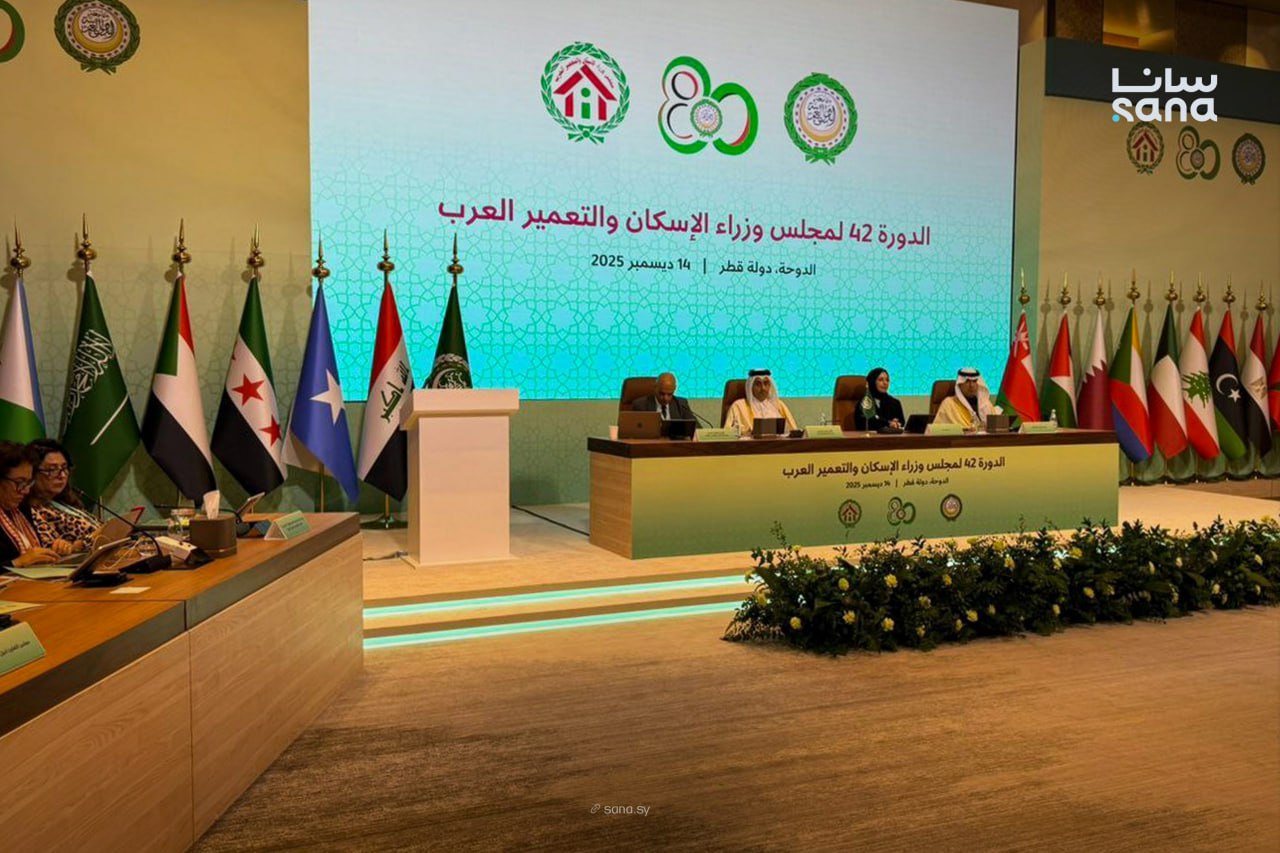
 In a step reflecting Syria’s serious effort to present its reconstruction vision and highlight the scale of damage incurred during years of war, the Minister of Public Works and Housing, Mustafa Abdurazaq, participated in the 42nd session of the Council of Arab Ministers of Housing and Construction, held in the Qatari capital, Doha. The session, attended by ministers and representatives of Arab states, serves as a central Arab platform for enhancing cooperation, exchanging expertise, and building effective partnerships in the fields of housing and urban development.
Thirty Percent of the Housing Stock Damaged
Abdurazaq stated that over 30% of Syria’s total housing stock has been damaged, equivalent to approximately 1.3 million housing units. This destruction coincided with the internal displacement of nearly seven million citizens and the refuge of around five million others abroad, placing a historic responsibility on all parties to secure the right of return and access to decent and adequate housing.
Despite progress in repositioning Syria regionally and the partial lifting of sanctions, the housing gap remains a major challenge. The current deficit is estimated at about 1.9 million housing units and is projected to reach approximately 2.6 million units by 2030 if urgent and comprehensive responses are not implemented.
Government Efforts and National Housing Strategy
The Minister explained that the Syrian government has launched a National Housing Strategy with clear and phased pathways. The year 2026 has been designated for immediate response in returning areas, followed by a short-term recovery phase extending to 2028. These efforts are accompanied by a fundamental restructuring of the housing sector, enabling the formation of strategic partnerships with the private sector.
He noted that stalled social housing programs have been reactivated, particularly those targeting youth, workers, and alternative housing, emphasizing that economic recovery begins with housing stability. Abdurazaq also called on Arab companies and investors to participate in housing and reconstruction projects, highlighting the development of an attractive legislative environment under the new Investment Law.
Strengthening Arab Cooperation in Urban Development
Abdurazaq further pointed to the completion of the first interim report on the new urban planning framework and the submission of a national working paper outlining Syria’s experience in social housing. He expressed hope that the outcomes of the Doha meeting would contribute to strengthening joint Arab action in the housing and construction sector.
Syria’s participation in the session represented a pivotal moment in its return to the Arab arena and in reinforcing regional cooperation. It provided an opportunity to present the scale of destruction caused by years of conflict while showcasing ongoing national efforts to lay the foundations for a sustainable and inclusive urban future for generations to come.