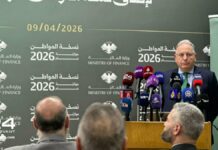
 In a move aimed at expanding the economic contribution of the phosphate sector, the General Establishment of Geology and Mineral Resources, represented by its Director General Siraj al-Hariri, signed two major agreements for the sale, investment, and marketing of phosphate.
The signing ceremony took place at the Ministry of Energy’s headquarters in the presence of Minister of Energy Muhammad al-Bashir. These agreements fall within the Ministry’s broader strategy to increase production capacity, strengthen the role of the phosphate sector in supporting the national economy, and boost state revenues.
Details of the Agreements
The first agreement was signed with Sharkia Holding Group and covers the investment, exploration, production, and export of one million tons of phosphate from the mine site. All quantities will be exported via maritime transport within one year.
The second agreement, concluded with Al-Hassan Holding Group, involves the sale and export of 2.5 million tons of phosphate. This includes 1.5 million tons for maritime export and one million tons for overland transport, a dual-channel approach designed to broaden market access and enhance logistical flexibility.
Economic Importance and Strategic Vision
Hariri stated that the agreements align with the strategic plans of both the Ministry of Energy and the Establishment to enhance phosphate production capacity and optimize the use of national resources. He emphasized that these deals will generate tangible added value for the national economy and strengthen the position of Syrian phosphate in international markets.
He added that the agreements build on previous efforts to scale up production and exports, reinforcing Syria’s competitiveness globally. Hariri outlined a phased development approach, beginning with increasing raw material exports and production levels, followed by future stages focused on establishing phosphate processing industries and developing local and international partnerships.
Building Local Capacity and a Sustainable Future
Addressing the local impact of the agreements, Hariri explained that Al-Hassan Holding Group will operate through a consortium of local partners, creating direct employment opportunities. Meanwhile, Sharkia Holding Group will work with local companies in exploration and mining operations, supported by foreign expertise, an approach aimed at maximizing operational efficiency and facilitating knowledge transfer.
Hussam Sharkia, Chairman of Sharkia Holding Group, affirmed the company’s commitment to expanding into larger and more comprehensive projects, particularly in fertilizer manufacturing and mining, in cooperation with the Syrian government to support sustainable economic development.
Similarly, Hassan Kamil al-Hassan, Chairman of Al-Hassan Holding Group, expressed his firm’s ambition to localize phosphate-related industries in Syria. He stressed that domestic manufacturing of phosphate products would generate higher added value and open wider opportunities for employment and investment.
Continued Momentum in the Phosphate Sector
The Public Establishment for Geology and Mineral Resources had previously signed a cooperation agreement on December 17 with Triak, a subsidiary of Serbia’s ELIXIR Group, to invest in and export 1.5 million tons of phosphate in 2026, in line with internationally recognized technical specifications and standards.
Taken together, these consecutive agreements underscore the state’s sustained efforts to develop the phosphate and energy sectors, maximize the utilization of national resources, enhance their contribution to the economy, and consolidate Syria’s position as a reliable player in the global phosphate market.