
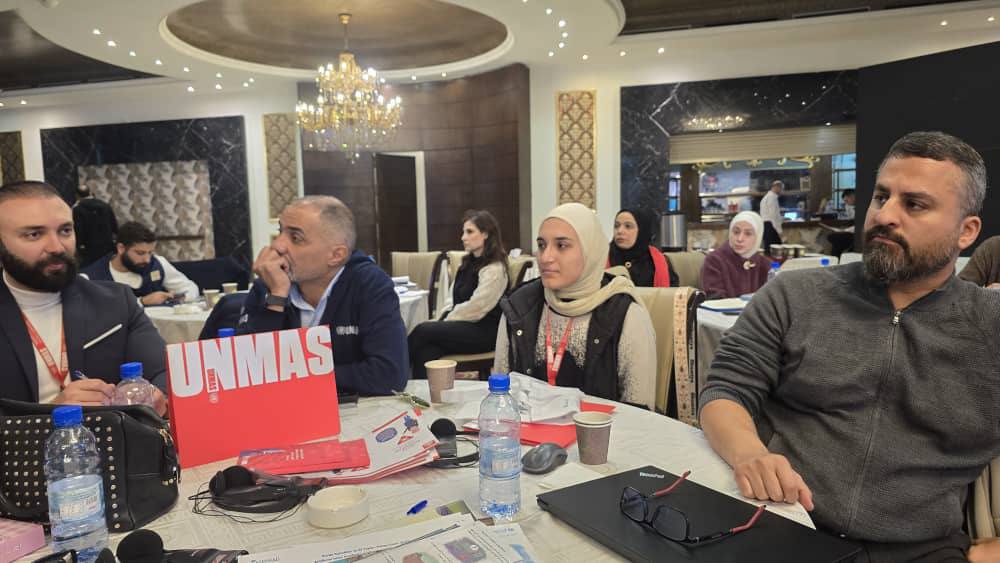
A four-day national workshop titled “Safety Step” has opened in Damascus as part of joint efforts by the National Mine Action Center (NMAC) and the Ministry of Emergency and Disaster Management to raise awareness about the dangers of unexploded explosive ordnance (UXO) and strengthen civilian protection measures.
Held at the Caesar Hotel, the workshop brings together representatives from relevant ministries, local and international organizations, and technical experts specializing in mine clearance and unexploded ordnance disposal. Discussions focus on Explosive Ordnance Risk Education (EORE) and victim assistance, including support mechanisms for survivors and affected families.
From Awareness to Safe Daily Behavior
Opening the workshop, Minister of Emergency and Disaster Management Raed al-Saleh described the initiative as a step toward unifying national efforts and aligning them with international standards. He stressed that reducing risks from mines and explosive remnants is essential to community safety and to restoring the dignity and social integration of victims.
Saleh emphasized that awareness must move beyond information campaigns to become part of everyday behavior. He noted that the ministry aims to integrate EORE into school curricula and daily life, turning citizens into active partners in prevention rather than passive recipients of warnings.
Targeting the Most Vulnerable Areas
NMAC Director Fadi al-Saleh explained that the workshop is the first of its kind to focus directly on coordinated national awareness of mines and explosive remnants. He underlined the importance of producing practical recommendations that lead to measurable change, particularly among the most exposed communities.
UNICEF’s Representative in Syria, Meritxell Relaño Arana, highlighted that mines and unexploded ordnance continue to pose a severe threat to civilians, especially children. She pointed to Deir Ezzor, Hama, and Idlib as among the most affected governorates, stressing that cooperation with national authorities is essential to deliver effective awareness messages and support clearance efforts.
Joseph McCartan, Head of the UN Mine Action Service (UNMAS) Syria Office, noted that UNMAS is working closely with NMAC to strengthen its capacity to lead emergency responses. He revealed that explosive incidents in Syria last year exceeded 900 cases, resulting in over 600 deaths, underscoring the urgency of prevention and education.
A Survivor’s Voice
Among the participants was Hanan Dawlatli, a survivor of explosive ordnance who was injured by a rocket fragment while returning from school in 2014, an incident that led to the amputation of her leg. Speaking to Levant24, Dawlatli said, “My injury not only resulted in physical and psychological challenges, but also imposed significant financial burdens due to the costs associated with obtaining a prosthetic limb.”
Despite these challenges, she continued her education and is now a second-year economics student. Dawlatli explained that she chose to turn her experience into advocacy, adding, “I did not surrender to my disability; I continued my education, and today I work with UNMAS and several organizations to raise awareness about the dangers of explosives.”
Recent incidents across several Syrian regions have demonstrated that unexploded ordnance and war remnants remain a serious threat, particularly to children. These hazards continue to hinder the safe return of residents, delay reconstruction, and obstruct development, making sustained awareness, clearance, and victim support essential national priorities.