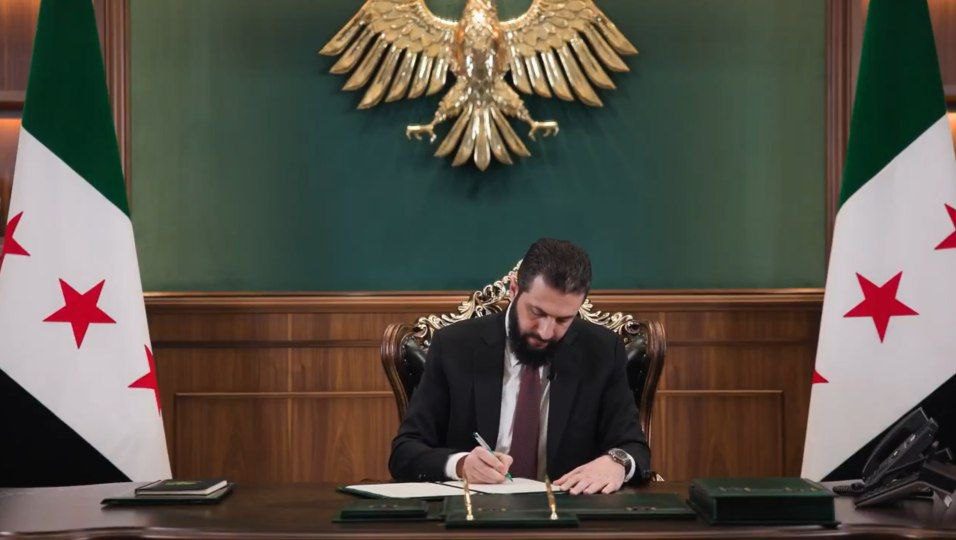
Syrian President Ahmad al-Sharaa signed Presidential Decree No. 13 of 2026, on Friday Jan. 16 a sweeping measure formally recognizing cultural, linguistic and civil rights for Syrian citizens of Kurdish origin and reverses decades-old legal restrictions stemming from the 1962 census in Al-Hasakah governorate.
The decree states that Kurdish Syrians are “an integral and fundamental part of the Syrian people” and their cultural and linguistic identity forms an inseparable component of Syria’s unified and diverse national identity. Issued on Jan. 16 and published in the Official Gazette, entering into force immediately.
Among its most consequential provisions, the decree cancels all exceptional laws and measures resulting from the 1962 census and grants Syrian nationality to all citizens of Kurdish origin residing in Syria, including those previously categorized as “foreigners” or “unregistered.” The decree guarantees full equality in rights and duties, according to the official text.
Language, Education and Public Life
The decree recognizes Kurdish as a national language and permits its teaching in public and private schools, particularly in areas where Kurds constitute a significant proportion of the population. Instruction may take place within elective curricula or as part of cultural and educational activities.
It also commits state media and educational institutions to adopt an inclusive national discourse and explicitly prohibits discrimination or exclusion based on ethnicity or language. Incitement to national strife is criminalized under applicable laws, the decree states.
Article Five designates Nowruz, celebrated on March 21, as an official paid public holiday across Syria, describing it as a national occasion marking spring and renewal.
Before signing the decree, Sharaa delivered a speech referencing the Prophetic statement regarding human diversity and equality. “There is no superiority for an Arab, a Kurd, a Turk, or anyone else except through piety towards God and the righteousness of a person,” he said. Addressing Kurdish Syrians directly, he added, “Whoever harms you will be our adversary until the Day of Judgment.”
Implementation and Official Response
Education Minister Muhammad Turko described the approval of Kurdish language instruction as “a progressive step in strengthening the values of citizenship,” saying his ministry would begin preparing executive instructions immediately. In a statement posted Friday, Turko said the decree reinforces equal citizenship and preserves cultural diversity as a source of social strength.
Foreign Minister Asaad al-Shaibani also welcomed the decree, saying, “we have always seen the Syrian identity as unifying all its people, with our Kurdish brothers forming an essential part of this foundation. They are part of us, and we are part of them, sharing one indivisible future.
“Syria’s strength,” he said, “lies in the cohesion of its people, and through unity, facing challenges to build a free nation that embraces everyone’s dreams and aspirations.”
Regional and Domestic Reactions
Iraqi Kurdistan Region President Nechirvan Barzani welcomed the decree, calling its true value dependent on its enforcement and incorporation into a future Syrian constitution. He urged all parties to avoid violence and expressed support for an inclusive Syrian state.
Germany’s chargé d’affaires in Damascus, Clemens Hach, also praised the move, calling it a correction of historical injustices and a step that could strengthen prospects for a political settlement, according to comments he gave Syria TV.
The Autonomous Administration of North and East Syria (AANES) described the decree as a “first step” but said lasting guarantees require a comprehensive national dialogue and a permanent constitution that reflects the will of all components.
Following those comments, the Syrian Turkmen Council issued a statement calling for clear and balanced recognition of the rights of all historical components of Syrian society. The council stressed that cultural and linguistic rights must be guaranteed through binding constitutional provisions and applied without selectivity, reaffirming its commitment to Syria’s unity and equal citizenship for all diverse and ethnic communities.
The decree was issued amid heightened tensions in eastern Aleppo countryside, underscoring the political weight of the move as Syria’s transitional authorities pursue reconstruction, stability and national cohesion.