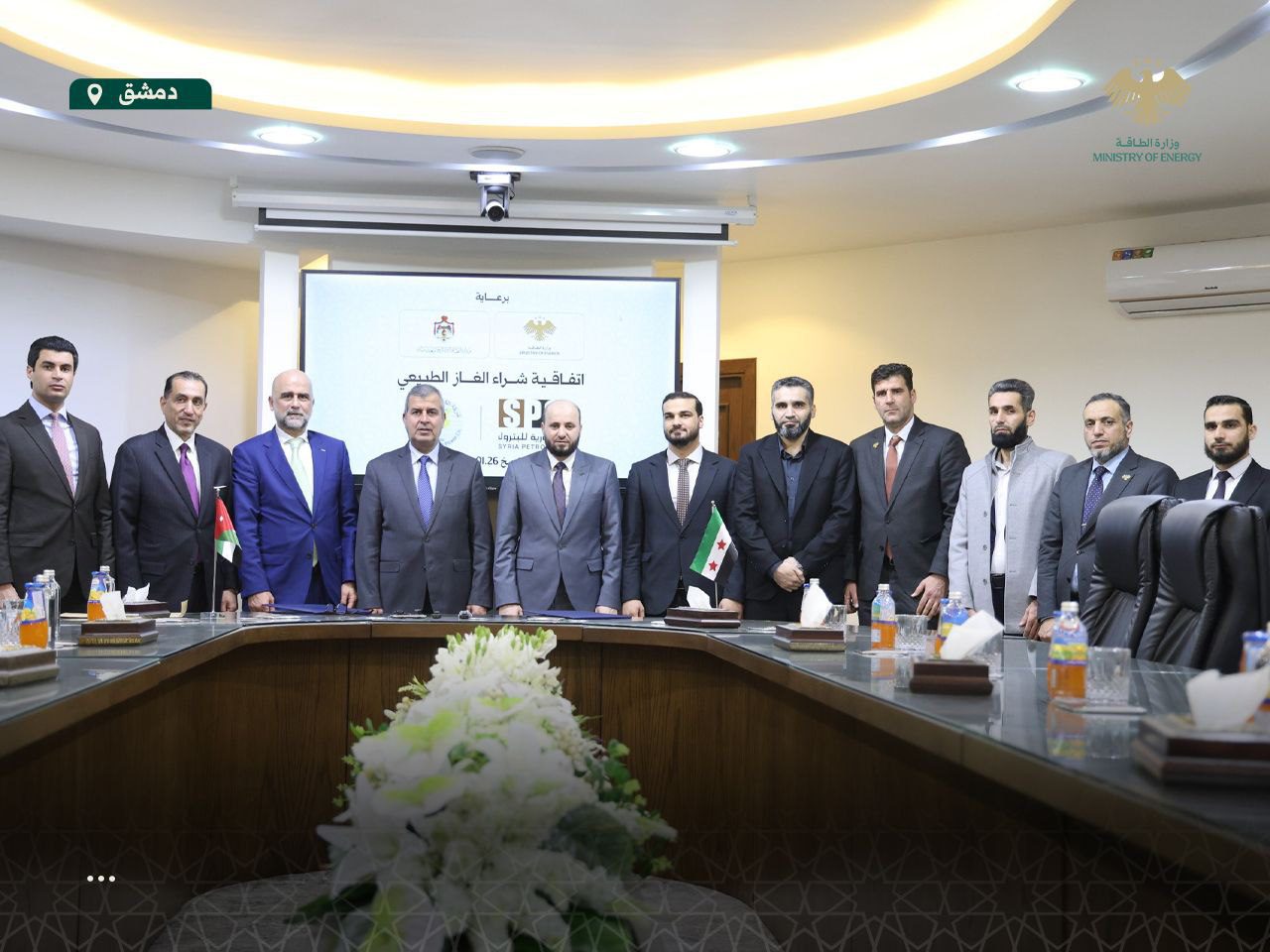
 In a step aimed at strengthening Syria’s electricity supply and stabilizing the national power grid, Syria and Jordan signed a natural gas supply agreement at the headquarters of the Syrian Ministry of Energy in Damascus.
The agreement was concluded between the Syrian Petroleum Company (SPC) and Jordan’s National Electric Power Company (NEPCO) to secure the delivery of natural gas to Syria via Jordanian territory, supporting electricity generation amid ongoing energy challenges.
High-Level Attendance and Signing
The signing ceremony was attended by Syrian Minister of Energy Muhammad al-Basheer and Jordanian Minister of Energy and Mineral Resources Saleh al-Kharabsheh, alongside the Jordanian Ambassador to Syria, Sufian al-Qudah. The agreement was signed on behalf of Syria by Hisham al-Saleh, Deputy Executive President of the Gas Sector at SPC, and on behalf of Jordan by Sufian al-Bataineh, Director General of NEPCO.
Minister Basheer described the agreement as a significant step within the government’s efforts to secure fuel supplies for electricity generation while improving the reliability of power services for citizens. “The agreement contributes to diversifying gas sources and increasing the operational efficiency of power plants, which will positively reflect on electricity supply levels,” Basheer said, noting the severe strain Syria’s energy sector has faced in recent years.
Supply Details and Timeline
For his part, Minister Kharabsheh explained the agreement provides for the supply of approximately 4 million cubic meters of natural gas per day, equivalent to about 140 million standard cubic feet (scf), to support the stability of Syria’s electricity system.
He revealed that gas deliveries began on Jan 1, 2026, with initial daily quantities ranging between 30 and 90 million scf. The supply is currently being facilitated through the Floating Storage and Regasification Unit (FSRU) Energos Force, stationed at the Port of Aqaba.
This arrangement will continue until the end of March. Kharabsheh also noted that NEPCO begun procedures charting a new FSRU to replace the current vessel, ensuring uninterrupted gas supplies in line with operational needs.
Regional Cooperation Framework
In remarks to Jordan’s Al-Mamlaka TV channel, Kharabsheh said Jordan is placing all available capabilities at the disposal of the Syrian people, particularly in the energy sector. He confirmed that Jordan is leveraging its infrastructure to import liquefied natural gas (LNG) from global markets, regasify it, and transport it via the Arab Gas Pipeline to Syrian power plants.
The agreement reflects a broader framework of bilateral cooperation between Syria and Jordan in the energy sector and represents a practical step toward addressing Syria’s gas shortages and strengthening regional energy integration.