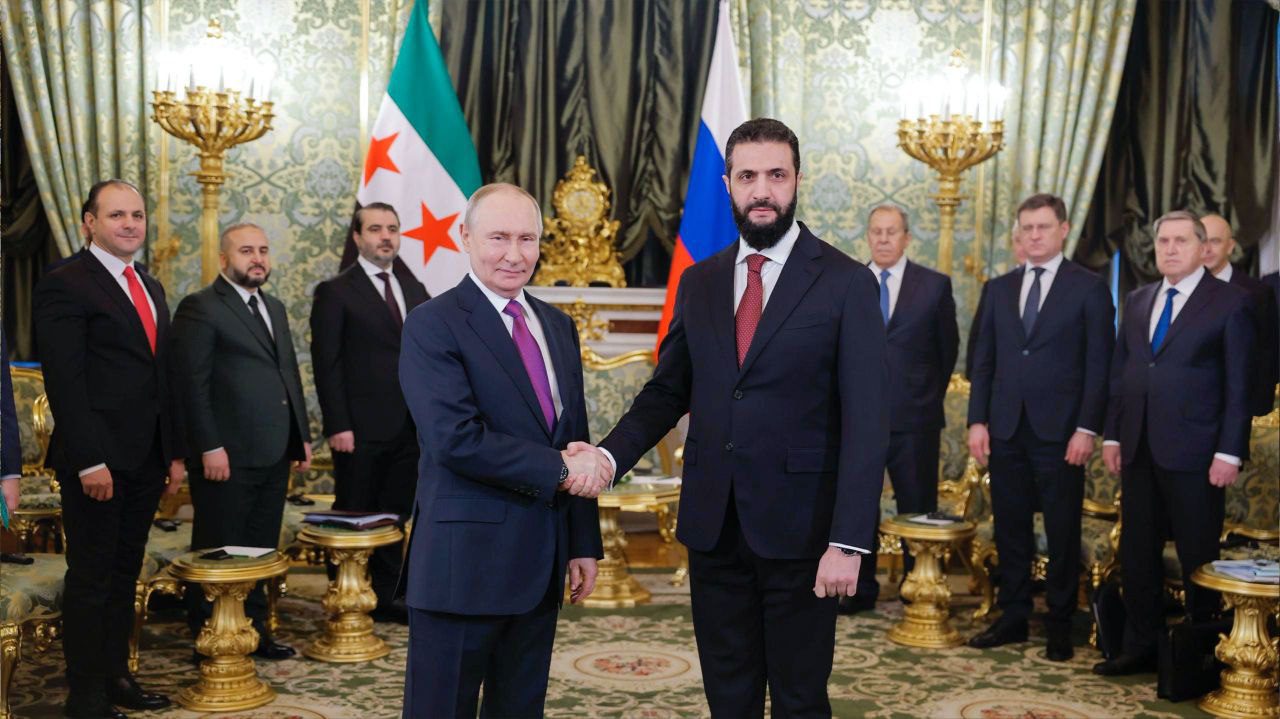
Syrian President Ahmad al-Sharaa traveled to Moscow today, Jan. 28, for talks with Russian President Vladimir Putin, marking his second official visit to Russia since taking office. The meetings focused on bilateral relations, economic cooperation and the future of the Russian military presence in Syria, according to statements from both governments.
The Office of Presidency said the talks reflected a shared interest in strengthening cooperation between Damascus and Moscow, particularly as Syria seeks to consolidate territorial control and move toward stability after years of conflict.
Emphasis on Unity and Stability
According to the presidency, Sharaa stressed the “depth of Syrian-Russian relations” and underscored what he described as Russia’s important role in supporting Syria’s unity and stability. He said Syria had overcome significant challenges during the past year, most notably the unification of its territory, and expressed hope for entering a phase of peace and stability.
“I am pleased with this visit to Moscow. We have many common interests,” Sharaa said during the meeting. He added that Russia supports the unity and stability of Syrian territory and has played a historical role in the broader region. The presidency’s statement said the meeting demonstrated a convergence of views on reinforcing bilateral relations within the framework of existing cooperation between the two countries.
Economy and Territorial Integrity
Putin affirmed Russia’s support for Syria’s unity and territorial integrity, calling the return of areas east of the Euphrates to government control “an important step” toward strengthening Syrian sovereignty.
“We support your efforts in this direction,” Putin told Sharaa, according to the Kremlin. He said the two sides had made progress in economic cooperation and trade since their first meeting and would continue developing relations across multiple fields, noting that Russian-Syrian ties have “deep roots.”
The Kremlin said ahead of the talks that the leaders would discuss economic cooperation, regional developments and the Russian military presence in Syria. Kremlin spokesman Dmitry Peskov said all issues related to Russian forces in Syria would be raised but declined to comment on the fate of Assad, who fled to Moscow after being overthrown.
Military Presence and Shifting Realities
The visit coincided with developments on the ground in northeastern Syria, where Syrian government forces have taken control of wide areas in recent weeks. Russian forces have also begun withdrawing from Qamishli Airport, according to Syrian sources cited by Reuters, transferring personnel and equipment to bases in Latakia province, with some forces expected to move to the Hmeimim air base. Despite this the US has expressed concerns over remaining Russian bases in the region.
Levant24 spoke with Russian analyst Anton Mardasov, who said Moscow’s posture in Syria has changed significantly, “Since the fall of the Assad regime, Russian facilities in Syria are no longer military bases.” He clarified long- and medium-range air defense systems and coastal missile systems had been withdrawn, making it impossible for Russia to conduct deterrence operations in the Mediterranean from Syrian territory. “Hmeimim is currently still used as a transit logistics hub for air cargo transportation to Africa, while the operation of Tartus has long been frozen,” he said.
Balancing Washington and Moscow
Mardasov also addressed US concerns about Russian influence, saying fears that Moscow could use Syria to challenge US naval power are overstated. “American fears that Russian ships will continue to deter the US Navy are no longer relevant and represent political rhetoric,” he said.
Mardasov posits that, despite tensions, Russia and the US may be forced into a form of coexistence in Syria. “Strange as it may seem, even during the Assad regime, it was disadvantageous for Russia for the US to withdraw from eastern Syria because the security vacuum is difficult to fill,” Mardasov said.
Israel and Assad…
On Israel’s continued airstrikes and incursions in Syria, Mardasov said Russia may seek a mediating role to maintain relevance. “For Moscow, any position of mediation is advantageous, as a physical presence in the region is essential,” he said, adding that Russian posts in southern Syria could force Israel to act more cautiously.
Regarding Assad’s status, Mardasov said extradition is unlikely. “It is clear that Moscow will not extradite Assad for image reasons, and I think Damascus understands this perfectly well,” he said. He added that while Russia’s leverage is limited, Moscow could pressure former Syrian officers residing in Russia to avoid efforts at destabilizing the new government.
The Moscow talks come ahead of a US Helsinki Commission hearing next week titled “Securing Syria’s Transition by Reducing Russian Influence,” which will examine Russia’s military and political footprint in Syria. As Damascus seeks stability and international legitimacy, Sharaa’s visit underscored the balancing act facing Syria as it navigates its relationship with Moscow amid shifting regional dynamics.