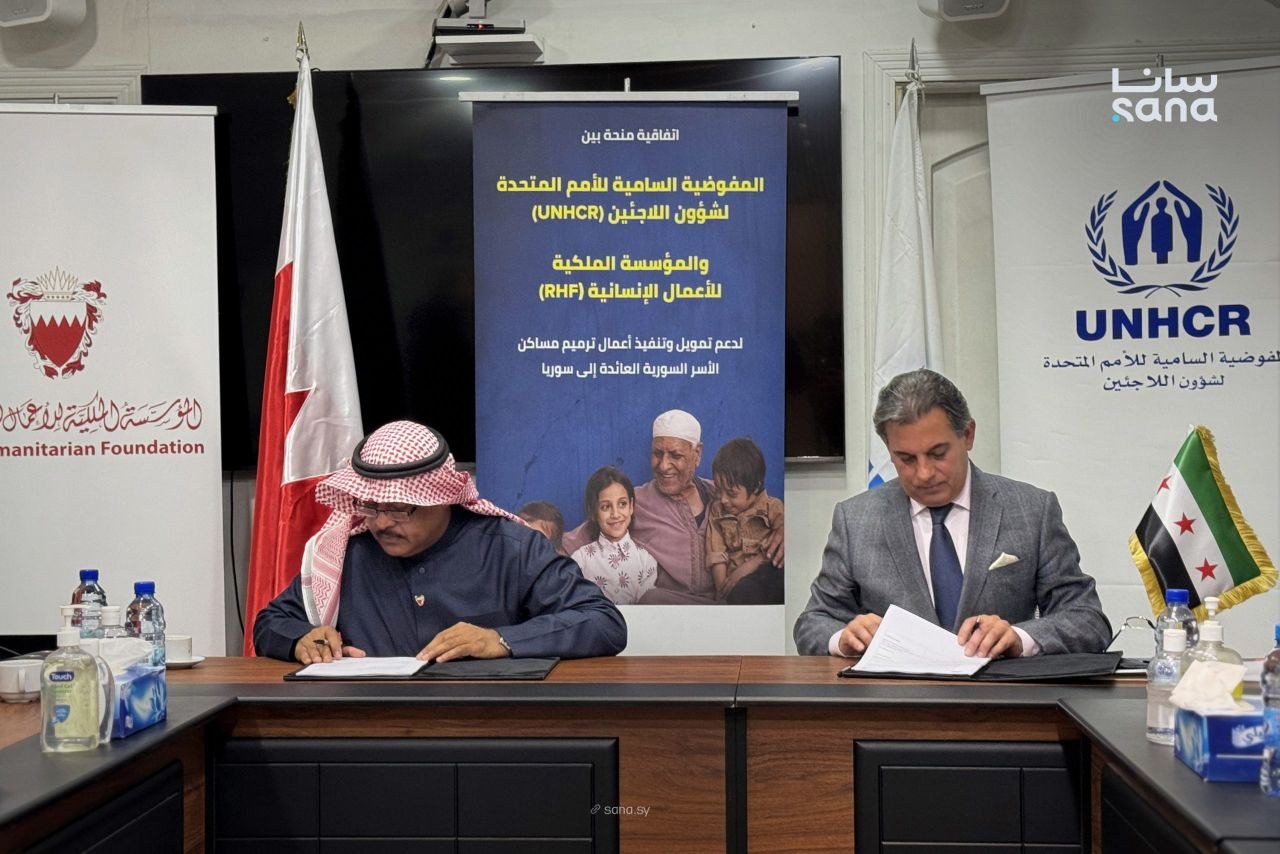
 In a step aimed at strengthening international cooperation and complementing the Syrian government’s efforts to ensure the safe and dignified return of refugees, the Royal Humanitarian Foundation (RHF) of Bahrain and the United Nations High Commissioner for Refugees (UNHCR) in Syria signed a $2 million grant agreement. The grant will support the rehabilitation of damaged housing for returnee families in the Zarbah subdistrict of Aleppo governorate and the city of Harasta in Damascus countryside.
Supporting Syria’s Returnees With Safe Housing
Celine Schmitt, spokesperson for UNHCR in Syria, stated that the grant will fund the rehabilitation of approximately 470 damaged housing units, benefiting nearly 2,350 individuals. She affirmed that the project aims to restore safe and dignified living conditions for vulnerable families returning to heavily damaged areas, with priority given to the most needy households, particularly those headed by women and persons with disabilities.
Schmitt explained that the rehabilitation work will include repairing walls, ceilings, and foundations to ensure structural safety and stability. Solar-powered lighting systems will also be installed to assist families in areas experiencing frequent power cuts or limited access to electricity.
She further clarified that the project will extend to repairing basic water, sanitation, and hygiene facilities, including pipelines and solar water heaters, to ensure that returning families have reliable access to clean water and safe sanitary conditions.
Strategic Partnership for Sustainable Return
For his part, Gonzalo Vargas Llosa, UNHCR’s representative in Syria, stated that the project will provide substantial support to returnees by enabling the repair and rehabilitation of a large number of homes. He noted that in recent years, over one million Syrian refugees have returned to their areas of origin, in addition to nearly two million internally displaced persons who have gone back to their homes.
Llosa called on the international community to strengthen similar initiatives in light of the scale of existing needs. He emphasized that rehabilitating homes represents a fundamental transformation in the lives of returnees, as housing is one of the most essential pillars of stability and dignity.
The acting secretary-general of the RHF, Engineer Ibrahim al-Dosari, stated the agreement is part of the foundation’s ongoing humanitarian efforts to support affected communities outside the Kingdom of Bahrain. He said it reflects the foundation’s commitment to rehabilitating crisis-affected areas through projects focused on providing safe housing and improving the quality of life for the most vulnerable families.
Dosari added that the foundation places special emphasis on supporting families returning to their home areas through effective partnerships with specialized international organizations. This approach, he said, helps achieve sustainable humanitarian impact and enhances opportunities for social stability and livelihood recovery for returning families.