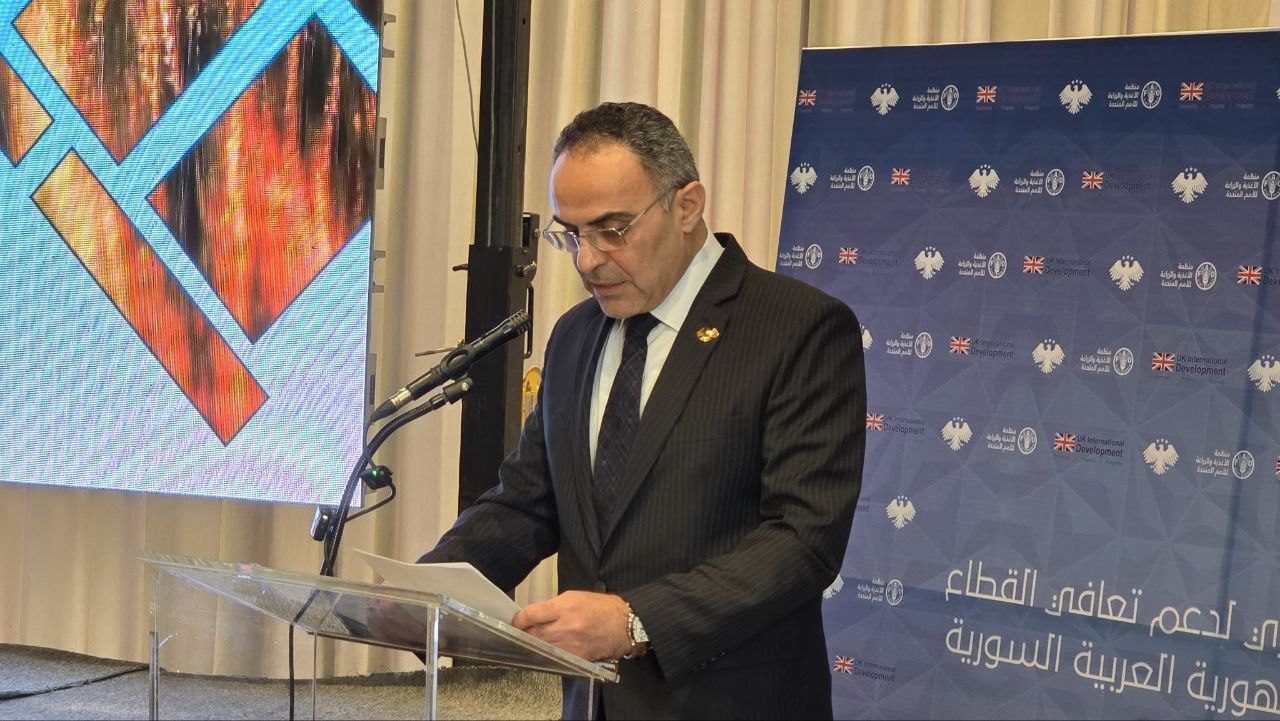
 The Ministry of Agriculture unveiled its national strategy for 2026–2030, outlining a comprehensive roadmap to restore the sector’s central role in ensuring food security, stimulating economic growth, increasing GDP contribution, promoting sustainable development, improving investment efficiency and expanding strategic reserves of key food crops.
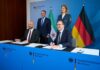
The strategy was announced at a workshop in Damascus, organized in partnership with the Ministry of Foreign Affairs and Expatriates, the UK Foreign, Commonwealth and Development Office, and the UN Food and Agriculture Organization (FAO), under the patronage of the General Secretariat of the Presidency of the Republic. Officials said the collaboration reflects a commitment to strengthening both national and international partnerships to support agricultural recovery.
Strategic Pillars
The plan is built around six main pillars: rural development; agricultural production and seed improvement; livestock and animal health; sustainable management of natural resources; agricultural extension and mechanization; and agricultural information systems. It also incorporates climate change adaptation measures and specialized agricultural projects aimed at supporting both sectoral growth and the broader national economy.
Supporting Livelihoods and Stability
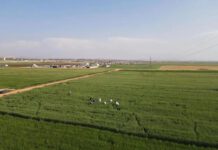
Agriculture Minister Amjad Badr described the strategy as a “safety valve” for the economy and society, emphasizing its importance in rehabilitating agricultural infrastructure, restoring farmland and enabling farmers to resume cultivation after years of hardship.
He said the strategy provides a practical roadmap focused on implementable projects and studies, with mechanisms for monitoring execution and mobilizing resources. He also highlighted its flexibility to respond to short, medium and long-term needs.
Badr praised the contributions of participating government bodies and international organizations, noting that support will help strengthen community stability, create jobs and provide decent livelihoods, thereby reducing internal and external youth migration.
Enhancing International Cooperation
In a video address, UK Minister of State for the Middle East Hamish Falconer called for coordinated action among all implementing partners to support Syria’s agricultural recovery, acknowledging the significant challenges faced in recent years.
Pierre Tomaso Perri, Officer-in-Charge of the FAO Representation in Syria, emphasized the shift from emergency response to long-term recovery. He affirmed FAO’s commitment to working with Syrian institutions and partners to build capacity based on governorate-level priorities and ensure that identified needs translate into measurable outcomes.
UN Resident and Humanitarian Coordinator in Syria Natalie Fustier stressed the urgency of coordinated implementation in light of widespread food insecurity affecting Syrian families. She highlighted the need to transition from short-term emergency assistance to structured, sustainable support guided by clear priorities.