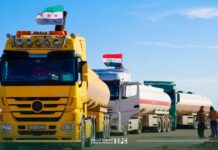
For the first time in more than two decades, a US company formally opened a branch in Syria, signaling a shift in economic engagement following the collapse of Bashar Assad’s government and the Trump administration’s rollback of most sanctions.
According to official registration documents cited by Benjamin Fève, senior research analyst at Karam Shaar Advisory Limited, GNZ LLC, a US-origin company, was established in Syria on Dec. 14, 2025, with declared capital of $1 million. Fève shared the details in a public post on X.
The company will operate in contracting, infrastructure and construction materials, including related import and export activities and participation in tenders. Registration documents explicitly prohibit the firm from engaging in real estate development.
“This marks the first time since 2004 that a US company has opened a branch in Syria,” Fève wrote. The last recorded case was Lincoln Syria LLC, established on Dec. 25, 2004, also with $1 million in capital and focused on oil field exploration and management, according to official records cited by Fève. The reopening comes amid broader efforts to support Syria’s reconstruction following over a decade of war and more than a year after the Assad regime’s fall on Dec. 8, 2024.
Surge in Foreign Registrations
The pace of foreign business registration has accelerated sharply since the political transition. Fève reported 94 foreign companies established branches in Syria after Dec. 8, 2024, averaging roughly 6.7 companies per month.
By comparison, between 2012 and 2024, only 58 foreign companies registered in the country, an average of approximately 0.4 per month, according to official records cited in Fève’s analysis. “The shift in pace is absolutely mind-boggling,” he wrote.
The geography of investment has also broadened. Between 2012 and 2024, registrations were concentrated among politically aligned states, including Russia, Iran, the UAE and Lebanon. Western participation was marginal.
In 2025 and early 2026, roughly 99 foreign companies registered in Syria, according to Fève. Saudi Arabia now leads new entries by a wide margin, while Turkey and Jordan have also been highly active. Qatar and Kuwait are increasing their presence. Russia’s relative footprint has declined. Western participation, though still limited, has diversified to include the US, Germany, Sweden, Norway and South Korea.
Fève cautioned that registration does not necessarily translate into capital deployment. Financial, regulatory and compliance constraints remain significant. Still, he argued that the post-collapse phase is “structurally different from the sanctions-era equilibrium.”
Trade Recovery Faces Structural Hurdles
Despite the easing of most US sanctions, and ongoing Western relief, trade between the two countries remains constrained. US-Syria goods trade fell from nearly $1 billion in 2010 to single-digit millions during the war and has only marginally recovered since, according to analysis published in “Syria in Figures,” Issue 16.
While formal sanctions have eased, legacy restrictions, high compliance costs, financial de-risking and newly imposed tariffs continue to limit commerce. Analysts note that overcompliance by financial institutions and the erosion of correspondent banking relationships pose binding constraints. For now, the reopening of a single US branch marks a symbolic milestone. Whether it signals a durable recovery in bilateral trade will depend on how quickly financial and regulatory barriers ease in practice.