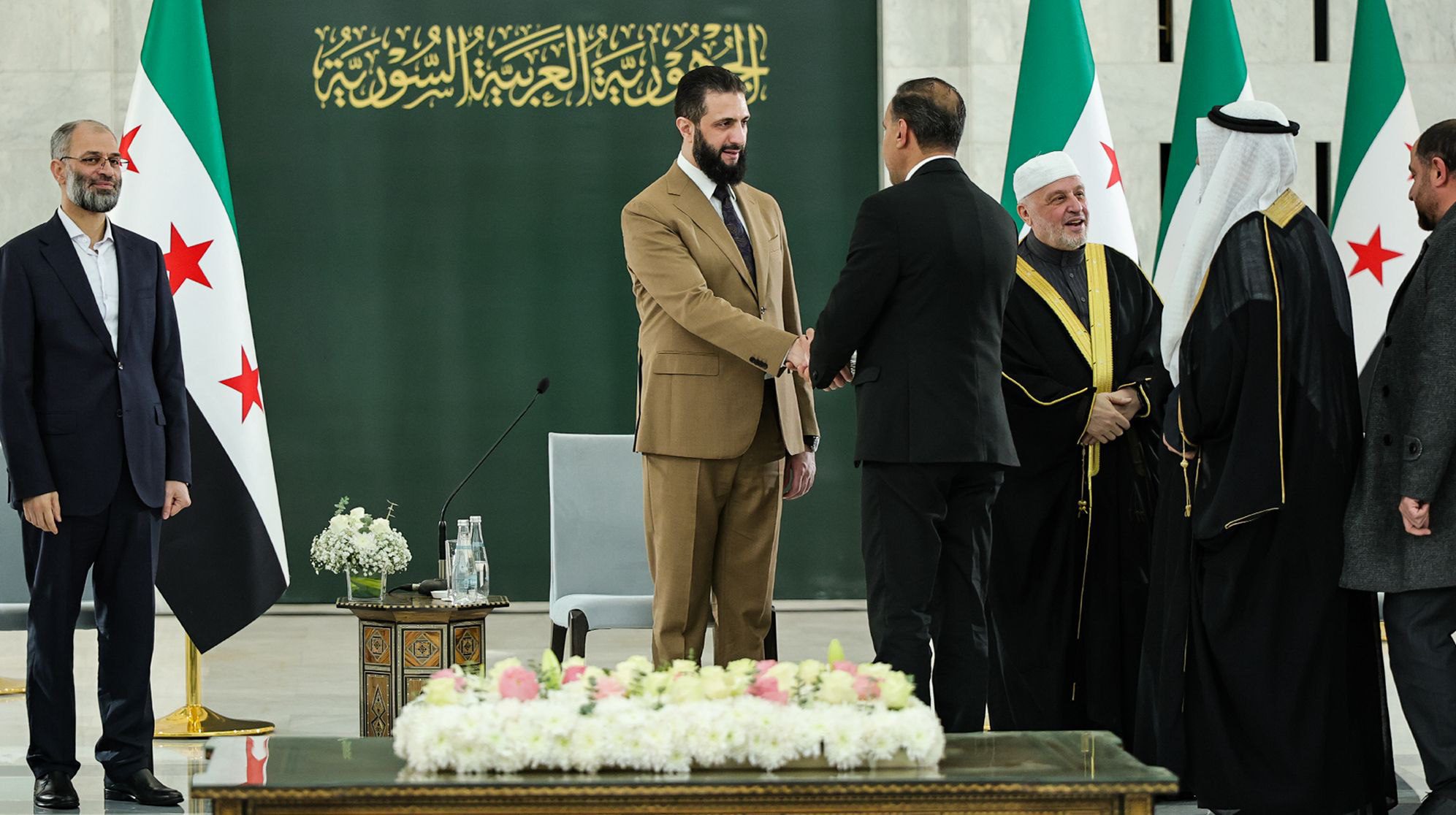
 In his first remarks following Eid al-Fitr, Syrian President Ahmad al-Sharaa outlined what he described as a year of significant economic and political progress, presenting a vision of recovery after years of conflict. Speaking on recent developments, Sharaa said Syria has entered a new phase marked by measurable growth, improved state finances and a shift toward stability in both domestic and regional arenas.
His comments emphasized government-led reforms and a focus on rebuilding infrastructure and public services. The address comes as Syria continues to navigate a fragile transition, with officials seeking to demonstrate progress despite ongoing regional tensions and internal challenges.
Economic Growth and Budget Surplus Mark Turning Point
Sharaa highlighted what he called an “unprecedented leap” in economic performance over the past year. He said Syria’s gross domestic product grew between 30% and 35% in 2025, reaching approximately $32 billion.
He also announced that the country achieved a budget surplus for the first time in recent years, describing it as a key indicator of fiscal recovery. Government spending increased from $2 billion in 2024 to $3.5 billion in 2025, while the 2026 budget has been set at $10.5 billion.
According to the president, the government expects GDP to reach between $50 billion and $60 billion in the current year, potentially returning to levels seen before 2010. He said such growth would translate into improvements in public services and living conditions. While independent verification of these figures remains limited, the government has framed the data as evidence of a broader economic turnaround.
Reconstruction Efforts Target Hard-Hit Regions
A central focus of the government’s plan involves large-scale reconstruction, particularly in areas heavily damaged during the conflict. Sharaa said a $3 billion infrastructure fund has been allocated, financed entirely through domestic resources without reliance on external aid or loans.
The reconstruction effort will prioritize regions such as rural Idlib, Aleppo, northern Hama and northern Latakia, as well as Eastern Ghouta, Daraa and Deir Ezzor. Additional resources have been earmarked for eastern provinces including Hasakah and Raqqa, with an emphasis on restoring essential services.
Sharaa said 40% of the current budget is dedicated to service sectors, including healthcare, education and transportation. He acknowledged infrastructure remains severely degraded but said the government is working to accelerate recovery. The president also identified the return of displaced populations as a key priority, linking reconstruction efforts to broader plans for resettlement and stabilization.
Wage Increases Aim to Boost Living Standards
Addressing economic hardship faced by many Syrians, Sharaa announced a series of wage increases and policy measures aimed at improving purchasing power. He said the government approved a new minimum wage aligned with poverty levels, alongside a 50% salary increase for public sector employees.
Additional targeted raises were introduced for professionals such as doctors and engineers. According to the president, the combined effect of wage adjustments and exchange rate improvements has resulted in overall increases of about 550%, with some sectors seeing gains of up to 1200%.
Sharaa said these measures exceed earlier commitments to raise salaries by 400% and reflect ongoing efforts to improve living standards. He added that further steps are being considered as part of a longer-term economic strategy.
Foreign Policy Shift Emphasizes Stability
On the international front, Sharaa said Syria moved away from being an “arena of conflict” toward what he described as a more stable and cooperative role in the region. He stated that Syria is now aligned with neighboring countries and maintains strong relations within the Arab world.
The president characterized the current geopolitical moment as a “rare, historic event,” adding that the government is taking a cautious approach to avoid being drawn into broader conflicts. His remarks come amid continued tensions across the Middle East, with regional dynamics posing ongoing risks to Syria’s stability.
Delayed Assembly Linked to Broader Representation
Sharaa also addressed the delay in convening the People’s Assembly, attributing it to the need for more inclusive elections in recently affected areas. He said the government aims to ensure broader representation before holding the first session, describing the Assembly as a key institution for oversight and public accountability.
According to the president, the body will serve as a channel for citizens’ concerns and play a role in reviewing government policies and strategic plans. As Syria continues its recovery efforts, Sharaa framed the coming period as critical, with economic reform, reconstruction and political development shaping the country’s path forward.