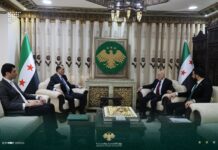
Syria’s President Ahmad al-Sharaa arrived in Berlin today, March 30, at the head of a ministerial delegation for his first official visit to Germany, opening talks aimed at deepening bilateral relations and rebuilding trust.
The visit began with a meeting with German President Frank-Walter Steinmeier, demonstrating mutual interest in expanding cooperation beyond formal diplomacy. The discussions focused on political coordination, economic recovery and long-term partnership, reflecting a broader effort to move Syrian-German ties toward practical cooperation after years of strained engagement.
Syrian Community Takes Center Stage
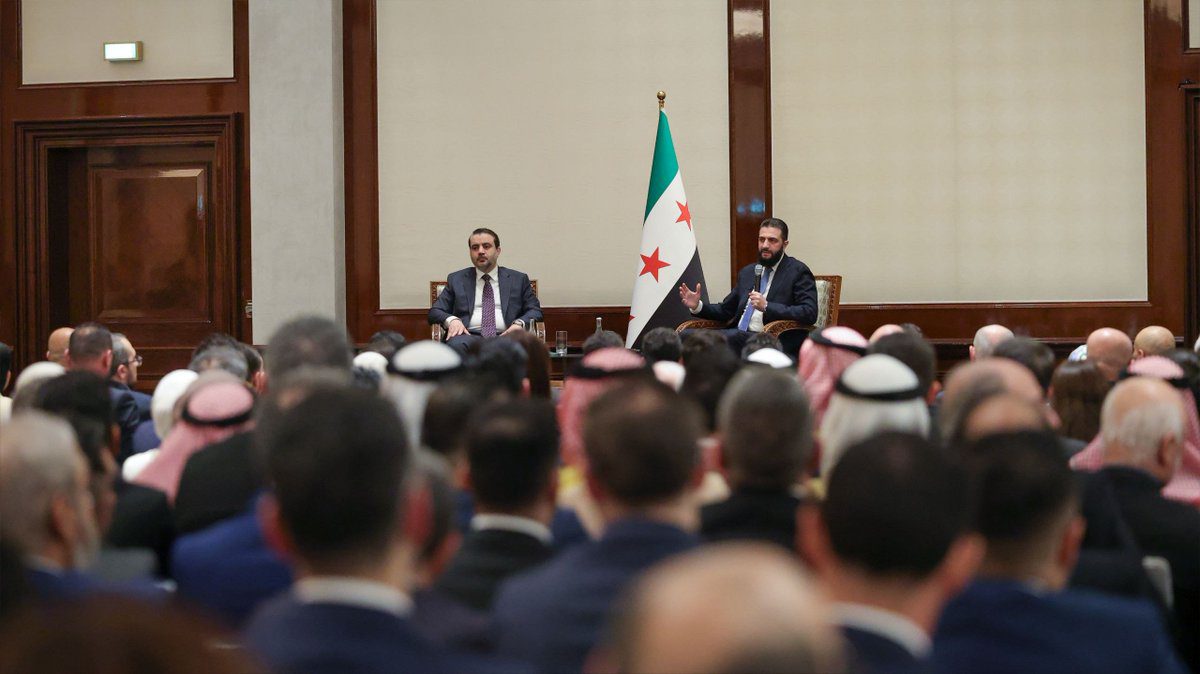
A notable part of the visit centered on the Syrian community in Germany. Joined by Foreign Minister Asaad al-Shaibani, Sharaa met with community members and praising their connection to their national identity, describing them as an important bridge between the two countries. Attendees described the gathering as open and candid, with discussions ranging from refugee concerns to citizenship and the role of younger expatriate Syrians in reconstruction.
Several participants said the meeting helped strengthen channels between officials and Syrians abroad, particularly those seeking ways to contribute to the country’s recovery through expertise, education and investment. According to attendee Fadi Obaid, “The President always affirms that he loves to meet with the community before any political stop, to engage in dialogue with Syrians.”
Business Forum Highlights Investment Push
The visit also featured the German-Syrian Business Forum, where Sharaa announced planned amendments to Syria’s investment law designed to simplify procedures and encourage foreign capital. He highlighted opportunities in infrastructure, energy and industrial development, while urging German companies to engage with Syrian professionals educated in Germany.
Foreign Minister Shaibani said the lifting of sanctions over the past year had opened “a gateway of hope” for Syrians and created momentum for economic rebuilding. Economy Minister Nidal al-Shaar described the Syrian community as a lasting economic and human bridge linking both countries.
Energy and Recovery Agreements Advance
Energy Minister Muhammad al-Bashir announced two memorandums of understanding with Siemens supporting a command and operations system for Syria’s power grid. Another agreement with Knauf covers cooperation in water and energy.
Meanwhile, Emergency Minister Raed al-Saleh emphasized the value of German expertise in disaster response, early warning systems and emergency management, particularly as Syria rebuilds critical public services.
Refugees and Stability Remain Central
Analyst Kristian Brakel said Germany is likely to maintain humanitarian and development support while remaining cautious on large-scale investment without stronger guarantees on security and rule of law. On refugee policy, he said gradual contributions through skills transfer and reconstruction initiatives remain more realistic than any rapid return framework.
Regarding the Iranian war, Brakel offered an optimistic perspective, “Syria is currently the least dangerous country in the Middle East, and is the only country living in a state of peace to a large extent.”
He added that capitalizing this dynamic among the people, civil society, and government could change the view of skeptical Germans and European politicians, provided the Syrian government seriously addresses existing concerns.
In all, the visit marked a significant shift from symbolic to concrete cooperation. By linking diplomacy, diaspora engagement and economic recovery, the Berlin meetings signaled a broader attempt to redefine Syrian-German relations around stability, investment and long-term rebuilding.