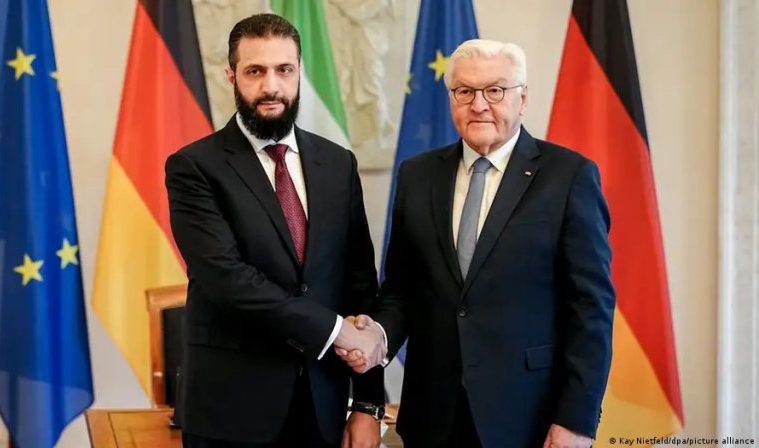
President Ahmad al-Sharaa’s visit to Germany marked a significant moment in Syrian-German relations, becoming his first official trip to Berlin since taking office after the 2024 political transition. The visit carried clear diplomatic weight, signaling Germany’s support for Syria’s reconstruction, stability and renewed engagement with Europe. German officials framed the talks as part of a broader effort to support Syria’s long-term recovery and reintegration into international economic networks.
More than a symbolic gesture, the visit reflects a practical political vision centered on rebuilding Syria’s regional and international standing. Meetings with senior German leaders focused on reconstruction, refugee return frameworks and pathways for economic recovery, placing Germany among the key European partners in Syria’s next phase.
Syria’s Position in Trade and Connectivity
The discussions underscored Syria’s strategic geography as a potential link between Gulf markets and Europe. As pressure on traditional shipping routes continues, overland corridors through Syria are drawing increased attention as an alternative route for trade and logistics. This geographic advantage could help position Syria as a regional hub, particularly if transport infrastructure and border systems continue to improve.
Faster overland freight access from the Eastern Mediterranean toward Central Europe would strengthen trade flows and create new openings for industrial investment, warehousing and cross-border supply chains. That economic logic has become increasingly central to bilateral talks, especially as both governments look beyond immediate humanitarian and political priorities.
From Support Talks to Reconstruction Deals
The visit also highlighted a shift from diplomatic coordination toward implementation-focused economic cooperation. Business and government representatives from both sides took part in economic discussions centered on rebuilding infrastructure, restoring industrial capacity and encouraging private-sector investment.
German officials said reconstruction and economic stabilization are now essential pillars of the relationship. This transition points to a partnership model built on expertise transfer, industrial cooperation and long-term institutional support. Energy, transport and manufacturing emerged as leading areas for future collaboration, reflecting both Syria’s reconstruction needs and Germany’s technical strengths.
The Syrian Diaspora as an Economic Bridge
A major theme of the visit was the role of Syrians living in Germany in supporting reconstruction. Sharaa emphasized a “circular migration” model that would allow skilled Syrians to contribute to rebuilding efforts without necessarily giving up the lives and careers they have established in Germany.
This community remains one of the strongest bridges between the two countries. Syrian professionals, engineers, academics and entrepreneurs in Germany bring valuable expertise, business networks and market familiarity that could help accelerate investment and institutional cooperation.
Germany’s support for Syria’s reopening to European markets, combined with the role of its Syrian diaspora, suggests that bilateral ties are moving toward a more structured economic partnership. If current talks lead to sustained agreements, the visit may be remembered as the start of a more practical and durable phase in Syrian-German relations.