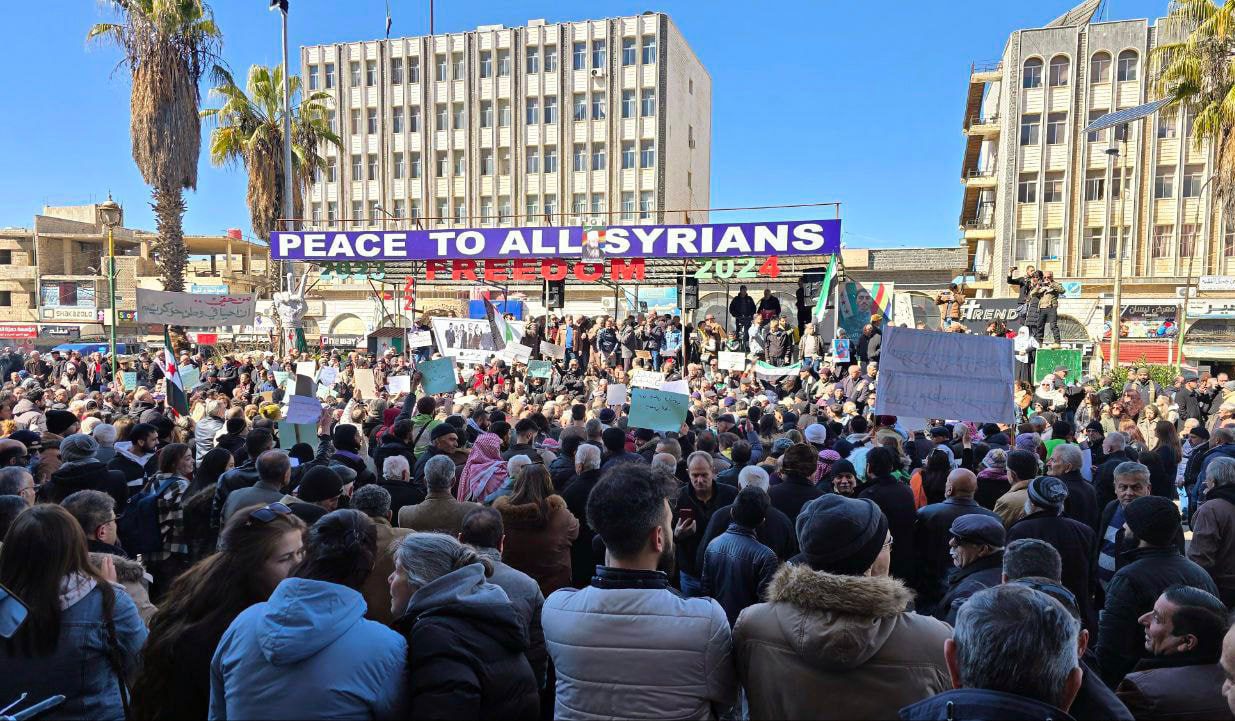
Public opposition in Suwayda is intensifying against Hikmat al-Hijri’s National Guard militia and its affiliated Supreme Legal Committee, as residents, civil activists and rival local factions accuse the group of deepening repression while expanding financial pressure on an already struggling population. A decision to collect fees from citizens has increased accusations that the militia is exploiting service management and aid distribution to consolidate power.
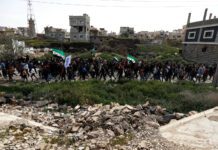
The latest sign of that anger came Sunday, April 5, in Karama Square, where dozens of residents protested decisions by the Supreme Legal Committee and local councils linked to the National Guard to impose monthly “community contributions” of 10,000 Syrian pounds (SYP) per family (around $90) and 25,000 SYP (approximately $225) on each commercial or professional activity. People described the measures as coercive taxation disguised as voluntary service support.
Residents told Syria TV the new fees come as Suwayda faces worsening living conditions, suspended salaries for many public workers and limited employment opportunities. Protesters also cited frustration over the committee’s failure to improve services, support displaced families from western villages or secure official recognition for high school diplomas with Syria’s Education Ministry.
Kidnappings and Land Restrictions Fuel Resentment
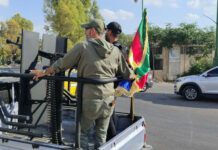
Public anger has also been driven by a series of security incidents attributed to the National Guard. According to the Suwayda Media Directorate, six people were abducted during a commemoration for Sultan Pasha al-Atrash in Qurayya after militia members attempted to deliver a political statement at the shrine affirming Syria’s unity. The directorate said journalists covering the event were beaten, insulted and forced to delete footage from their phones. Suwayda 24 also reported on beatings and abductions, including women.
Separate reports from Suwayda 24 and Syria TV said farmers in the eastern countryside were blocked from reaching their land in the Tal Sahn area near Huwaya and Shaab. Farmers said armed members of the National Guard prevented them from accessing fields they have worked for years, disrupting seasonal agricultural work that many families depend on for income.
Local residents and activists have also accused militia-linked councils of repeated levies yielding little visible improvement. Similar campaigns launched in Suwayda city, Shahba and Qarya in recent months raised funds for sanitation, water pumps and municipal services, but many residents said promised repairs never materialized. That pattern has reinforced public distrust, particularly amid allegations that aid, flour and other relief supplies have been diverted or used as leverage.
Rival Factions Reject Expanding Control
Opposition is not limited to civilians. The Men of Dignity Movement, one of Suwayda’s most influential Druze factions, openly rejected joining the National Guard and accused it of repeated truce violations that risk renewed violence.
Sources cited by Syria TV said the movement opposes the militia’s role in distributing gas and humanitarian aid, as well as its restrictions on residents traveling to Damascus to collect state salaries. The group condemned what it described as arrest campaigns, extortion and interference in daily civilian life.
Tensions rose further after a widely circulated video appeared to show National Guard leader Jalaa Abu Daqqa threatening Sheikh Abu Dhiab Mazid Khadaj, the Men of Dignity’s commander, along with members of the civil “Third Current” initiative. The threats drew sharp criticism from activists and community figures, many of whom said the militia’s conduct has become synonymous with coercion and intimidation rather than governance.
Damascus Blames Outlaw Groups for Crisis
The Syrian government responded by emphasizing its role in sustaining food and service deliveries to the province while criticizing armed actors it says are obstructing basic supplies. Suwayda Gov. Mustafa al-Bakour said Sunday, “whoever stands in the way of the poor man’s bread is complicit in starvation,” in remarks widely seen as a reference to armed groups accused of blocking flour shipments.
His comments followed reports from local networks that flour supplied through the UN World Food Program (WFP) stopped reaching public bakeries, nearly halting production. Bakour said Damascus had moved to request additional flour allocations and continued to facilitate aid convoys in coordination with the Syrian Arab Red Crescent and the WFP.
The growing wave of protests suggests many residents increasingly hold the National Guard and its legal bodies responsible for both the economic squeeze and the security deterioration, raising fears that Suwayda’s already fragile balance could face further strain in the weeks ahead.