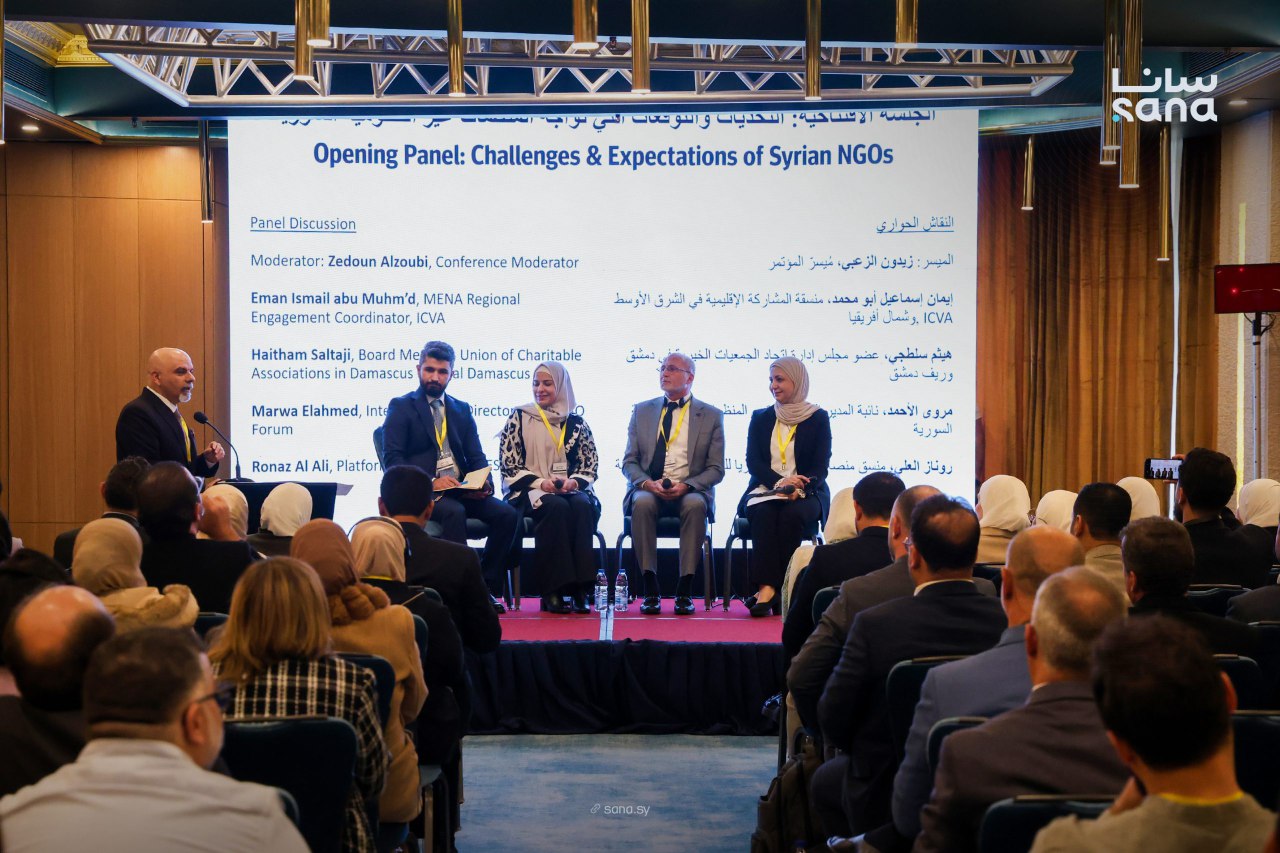
Syrian civil society actors and the international German humanitarian aid organization Hilfe zur Selbsthilfe, also known as “Help,” launched the first Syrian Humanitarian Action and Recovery Conference in Damascus. For the first time, leading figures from Syrian civil society gathered with local and international stakeholders to discuss challenges and develop solutions related to humanitarian aid and reconstruction in Syria.
The conference, titled “Syrian Humanitarian Action Recovery, Local Solutions for Sustainable Impact,” aims to shape future policies for civil society and humanitarian work, drawing on ideas and recommendations presented by participants.
Bahjat Hajar, representing the Ministry of Social Affairs and Labor, emphasized the significant responsibility shared by government institutions and civil society to design programs that fill existing gaps and ensure humanitarian aid reaches those who need it most.
The conference brings together the expertise of over 170 humanitarian organizations and local associations, focusing on current challenges in recovery efforts, practical solutions, and recommendations intended for adoption by Syrian and international decision-makers.
‘Symbolizing a Diverse Syria …’
In a recorded message, German Minister for Economic Cooperation and Development Svenja Schulze stated that the conference “symbolizes diverse Syria,” affirming that Germany will continue supporting efforts to improve living conditions and empower communities.
Saria Akkad, coordinator of the Syrian Alliance of NGOs, called for intensified efforts and the involvement of all Syrians in rebuilding their society, particularly through relief work, education, women’s empowerment, and livelihood support. She highlighted the central role of Syrian civil society in preserving the social fabric and reaching vulnerable groups despite enormous humanitarian needs and strained infrastructure.
For her part, Mirna Aboud, country director for Help, underscored the importance of learning from the experiences Syrians have endured both inside and outside the country. She stressed the need to build a better reality for the population after years of suffering and injustice caused by the crimes of the Assad regime.
Networking with Local Associations
Haitham Saltaji, a member of the Federation of Charitable Associations in Damascus and its countryside, emphasized the necessity of networking with associations and institutions operating in newly liberated country, noting that their extensive experience can help expand the reach of humanitarian services.
He called for directing support based on actual needs rather than donor restrictions, particularly in rural regions requiring development to reduce pressure on cities and curb migration. The German organization Help has supported people affected by crises since 1981, working to assist them in building lives rooted in dignity, security, and self-reliance.