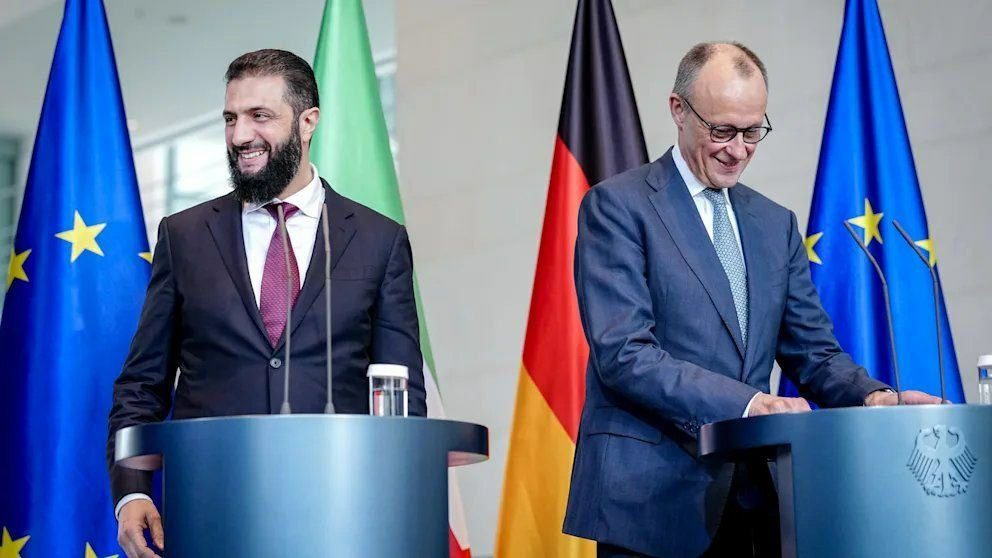
 Syrian President Ahmad al-Sharaa and German Chancellor Friedrich Merz met at the Federal Chancellery in Berlin during Sharaa’s first official visit to Germany, with discussions centered on bilateral relations and prospects for expanded cooperation across multiple sectors. The meeting concluded with a joint press conference where both leaders addressed reconstruction, migration, security and regional stability, indicating the scope of the emerging Syrian-German dialogue.
Refugees and Diaspora Expertise Shape Discussions
At the outset of his remarks, Sharaa thanked Germany and its people for hosting Syrians during the revolution, emphasizing the role education and employment opportunities played in rebuilding lives abroad. Both sides highlighted the contribution Syrians in Germany can make to reconstruction efforts.
Sharaa pointed to the large Syrian community, including thousands of medical professionals working in German hospitals and many others active across the economy. He said discussions are underway on a circular migration framework that would allow Syrian professionals to contribute to rebuilding efforts while maintaining ties to Germany.
Merz said Syrians living in Germany are well positioned to support reconstruction through the skills and experience they have gained, adding that economic growth and stability in Syria remain essential to long-term recovery.
Reconstruction and Investment Move Forward
Economic cooperation featured prominently in the talks. Sharaa described Syria as a strong opportunity for a Syrian-European partnership led by Germany, citing the country’s strategic location and reconstruction needs as drivers for long-term investment. Merz announced plans to establish a joint working committee with Syria, which is expected to begin work in the coming days.
The framework will include visits by German delegations to Damascus and is intended to support practical cooperation on reconstruction and economic development. The discussions also explored how German and broader European markets could participate in rebuilding infrastructure and reviving key sectors.
Security and Territorial Unity Remain Priorities
Sharaa reaffirmed Syria’s territorial unity and state sovereignty as central priorities, rejecting any unauthorized weapons outside national institutions. He said restoring stability, ensuring citizen safety and combating terrorism remain at the forefront of government efforts.
He also emphasized dismantling cross-border Captagon trafficking networks as part of a wider security agenda. Merz, for his part, welcomed what he described as progress in dialogue with Kurdish groups, including ongoing efforts to integrate “Kurdish forces” into Syrian state structures.
Regional Tensions Add Diplomatic Weight
The leaders also addressed escalating regional tensions. Sharaa voiced concern over the broader military escalation in the Middle East, namely the US-Israel-Iran war, and criticized Israeli strikes on Syrian territory, while reiterating opposition to attacks targeting Gulf Arab states. He also highlighted Syria’s geographic importance as a land bridge connecting eastern and western trade and energy routes, framing stability as a prerequisite for regional economic integration.
Closing the visit, Sharaa said Syria is working to lay the foundations of a state based on law and institutions after decades of authoritarian rule. The Berlin talks, meanwhile, signaled a continued shift toward practical engagement between Damascus and European capitals, with reconstruction and stability at the center of the agenda.