 Syria’s offshore energy sector is attracting renewed international attention as major companies move to explore natural gas reserves in the Eastern Mediterranean, signaling a new phase of investment in the country’s energy industry.
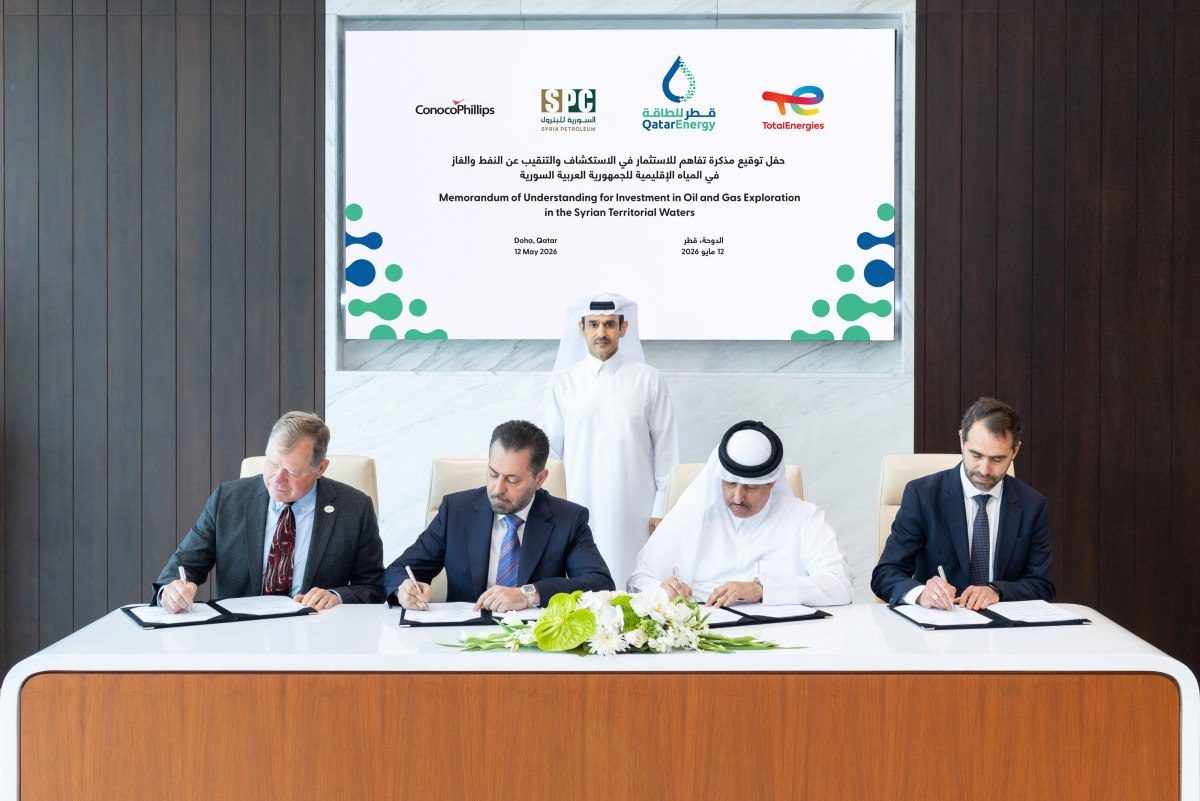
The momentum follows the signing of a memorandum of understanding involving Qatar Energy, France’s TotalEnergies, US-based ConocoPhillips and the Syrian Petroleum Company (SPC). According to Platform Energy, a Washington-based specialized outlet, the agreement was signed Tuesday, May 12, and focuses on launching offshore exploration activities along Syria’s coast.
The deal centers on evaluating the hydrocarbon potential of “Block No. 3,” an offshore area located within the Levant Basin, one of the region’s most significant gas-rich zones. Qatar Energy said the agreement includes a comprehensive technical review of the block and discussions related to commercial and technical requirements ahead of possible future drilling operations.
Levant Basin Holds Major Gas Potential
During the signing ceremony, Qatar’s Minister of State for Energy Affairs, Saad bin Sherida al-Kaabi, described the agreement as part of the company’s broader strategy expanding into promising regional markets. He said the partnership reflects growing international interest in Syria’s energy sector and aims to support cooperation with Syrian authorities through advanced technology and financing for large-scale projects.
Current studies focus on an offshore area near Latakia, where water depths range between 100 and 1,700 meters. The location is considered strategically important as it forms part of the Levant Basin, which international estimates identify as containing substantial natural gas reserves. According to data reviewed by Platform Energy, Syria’s offshore reserves could total approximately 1.2 trillion cubic meters of natural gas.
If confirmed, the reserves could strengthen Syria’s position in the regional energy market at a time when the government is seeking to revive an energy sector weakened by years of conflict and sanctions. Officials hope expanded gas production could improve supplies for electricity generation and domestic industries, both of which continue to face shortages.
Energy Sector Tied to Economic Recovery
Syrian authorities are aiming to restore oil and gas production levels that declined sharply during the conflict. National oil production averaged around 400,000 barrels per day between 2008 and 2010 before falling to roughly 15,000 barrels per day in 2015. By 2023, production had recovered only slightly, remaining below 30,000 barrels per day.
In a related development, SPC announced it had identified a site for its first deep-water exploration project in partnership with US-based Chevron and Qatar’s UCC Holding. Officials view offshore exploration as an opportunity not only to increase domestic production, while attracting foreign investment and generate export revenue.