
A year after the fall of the Assad regime, security forces in northeastern Syria intensified restrictions on public expression, drawing renewed criticism from residents, activists and rights groups. The most visible flashpoint came in Raqqa, where Syrian Democratic Forces (SDF) detained a man who carried a banner reading, “It is our right to celebrate, oh SDF,” during an attempt to mark the anniversary of Syria’s liberation.
The arrest followed a directive issued by the Autonomous Administration of North and East Syria (AANES) banning all public gatherings on December 7 and 8. Officials said the measure aimed to prevent attacks by ISIS cells. The administration described the security climate as fragile and said militant groups could exploit public events.
Celebrations Continue Despite Ban
In Qamishli, the Kurdish National Council (KNC) defied the ban and held its own event marking the first anniversary of the Assad regime’s collapse. A council representative told Syria TV the group did not consider itself bound by the administration’s decision and had “always been an essential part of the Syrian revolution and opposition forces.”
The Democratic Union Party, and AANES-linked Syriac and Arab parties failed to attend, despite formal invitations by the council. Several activists said they stayed away out of concern they could face questioning or prosecution later. A patrol from the Internal Security Forces briefly entered the venue but withdrew after receiving orders to avoid an escalation.
In its anniversary statement, the council called the liberation “the most prominent historical event in the world” and urged a national dialogue including all political and social groups. It also urged Damascus to begin talks with a joint Kurdish delegation and warned that ignoring “Kurdish demands” would undermine long term stability.
Reports of Arbitrary Arrests Continue
Human rights organizations documented a rise in detentions tied to political expression over the past year. The Syrian Network for Human Rights (SNHR) reported nearly 800 arbitrary arrests in SDF controlled areas since December 2024, including 87 children and eight women. The group said many cases of violations involved criticism of SDF practices or displays of support for the new Syrian government.
Cases ranged from celebrating in public spaces to possessing Syrian flags or images of national symbols. In one incident, witnesses told The New Arab that SDF forces arrested 76 year old Hajji al-Halabi and his son in Amuda after raiding their home. Family members described verbal and physical abuse during the arrest and said the detention was intended to pressure activist Ibrahim al-Halabi to stop his political work.
A Widening Divide
The administration defended its ban as a protective measure. Critics countered that the decision conflicted with its stated commitment to democratic freedoms, especially given its large scale public events for the PKK, considered a terrorist organization by the US and EU, weeks earlier.
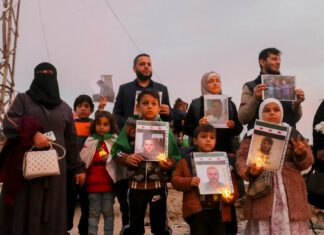
Residents in Raqqa and Deir Ezzor still marched in limited numbers to mark Liberation Day, insisting on what they described as their right to peaceful expression. As public frustration rises, calls for clearer legal safeguards and transparent security procedures continue to gain force across the region.
As criticism widens, Syrian officials question justifications for restricting anniversary events. Qutaiba Idlbi, director of American Affairs at the Syrian Foreign Ministry, said the ban undercuts the administration’s claims to democratic governance.
He argues any authority preventing Syrians from marking what many view as a defining moment in their national history weakens its own credibility. “An entity that prohibits Syrians from celebrating a defining moment in their national history cannot credibly describe itself as ‘democratic’ or ‘representative,’” he said, adding that a body that fears the “legitimate expression of joy” cannot speak on behalf of the public. Freedom, says Idlibi, “is indivisible” and should apply across all regions.