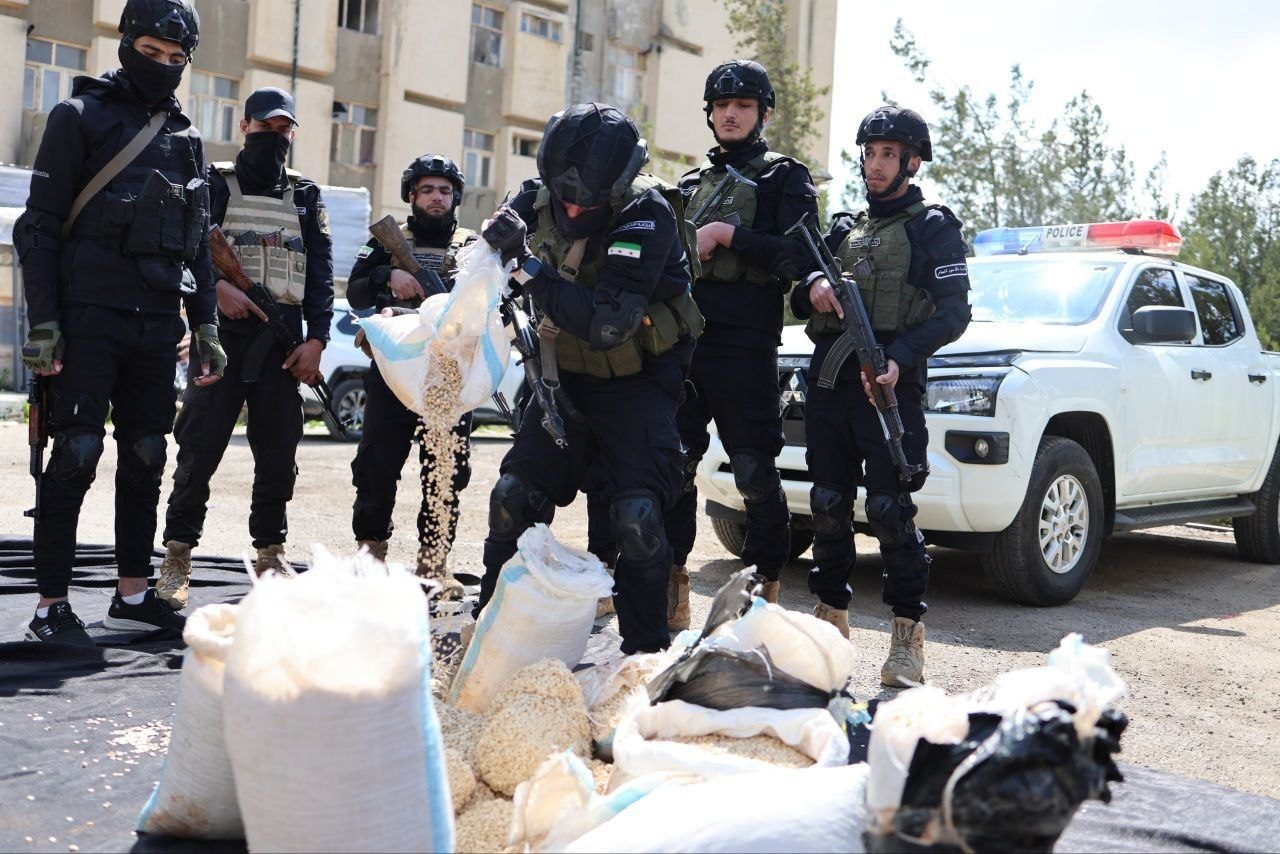
Syria’s Interior Ministry said its Anti-Narcotics Department thwarted 205 drug trafficking and smuggling operations during the first quarter of 2026, seizing nearly 10 million Captagon pills and dismantling multiple domestic and cross-border networks.
In a video statement and accompanying figures released April 4, the department said the seizures from January through March included over 10 million Captagon pills, 1.046 tons of hashish, 4.739 kilograms of crystal meth, 173.5 kilograms of cocaine and 15,540 other narcotic tablets.
The scale of the Captagon seizure remains the most striking element of the report, highlighting the continued prominence of the amphetamine trade in Syria and across the wider region. The ministry did not provide a direct comparison with previous quarters, but the volume points to sustained enforcement pressure on trafficking routes that have long linked Syria to regional smuggling markets.
Arrest Tied to Former Regime Smuggling Links
Among the most notable arrests, the department announced it had detained Fayyad al-Ghanem, described as a major figure in international drug trafficking and the right-hand man of Suhail al-Hassan, the former commander of the 25th Special Forces Division under the ousted Assad-era military structure.
According to the ministry, Ghanem played a central role in smuggling activity across Aleppo and the eastern Euphrates region, areas historically serving as an important corridor for the movement of narcotics.
The report also highlighted action against internal criminal groups. Authorities said they dismantled a 23-member cell accused of exploiting people suffering from addiction for prostitution, including 14 girls and nine young men. In addition, the department said it broke up over 15 domestic and international smuggling networks.
Regional Cooperation Expands Border Crackdown
Cross-border coordination featured prominently in the ministry’s first-quarter summary. Officials said Syrian authorities carried out six joint anti-smuggling operations with Iraq, alongside one operation each with the UAE, Lebanon, Jordan and Turkey.
The department added that two international trafficking networks operating along Syria’s borders were dismantled, leading to the arrest of 14 active members. The emphasis on joint operations reflects Damascus’ effort to present anti-narcotics work as part of a broader regional security framework, particularly as neighboring countries continue to press for tighter controls on smuggling routes.
Damascus Signals International Anti-Drug Commitment
The ministry’s latest figures align with recent public messaging from Deputy Interior Minister Maj. Gen. Abdulqadir Tahan, who said last month Syria “will no longer be a transit route or a source of the drug economy.”
Writing on X after attending the 69th session of the UN Commission on Narcotic Drugs in Vienna, Tahan said Syria had committed to becoming “an active partner” in international efforts to eradicate narcotics trafficking.
The first-quarter report appears designed to reinforce that pledge, combining large-scale seizures, high-profile arrests and international coordination as Damascus seeks to demonstrate a more assertive anti-drug posture in 2026.