Syria marked the first anniversary of the fall of Assad’s regime on Monday, December 8, with dawn prayers, military parades and speeches that framed the day as the start of a new chapter. President Ahmad al-Sharaa led the dawn prayer at the Umayyad Mosque in Damascus, wearing the same military uniform he had on when revolutionary forces entered the capital a year earlier. The Ministry of Religious Endowments urged Syrians nationwide to attend morning prayers to commemorate what it called the “dawn of liberation.”
After the prayer, Sharaa delivered a short address, telling worshippers Syrians would rebuild a unified country “from its north to its south and from its east to its west”. He said no obstacle would prevent national reconstruction and added that the government remained committed to justice, support for the oppressed and the protection of rights.
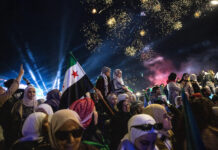
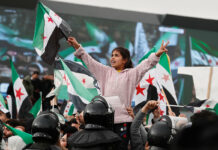
Streets in central Damascus filled with crowds carrying Syrian flags as the Ministry of Defense held a military parade that moved from Mezzeh Airport to Customs Square. Units from several formations took part. Tens of thousands gathered later in Umayyad Square for various programs and public events.
Sharaa Calls Liberation a Historic Break
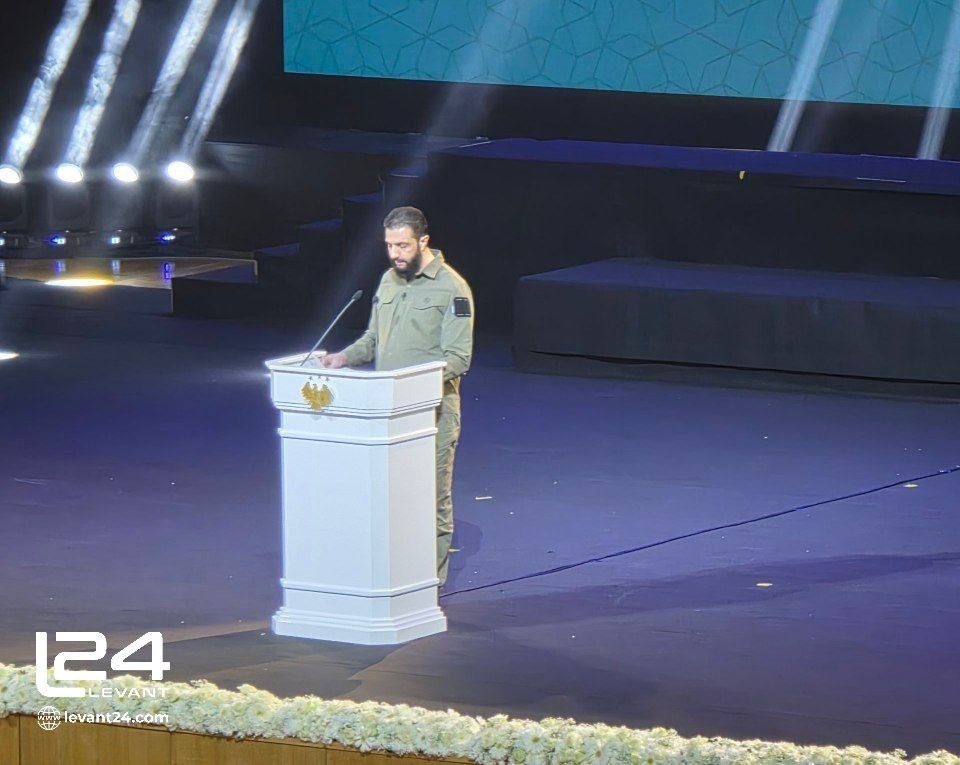
At the Conference Palace, where the main state ceremony was held, Sharaa congratulated the nation on what he described as the return of the homeland “free and dear” to its people. He said the fall of the Assad regime on December 8, 2024, after an 11 day battle, marked a decisive break with an era he called a dark chapter built on fear, corruption and the denial of rights.
“For over five decades, Damascus, the jewel of the East, was lost to us” he said, noting that previous authorities tried to strip the capital of its identity and bury its history. He described the last year as a period in which Syria regained its position abroad, citing new diplomatic activity and partnerships in energy, ports, airports and communications. Such projects aim to support economic recovery and ease pressures on citizens.
Sharaa stressed that transitional justice remained a central priority. He said the government had unified military forces into a single national army and had pledged accountability for abuses. “The people’s right to knowledge, accountability and then reckoning or reconciliation is the basis of the stability of the state,” he said.
Symbolic Gift and Public Messages of Unity
Monday’s events also included the unveiling of a piece of the Kaaba’s covering presented by Saudi Crown Prince Mohammed bin Salman. Sharaa said he chose to place the gift in the Umayyad Mosque to underline ties between Mecca and the Levant.
In an evening ceremony attended by his wife, Latifa al Droubi, he again praised the sacrifices of fighters, detainees, wounded and families affected by the conflict. He told the audience that Syrians had “formed a page of heroism and a story of great victory,” and said the unity of the population remained the cornerstone of the country’s future.
Across the governorates, crowds held local events tied to the government’s call to extend celebrations from December 5 to 8 under the slogan “Let’s complete the story.” Authorities described the anniversary as both a remembrance of sacrifice and a signal of the political transition now underway.