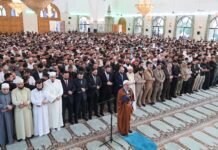
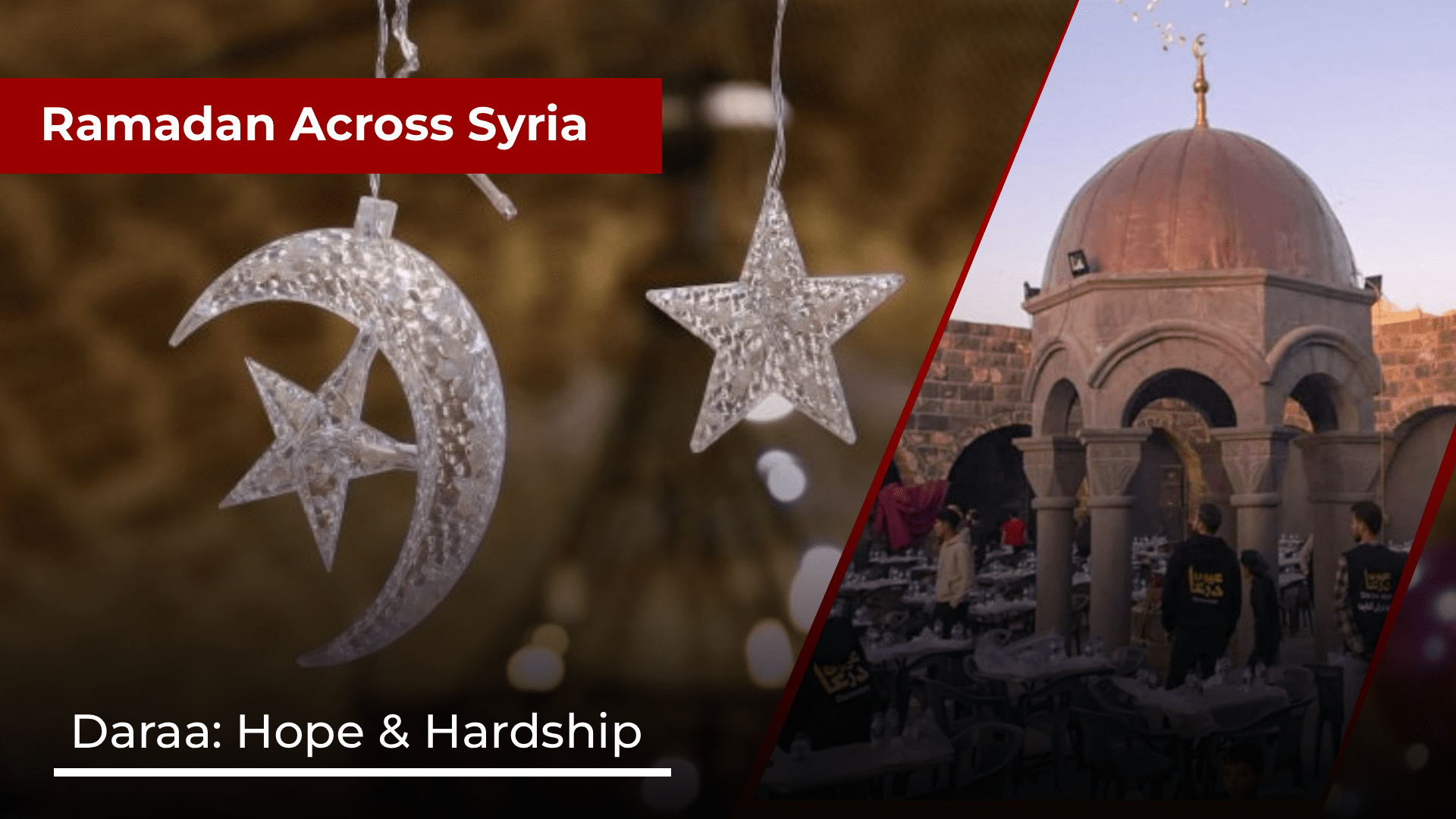
The call to prayer drifts across the towns of Daraa at sunset, echoing over rooftops scarred by years of shelling and streets that have witnessed both protests and patrols.
Daraa, where Syria’s uprising first began in 2011, has endured years of bombardment, displacement, and shifting control. Although the fall of the Assad regime ended decades of authoritarian rule, southern Syria is still struggling with economic hardship and the slow return of displaced families.
In Nawa, Abu Omar sits with his wife and five children around a modest iftar (the meal Muslims break their fast with) table. The plates are simple, the room borrowed. Seven years after fleeing his hometown of Sheikh Maskin, he still feels like a guest in his own province.
“Since I left Sheikh Maskin, I lost my soul and memories,” Abu Omar, 46, told Levant24 during a recent interview. “Although the people and families here are very good and never show any discrimination against me and my family, I really feel the alienation of displacement.”
Across southern Syria, Ramadan (observed by Muslims worldwide as a time of fasting, prayer, reflection, and community) unfolds this year in a region that has known occupation, incursions, and years of rule by militias and security forces. While many residents say stability has improved since the collapse of the Assad regime, economic hardship, unresolved displacement, and lingering insecurity continue to shape the holy month. Yet amid the uncertainty, families fast, pray, and gather as they can, holding tightly to rituals that have outlasted the conflict.
The Alienation of Displacement
For Abu Omar, Ramadan once meant a revolving door of relatives. In Sheikh Maskin, he and his extended family shared iftar at home for half the month and spent the other half accepting invitations.
“Some nights were two or three families breaking Iftar together,” he said. “Men were going to the mosque together to pray Tarawih (special voluntary night prayers in Ramadan), and after that, we spent hours talking over tea and sweets.” That rhythm broke in 2017, when fighting forced his family to go west to Nawa. His house in Sheikh Maskin was completely destroyed. The first Ramadan away was, as he described it, “a disaster.”
“My wife was crying in the kitchen so I wouldn’t see her,” he said. “She said she was remembering her parents, brothers, and sisters and told me, now we are eating alone and there is no one to eat with us or invite us.”
Although neighbors in Nawa send dishes and treat his family kindly, he said invitations rarely come. He blames both social disruption and strained finances. As a government employee at the Directorate of Electricity in Daraa, he earns the equivalent of about $100 a month. Rebuilding even a single room of his home would cost at least $10,000, he said.
“While I can return to my hometown, I have no house to live in,” Abu Omar said. “How can I raise the money, and my salary is only about a hundred dollars?” He hopes to begin modest repairs this summer with help from relatives. “I hope that stability and security are achieved in Daraa,’’ he said. “People are tired of war; they want to live in peace.”
Ayad al-Sahab, displaced from Shayah village in 2018, shares that longing. He lost everything when the Assad regime destroyed his village. “It’s still a pain to have lost my land, my property, and the olive and fig trees I worked so hard to plant,” he told Levant24.
Now living in Jabib, east of Daraa, he says he has adapted, but basic services remain absent in his hometown. The well was destroyed, there is no electricity, and the school building needs repairs. “I hope by next Ramadan, I’ll be able to return to my village, proud and honored, and at least have access to basic services like water,” he said. “I pray that God will support the new state and take control so that living conditions can improve and people can return to their livelihoods.”
Tables Shrink as Prices Rise
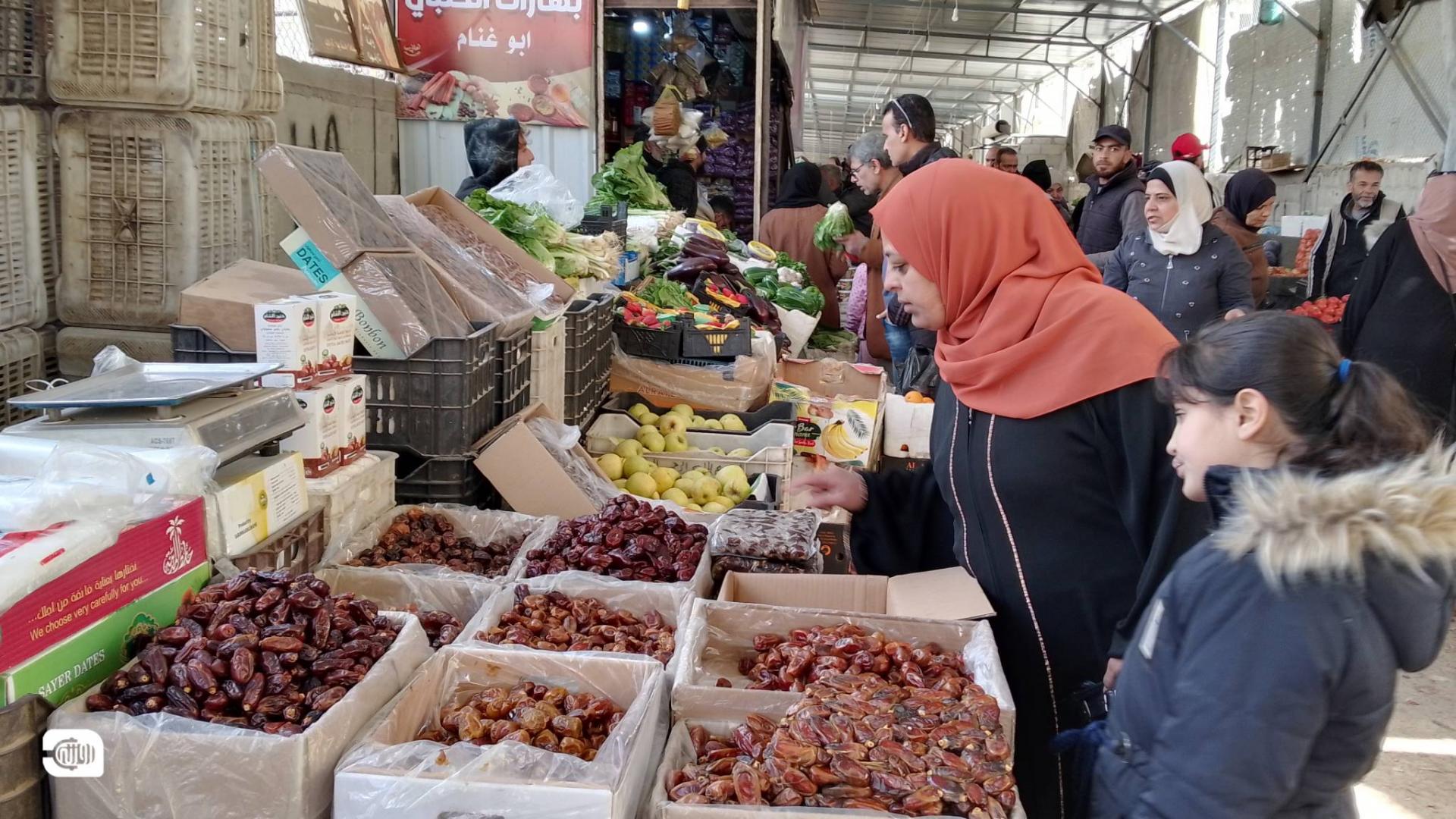
Even for those who never left home, Ramadan in Daraa carries a financial strain many describe as heavier than before. “The difference has been felt by all citizens,” Ibrahim Hariri, a resident of Daraa, told Levant24. He cited a decline in purchasing power, rising prices, and a lack of state pricing controls in most areas, which has led to “price chaos.” Salaries for many employees are delayed, he added, and an ongoing gas shortage, which began weeks before Ramadan, has continued into the month.
Construction worker Khalid al-Khatib, 50, echoed these concerns. “Last Ramadan was good, and this Ramadan is good, but the challenges are mostly the economic situation,” he said. The price of one kilo of lamb has increased by about 50%, and this is too much.”
Muhammad al-Hamadi, 65, from Inkhel coordinates charity for widows and needy families, said food prices rose 15% to 20% in the days before Ramadan. At the same time, donations from Syrians abroad have declined.
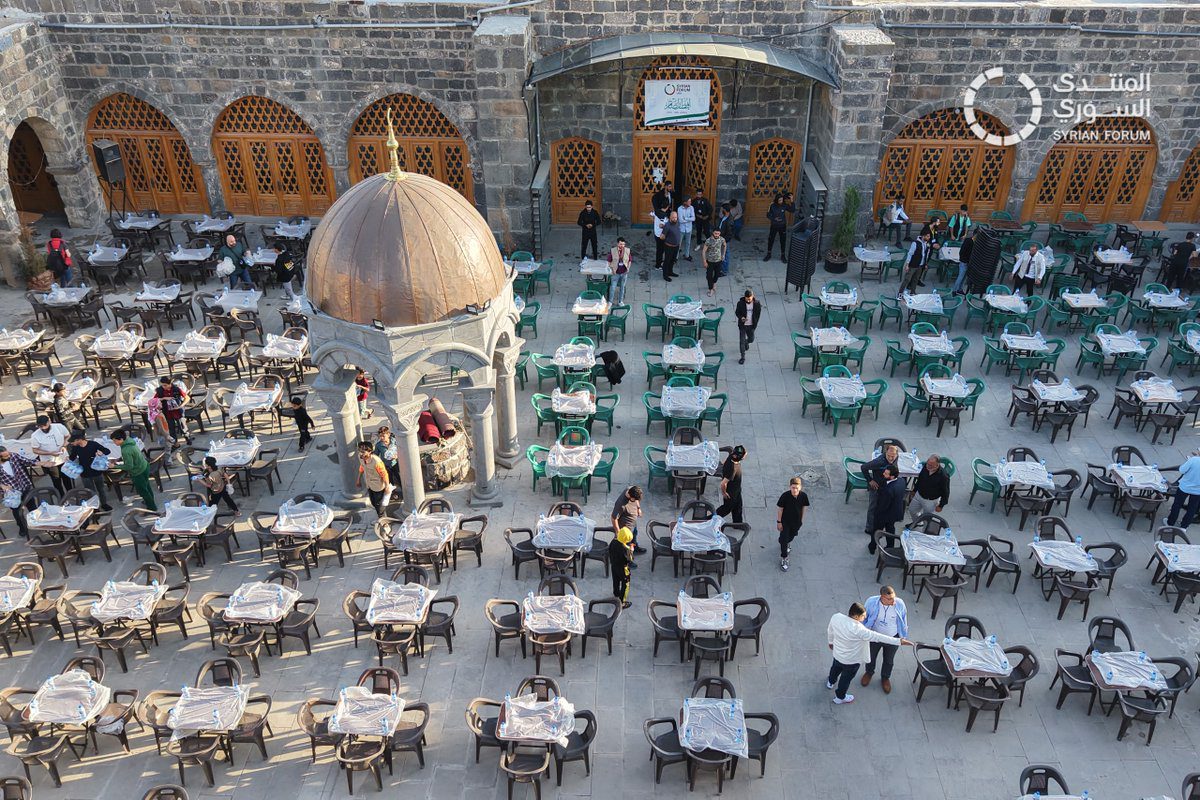
“This year, charity organizations face a double problem: rising prices and decreasing donations.” Economic pressures in Gulf states and now tensions involving Israel, the US, and Iran have left some expatriates worried about losing jobs, greatly reducing remittances.
Still, Hamadi said local networks remain strong. “In Daraa, the social networks and relationships are good, and families support each other, and they increase their support in Ramadan,” noting that farmers and traders often pay zakat during the holy month.
Adnan Masalma, a member of the new People’s Council in Daraa, also acknowledged the strain. Telling Levant24 that collective Ramadan activities such as charity and iftar meals “are greatly affected by the sometimes tense general situation in the region,” but warned that “the challenges facing the Syrian people are immense due to the lack of some services, exorbitant food prices, and unjustified price hikes.”
New Freedoms Amid Old Fears
Residents describe a mixed security picture in Daraa. Some point to greater freedom in religious life compared with years under the Assad regime, while others note ongoing tensions in neighboring provinces.
“Praise God, Syria and Syrians got rid of the dictatorship of Assad,” Khatib said. “This is enough for Syrian Muslims to practice their rituals without any fear.” He said that families now feel safer visiting relatives across towns, even returning home late at night after iftar or suhoor. “During the Assad regime era, we couldn’t leave our homes after iftar because of the arrests and kidnappings by regime forces and militiamen.”
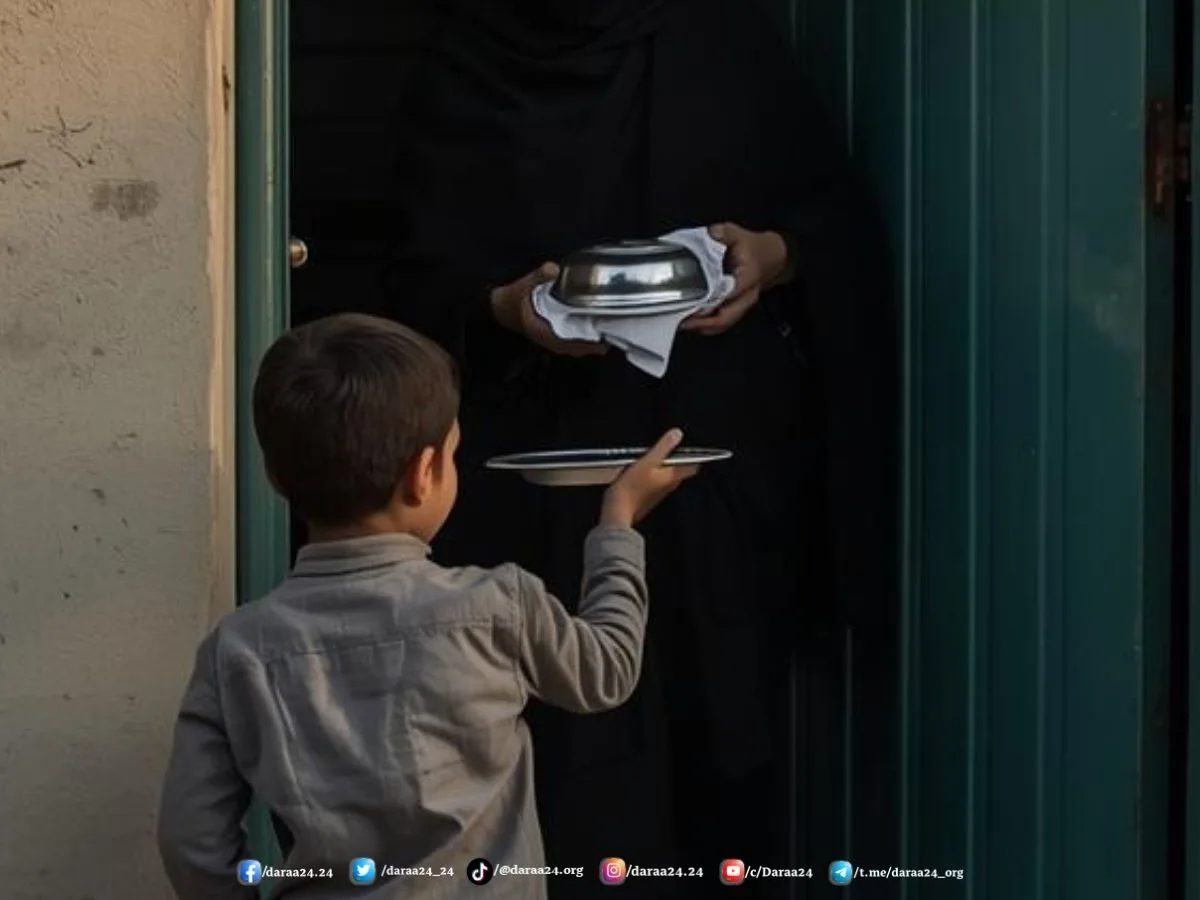
Yet even as some speak of improved stability, the weight of loss remains close to the surface. Khatib said his brother is still missing. Assad’s Military Intelligence arrested him in 2014, and the family has received no information since. “To this day, my mother puts an empty dish on the iftar for him and cries.”
He said many families across Daraa face similar absences. “Most families lost their sons, children, husbands, and fathers,” he said. “How can they have a normal Ramadan while every iftar they remember the dead and missing members?”
Enduring Faith
Despite grief and hardship, residents describe Ramadan as a source of steadiness. Majar al-Sahab said displacement taught him to value survival above all else. “Thank God, my children and family are alive,” he told Levant24. “Syrians are resilient and adapt to whatever challenges they face.”
For Abu Omar, hope centers on return. He imagines praying in the mosque of his childhood and sharing iftar once more with cousins and siblings. “I hope next Ramadan will be in my hometown and I’ll have iftar with my family.”
In Daraa, Ramadan does not erase the scars of revolution and war. It unfolds in rented houses, half-repaired villages, and neighborhoods where memories of the missing linger at empty tables. But as the sun sets each evening and families gather with what they have, faith and worship offer a quiet form of perseverance.