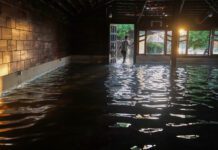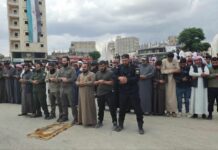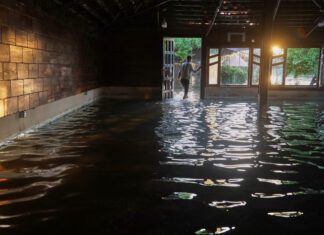
Syria’s President Ahmad al-Sharaa arrived in Deir Ezzor May 29 alongside a high-level ministerial delegation to oversee emergency flood response operations and announce a new phase of reconstruction and development projects in eastern Syria, as rising waters along the Euphrates River continued to threaten thousands of residents.
The delegation included the secretary-general of the presidency, the ministers of local administration, energy, health, public works and housing, agriculture, emergency and disaster management, the director of the Petroleum Company and the deputy minister of economy.
Officials toured flood-affected areas, inspected damaged infrastructure and met with local authorities to coordinate immediate response efforts and long-term recovery plans. The visit came as Deir Ezzor and neighboring Raqqa governorate remained under heightened emergency alert following the most severe Euphrates flooding in over 35 years.
Emergency Measures Across the Euphrates Basin
Officials said approximately 2,400 to 2,500 families in Deir Ezzor remain affected by rising water levels, particularly in communities along the riverbanks and agricultural zones. The Ministry of Social Affairs and Labor opened temporary shelters, while naval forces deployed boats and ferries to transport civilians, medical cases and supplies between the river’s two banks after bridge access became severely disrupted.
Minister of Emergency and Disaster Management Raed al-Saleh said damage in Deir Ezzor exceeded that recorded in Raqqa, adding that specialized committees had begun assessing losses in preparation for compensation measures. “The operations room detected significant damage to infrastructure and agricultural areas,” Saleh said during a press conference in Deir Ezzor.
He added that Syria lacked a functioning early warning system in previous years and that the ministry is now working to establish one. Emergency teams also deployed 40 fire stations across the governorate amid fears that high temperatures and electrical disruptions could ignite wheat field fires.
Water Stations and Agricultural Losses
The flooding forced dozens of water stations out of service across eastern Syria. According to the Ministry of Energy, 62 of Deir Ezzor’s 211 water stations stopped operating because of rising water levels, while 15 stations in Raqqa were shut down as a precaution.
Abdullhamid Sallat, director of media at the Ministry of Energy, said technical crews restored 10 major stations in Deir Ezzor, including facilities in Mahkan, Ayash and Sabkhan, after protective barriers were reinforced around them. To maintain drinking water supplies, the ministry launched an emergency relief plan including dispatching water tankers from other governorates to Deir Ezzor and surrounding rural areas.
Flooding damaged thousands of dunams of farmland. Governor Ziad al-Ayesh said at least 5,000 dunams of agricultural land in Deir Ezzor suffered flood damage, while agricultural authorities in Raqqa estimated 1,500 dunams were submerged in just a single village.
Agriculture Minister Basil al-Suwaidan said technical committees would begin inspections to assess crop damage and irrigation losses before compensation payments are distributed to farmers. He added the ministry activated emergency agricultural support measures, including the provision of free animal feed and veterinary medicine for livestock owners in affected villages.
Reconstruction Projects and Service Expansion
Alongside emergency response operations, Sharaa used the visit to emphasize reconstruction and development plans for Deir Ezzor, which officials described as a future economic hub for eastern Syria. Government officials confirmed that work has begun on bridge projects in Deir Ezzor, with construction planned in the coming phase to improve connectivity between the Euphrates riverbanks after floodwaters severed transportation routes.
Health Minister Musab al-Ali announced plans to rehabilitate Deir Ezzor’s heart hospital, which will be renamed the “Martyr Ahmad Fatih Hospital.” He said the ministry already rehabilitated 461 health centers across Syria during 2025 and is continuing work to restore damaged facilities in Deir Ezzor.
Ali described the governorate’s health infrastructure as “deteriorating,” noting that only 46 of Deir Ezzor’s 105 health centers currently function properly. He said rehabilitation work is underway on an additional 23 centers, with new contracts expected for more facilities.
Energy Minister Muhammad al-Bashir confirmed coordination with Turkey led to a gradual reduction in water releases into Syria through the Euphrates River. Technical teams at the Euphrates Dam have already reduced water flow by 100 cubic meters per second during the first phase of de-escalation efforts. Officials said the Euphrates Dam reservoir had reached 98.5% of its storage capacity, forcing authorities to continue controlled water releases to protect the dam infrastructure.
Coordination With Regional Partners
Syrian officials said communication with Turkey and Iraq remained active throughout the crisis. Sallat said Turkish authorities informed Damascus last week that heavy rainfall and snowmelt would increase water releases into the Euphrates, though Syrian officials said the water surge arrived in less than 24 hours, leaving limited preparation time.
Authorities subsequently notified Iraq about spillway releases reaching 1,800 cubic meters per second as floodwaters moved downstream. Despite the scale of the flooding, officials insisted the situation remains under control. Water experts and engineers monitoring the crisis said no structural threats currently face the Euphrates or Tishrin dams.
“The current flood wave is exceptional,” water resources expert Abdurazaq al-Alawi told local media. “But there is no danger to the dams, and the situation remains manageable through coordination between Syria, Turkey and Iraq.”