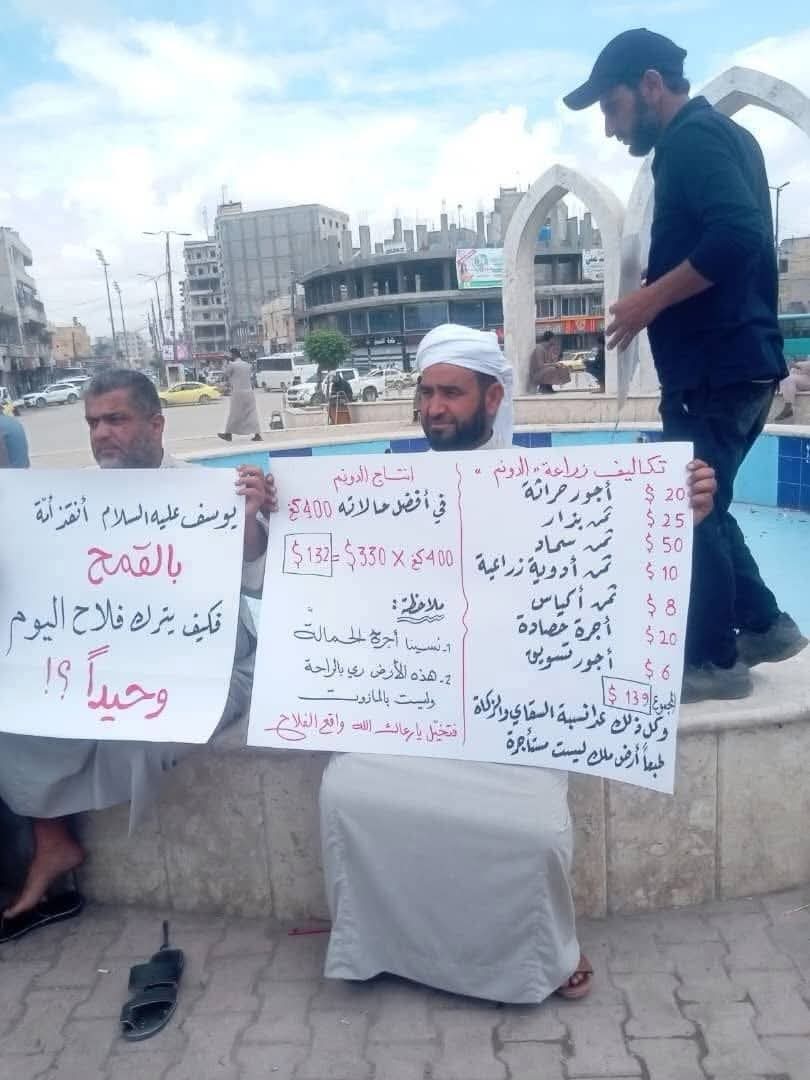
 Syria’s Ministry of Economy and Industry has set the purchase price for hard wheat this season at 46,000 Syrian pounds per ton, or about $340. The announcement quickly sparked criticism from farmers across several regions, particularly in the Jazeera area, where many described the price as insufficient to cover production costs.
Farmers and agricultural researchers argue that the main issue lies not in the sale price itself, but in the steadily increasing costs of cultivation. Fuel, fertilizers, irrigation, transportation and seasonal operational challenges have all driven expenses higher in recent years, placing additional pressure on producers already struggling with economic instability.
Speaking to Levant24, a farmer from Hasakah said the new pricing structure failed to reflect the reality facing producers in the field. “This price is unfair. It does not match my effort, my hard work, or my costs,” he said. “To produce my crop, I actually need nearly double what the state has set. If this pricing continues, I will not cultivate my land in the coming years. My family and I wait an entire year, only to be disappointed.”
Balancing Imports and Food Security
The controversy comes despite the government purchasing local wheat at rates above international market prices. Russian wheat currently ranges between $236 and $242 per ton, while European wheat averages between $230 and $250 per ton. Imported wheat, including shipping and insurance costs to Syria, generally remains below $290 per ton.
From a purely financial perspective, importing wheat from countries such as Russia or Ukraine appears less expensive for the Syrian treasury, especially after global wheat prices declined from their 2022 and 2023 peaks of over $400 per ton. However, officials continue to weigh direct financial costs against broader strategic priorities.
The government aims to support local farmers, reduce dependence on imports and preserve food security despite the higher costs associated with domestic production. Similar policies exist elsewhere in the region and internationally. Turkey, for example, purchases local wheat at elevated prices, while the EU and the US provide support programs designed to stabilize agricultural production and protect food supplies.
Debate Over Agricultural Sustainability
Officials view the wheat pricing policy as part of efforts strengthening local self-sufficiency while reducing reliance on foreign imports. Still, many farmers and analysts argue the current rates require revision to create a more sustainable balance between state finances and agricultural livelihoods.
They warn long-term investment in Syria’s agricultural sector depends on stable wheat prices and reliable financial returns. Without stronger incentives, some farmers may reduce cultivation in future seasons, potentially weakening domestic production capacity over time.