The Syrian government is open to allowing Russia to maintain its military bases along the Mediterranean coast, provided that any agreement serves Syria’s national interests, Defense Minister Murhaf Abu Qasra said this week, publicizing Damascus’ strategic outlook since the fall of the regime of dictator Bashar al-Assad.
Abu Qasra’s remarks, made during an interview with the Washington Post, reflect the new administration’s evolving stance on foreign military agreements and highlight its efforts to redefine Syria’s alliances. Once a staunch adversary of Russian intervention, the former revolutionary commander acknowledged that Moscow’s position toward Syria has “improved significantly” since Assad’s ouster in December.
“In politics, there are no permanent enemies,” Abu Qasra said when asked whether Syria would allow Russia to retain its naval base in Tartus and the Hmeimim air base in Latakia. “If we gain something for Syria from that, then yes.”
Reassessing Foreign Military Agreements
The future of Russia’s military presence in Syria remains a subject of ongoing negotiations. Moscow, which intervened in Syria’s civil war in 2015 to prop up Assad’s regime, has since withdrawn from numerous outposts across the country, concentrating its forces at Tartus and Hmeimim. These two bases remain of deep strategic importance to the Kremlin, particularly the naval facility, which grants Russia critical access to the Mediterranean.
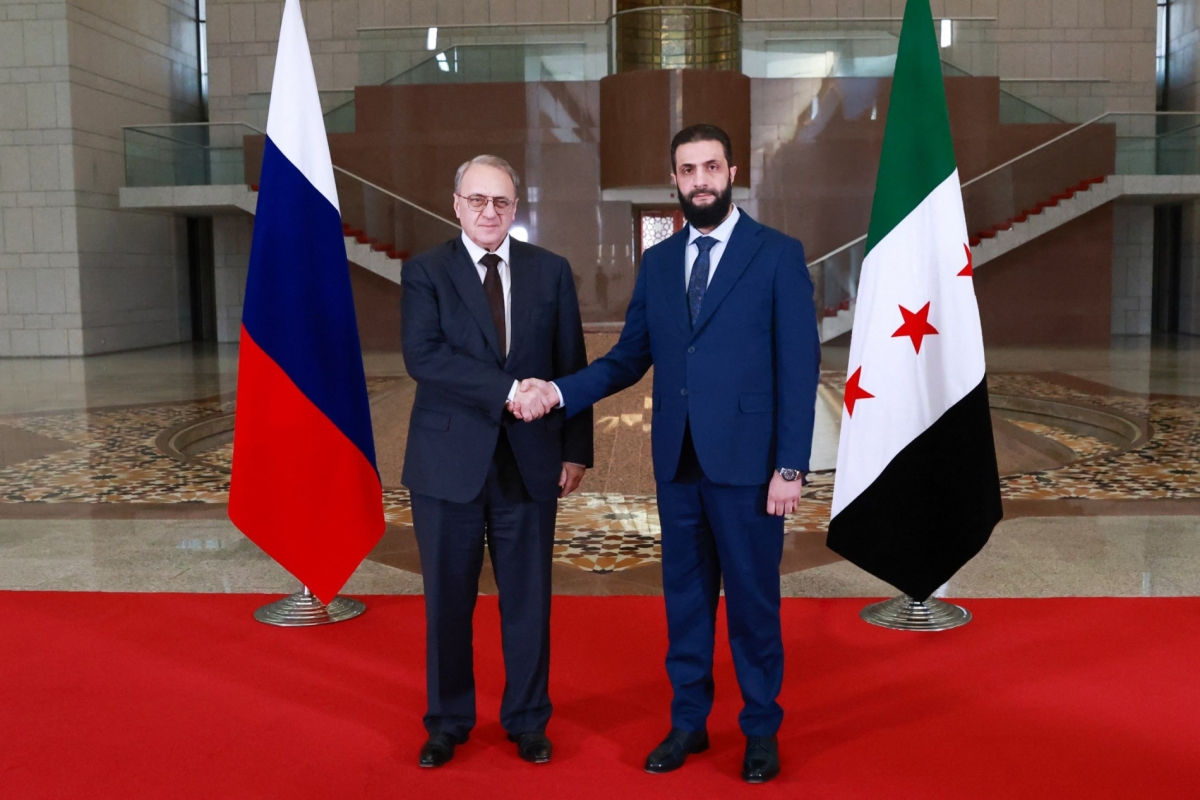
Russian Deputy Foreign Minister Mikhail Bogdanov, who met with Syrian President Ahmad al-Sharaa in late January, confirmed that the status of Russian military facilities “requires additional negotiations.” While Moscow has expressed interest in maintaining its military foothold, Damascus has signaled that any deal must be “mutually beneficial.”
Abu Qasra also revealed that Syria is engaged in separate negotiations regarding the presence of US and Turkish military bases in the country. The new government is reportedly discussing military agreements with Ankara that could lead to a reduction or redistribution of Turkish troops in northern Syria.
“The issue of whether the United States will maintain a military presence in northeastern Syria is under negotiation,” he said. Approximately 2,000 US troops remain stationed in Syria, primarily supporting the PKK-aligned Syrian Democratic Forces (SDF) in the country’s northeast.
Russia’s Role in Assad’s Fate
As Syria reassesses its relations with Moscow, one key issue remains unresolved: the fate of Bashar al-Assad. The former dictator fled to Russia following the rapid collapse of his regime in December, and his extradition has become a focal point of Syrian-Russian discussions.
Abu Qasra declined to confirm whether President al-Sharaa had formally requested Assad’s handover but acknowledged that the topic was raised during recent high-level talks. “When Bashar al-Assad decided to go to Russia, he thought it was impossible for us to reach an agreement with the Russians,” he said. “Perhaps relations with them will be restored in a way that serves Syrian interests first, and then [Russian] interests.”
Integrating Armed Factions & Kurdish Negotiations
As part of the government’s broader security strategy, Damascus is working to consolidate armed groups under a unified military structure. Abu Qasra confirmed that approximately 100 factions have agreed to join the Ministry of Defense, though some groups have resisted integration.
“The factions that will join the leadership of the Ministry of Defense will not be allowed to remain as independent units,” Abu Qasra stated. “All military formations will eventually be dissolved.”
Meanwhile, Syria is engaged in sensitive negotiations with the SDF, which controls about 25% of the country’s territory. The government has rejected an SDF proposal to merge into the Syrian military as a unified bloc, insisting instead that the region must come fully under Damascus’ authority.
“The military solution will cause bloodshed on both sides,” Abu Qasra said. “According to our assessment, the solution will be peaceful. We are not inclined toward a military solution.”
While discussions continue, Syria remains firm in its stance against any form of autonomous regions within Syria, ruling out any self-administered areas. US officials have suggested that some elements of the SDF may be integrated into Syria’s security forces, but no formal agreement has been reached.
A Pragmatic but Uncertain Future
As Syria navigates a complex geopolitical landscape, its new leadership appears willing to engage with former adversaries—including Russia—if it serves the country’s broader interests. While the status of foreign military bases remains uncertain, Damascus is positioning itself as a central player in determining Syria’s future security and sovereignty.