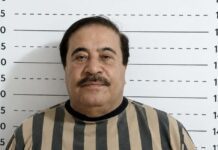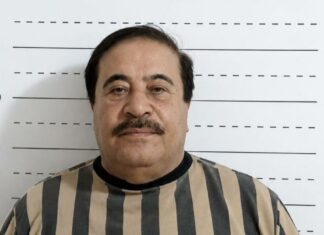
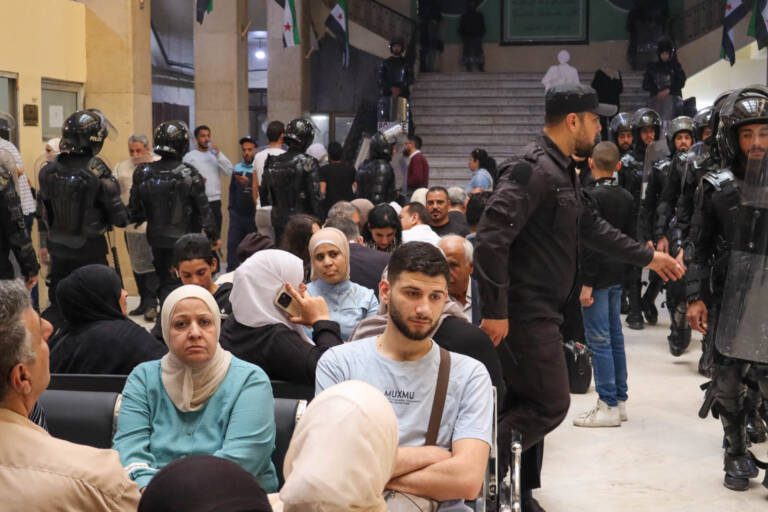
Syria’s Fourth Criminal Court pressed ahead Sunday with the second public session in the trial of Atef Najib, a former political security chief in Daraa and cousin of ousted President Bashar al-Assad, in a case that has become an early test of the country’s fragile transitional justice process.
The hearing at the Palace of Justice in Damascus centered on allegations tied to the 2011 crackdown in Daraa, where anti-government protests first erupted before spreading across Syria. Prosecutors accused Najib of overseeing a campaign of systematic repression that included arbitrary arrests, torture, killings and attacks on civilians.
Judge Fakhruddin al-Arian read charges accusing Najib of crimes against humanity, war crimes and “systematic mass murder” linked to the suppression of demonstrations in Daraa. The indictment alleged that schoolchildren detained for anti-government graffiti were subjected to severe torture, including electric shocks and fingernail removal, with some dying in custody.
The court also accused Najib of ordering attacks on protesters at the Omari Mosque in Daraa, preventing wounded civilians from receiving medical aid and coordinating the use of snipers against demonstrators and mourners. Najib denied responsibility during the hearing, arguing that other security branches carried out many of the abuses. He also claimed he no longer headed Political Security in Daraa after March 2011.
Assad Family Tried in Absentia
Alongside Najib’s proceedings, the court formally confirmed the absence of several senior Assad-era officials, including Bashar al-Assad, his brother Maher al-Assad and former Defense Minister Fahd Jassim al-Farij. The court declared them fugitives from justice and ordered them tried in absentia.
Judges also stripped the absent defendants of their civil rights and placed their movable and immovable assets under Syrian government administration under Article 322 of Syria’s Code of Criminal Procedure. The rulings extended to several former military and intelligence officials, including Louay al-Ali, Wafiq Nasser, Muhammad Ayoush, Qusay Mahyoub and Talal al-Asimi.
Under Syrian law, deprivation of civil rights effectively bars individuals from political participation, holding public office, managing assets or exercising other civic powers. Legal analysts described the move as both symbolic and practical, preventing former regime figures from using wealth or political networks during Syria’s transition.
The hearing drew lawyers, human rights activists and relatives of victims, although media access was partially restricted after the court halted the live broadcast to protect witness identities and confidential evidence.
Daraa’s Symbolism in Syria’s Transition
The prosecution emphasized the symbolic weight of holding the proceedings in connection with Daraa, often described as the birthplace of the Syrian uprising. Najib is the first senior Assad-era official to face trial inside Syria since Assad’s regime collapsed in December 2024.
The proceedings have unfolded amid mounting public pressure for accountability after over a decade of war, mass displacement and alleged atrocities committed by multiple sides in the conflict. Judge Arian argued the court could rely on both Syrian law and international legal conventions, including the Geneva Conventions and the Convention Against Torture, to prosecute crimes that “do not lapse with time.”
Lawyer Nouha al-Masri, who represents four plaintiffs in the case and lost two brothers during the war, told Syria Direct the court’s use of international legal principles gave victims hope that convictions could follow. “For us, the code of criminal procedures used to form an obstacle to convicting the defendants,” Masri said.
“The court’s adoption of international law and the description of the crimes committed as crimes against humanity gives us hope that the defendant will be convicted and punished.” Still, some legal experts questioned whether the trials were moving faster than Syria’s legal framework could support.
Human Rights Watch researcher Hiba Zayadin warned that the absence of a finalized transitional justice law risked undermining confidence in future prosecutions. Others noted that Syrian law still lacks explicit provisions covering genocide or crimes against humanity, forcing judges to rely heavily on international treaties not fully incorporated into domestic legislation.
Justice Beyond the Courtroom
Despite the legal debate, many Syrians view the Najib trial as a landmark moment in confronting the legacy of the Assad era. Families of victims gathered outside the courthouse carrying photographs of relatives killed or disappeared during the conflict.
The court scheduled the next hearing for May 19, with additional trials expected against other former regime figures, including members of Assad’s extended family and military officers accused of serious abuses.
For a country still emerging from years of war and political fragmentation, the proceedings have become over a criminal case. They represent an attempt to establish an official historical record of abuses and define how Syria will pursue accountability after decades of authoritarian rule.