
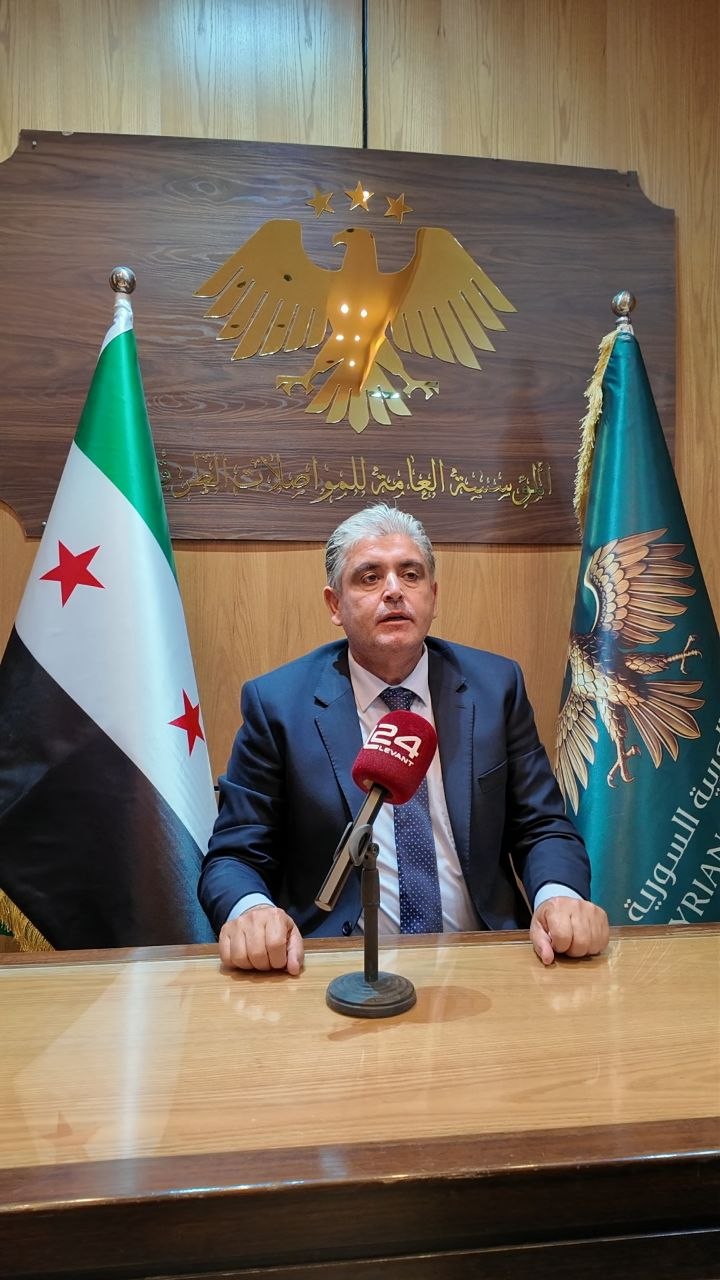
 Minister of Transport Yarub Badr announced the ministry started rehabilitating Syria’s main highways using modern international equipment and technical standards. He said the ministry is also seeking bids from specialized foreign companies to carry out the work according to the highest engineering specifications.
During a press conference, Badr said the largest project will focus on rehabilitating the M45 international highway, extending from the Nassib border crossing with Jordan to the Bab al-Hawa crossing on the Turkish border. The route passes through Damascus, Homs, Hama, Saraqib, and Aleppo. A second major project will rehabilitate the Damascus-Deir Ezzor highway to strengthen connections between the capital and northeastern Syria while completing key infrastructure in the eastern region.
Additional work will include the Nassib-Damascus, Damascus-Homs, and Homs-Aleppo highways, as well as the Saraqib-Idlib road and a new branch connecting Damascus, Palmyra, and Deir Ezzor. Badr said linking northeastern Syria with Damascus remains one of the ministry’s highest priorities as it will improve transportation, enhance road safety, and support economic activity. He added all projects will be financed through the state budget without grants or loans to help ensure timely completion.
Long-Term Infrastructure Strategy
According to Badr, rehabilitation projects will incorporate advanced safety standards, including improved road surfaces, upgraded traffic safety infrastructure, and asphalt recycling technology to reduce costs and conserve resources. Rehabilitated roads are expected to remain in service for up to 15 years with regular maintenance, making the projects a long-term investment in Syria’s transportation infrastructure.
The minister estimated construction of the new road corridors will take between five and seven years following the completion of technical and economic studies. In the meantime, the ministry continues maintaining and rehabilitating the existing road network while planning additional expressways to accommodate increasing traffic volumes.
Public-Private Partnerships Planned
Badr also outlined plans for future toll roads to be developed through public-private partnerships. These projects are intended to reduce congestion on existing highways and improve regional transit. The proposed corridors include a north-south route extending from the Jordanian border to the Turkish border and an east-west route linking Tartous Port with the al-Tanf border crossing, strengthening Syria’s role as a regional transportation and logistics hub.
Speaking to Levant24, General Corporation for Road Transport Director General Muaz Najjar said the corporation prepared an implementation plan for this year covering all Syrian provinces, with particular emphasis on the eastern regions as well as Aleppo and Idlib.
Najjar said over 40% of planned projects were announced, including five major projects which are now underway. He added the corporation introduced a competitive tendering system to replace previous procedures, aiming to attract experienced companies and improve construction quality. He said all projects will follow strict technical standards to ensure long-term sustainability and operational efficiency.