 Regional interest continues to grow in the Amanos Tunnel (Dörtyol-Hassa) project and its accompanying railway and highway network, which Turkey is developing through the Amanos Mountains in Hatay Province. Expectations are rising that the project could become one of the most significant economic corridors in the Middle East in the coming years.
Observers note that the initiative goes beyond improving Turkey’s domestic transportation infrastructure. Its impact could extend across regional trade networks linking the Gulf, Iraq, Syria and Europe, with some describing the Amanos Tunnel as a new trade route connecting Gulf markets to Europe.
Building a Regional Transport Corridor
The project includes the construction of an advanced network of tunnels connecting the port of İskenderun with industrial and commercial centers in southeastern Turkey, particularly Gaziantep, Kahramanmaraş and Kilis. Once completed, the network is expected to reduce freight transit times and lower transportation costs.
The project also aligns with Turkey’s broader strategy of strengthening its position as a logistics hub connecting Asia, Europe and the Middle East. At the same time, Gulf states continue to seek faster and more diversified routes to European markets, while Iraq aims to expand its role as a regional transit center. Against this backdrop, the Amanos Tunnel could become an important component of emerging regional trade networks.
Syria’s Strategic Position and Stability Concerns
Analysts suggest Syria could be among the project’s most significant potential beneficiaries because of its location between the Gulf, Turkey and Europe. In particular, Aleppo could emerge as a key link in efforts to restore Syria’s economic role in regional commerce.
However, academic and political researcher Dr. Ahmad al-Kinani told Levant24 that geography alone cannot transform Syria into a major player in international supply chains. He emphasized political stability remains essential, particularly regarding Israel’s actions in the region.
“Syria cannot be part of such a project while remaining vulnerable to the risks of Israeli targeting,” Kinani said. “This is one of the most prominent problems preventing Syria, at present, from serving as a source or transit route for international supply chains.” Kinani added that any substantial Syrian role would require broad international agreement to address longstanding structural challenges.
Although Syria has presented itself as an alternative or emergency transit route should the Strait of Hormuz close, he argued that comparisons with Hormuz remain unrealistic under current conditions. Sustainable reliance on a Syrian corridor would require lasting security guarantees and international consensus, conditions that have yet to materialize.
Reconstruction and Investment Obstacles
Kinani also noted Syria faces severe economic challenges limiting its ability to benefit from emerging trade corridors. Years of conflict heavily damaged transportation infrastructure and ports such as Latakia and Tartus. International estimates place reconstruction costs at over $200 billion, including roughly $100 billion needed for electricity, water and other essential infrastructure.
At the same time, the investment environment remains challenging for both domestic and foreign investors. Banking regulations and trade policies remain uncertain, while the SWIFT financial system has not been fully restored.
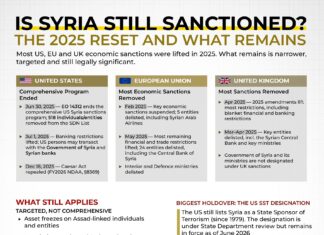
Lingering restrictions and fears from sanctions continue to present a significant obstacle. Washington still classifies Syria as a “state sponsor of terrorism,” making many European companies reluctant to pursue major investments until those classifications are removed.