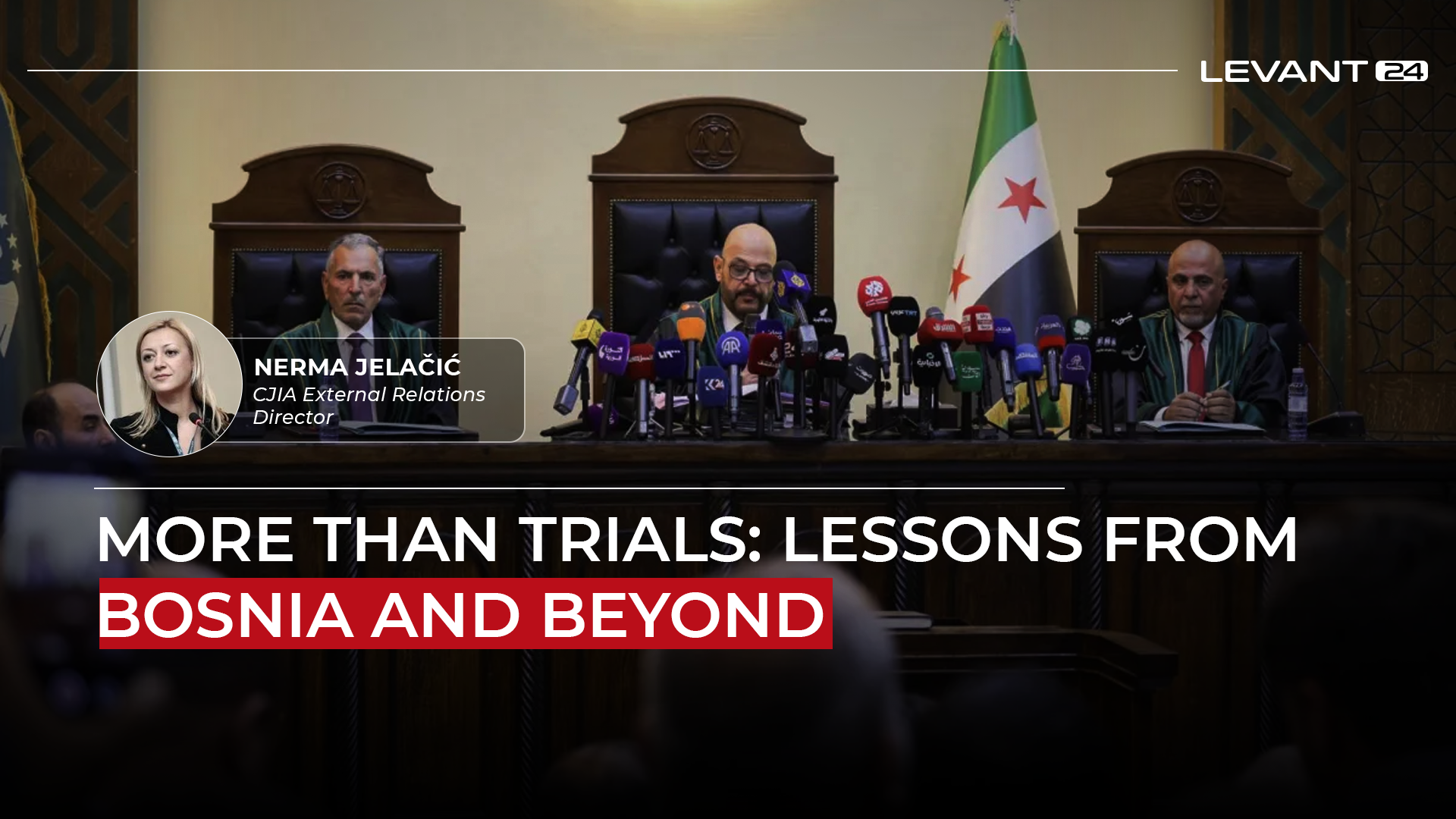
In part one of Levant24’s interview with Nerma Jelačić about Syria’s transitional justice process, veteran accountability expert Jelačić discusses the historic significance of Syria’s first public trials after decades of Assad-era impunity. Drawing on more than twenty years of experience in war crimes investigations, international justice, and post-conflict recovery, Jelačić reflects on the challenges Syria now faces as it attempts to rebuild trust in state institutions while addressing the demands of victims and survivors.
Jelačić oversees external relations and strategic development at the Commission for International Justice and Accountability (CIJA). She has worked extensively on transitional justice issues across Syria, Yemen, Iraq, Egypt, Uganda, and the Balkans. In this first installment, she explains why criminal trials alone cannot heal societies fractured by war and repression, and what lessons Syria should take from Bosnia and Rwanda as it builds its own path forward.
_______________________________
Levant24: What makes the current public trials in Syria significant, after decades of impunity under the Assad regime?
Nerma Jelačić: “It’s been decades of grievous crimes that have been committed by the Assad regime against the Syrian people. We’re not only talking about the crimes since the start of revolution in 2011, but even beforehand. So, to see the start of the first trials is a significant step, for any country.
“I was really pleased to see that the Syrian law enforcement, the Syrian authorities, were able to start such a significant case against quite a high-ranking individual in the former regime just a year and a little bit after the fall of Assad. A lot of work has to go into preparing those cases. So, I’m aware that many people, many Syrians and organizations are waiting to see what happens in the trial sessions as they start.
“They are waiting to see the judgment. And that’s all going to be told, a story that’s going to be told with time as the trial progresses. But the fact that it has started without any incidents in a very smooth way is something to be welcomed.”
Levant24: Why are trials alone not enough for transitional justice, and what else must Syria include for victims and families?
Nerma Jelačić: “Trials in any country, any post-conflict country, any country that has been ruled through a rule of force rather than the rule of law, like Syria, the justice for the people cannot be delivered only through trials.
“I come from Bosnia originally, so I started working on the war crimes in my own country that were committed in 1990s. And there is no war in a modern world that has had more trials, more individuals put on trial, both at The Hague and international courts, but also in national courts around Europe, as well as in Bosnian courts.
“There are hundreds and hundreds of people who have been tried, but all that alone was not sufficient to bring people together. Bosnia, like Syria, comes from a very complex, rich, beautiful tapestry of people, not only of religions, but of cultures and other types of beliefs. So, trials alone cannot bring the people to sit together and start trusting each other again.
“And trials alone will never be delivered with the speed with which the people need to see restitution of what has been taken away from them or the harm that they have suffered. So that’s why you need to see the other elements in place, which includes truth-telling and establishing a historical record that recognizes all aspects of the crimes and repression that have taken place.
“You need to see the reparations of the people who have suffered. People have to gain rights to the things that they have lost, that have been taken away from them unlawfully. And most importantly, people need to regain trust in the state institutions.
“You’ve had a regime that took control of a very powerful state machinery, which was most visible, for example, through the activities of the security and intelligence forces and all the torture and murder that they have committed against the Syrian people.
“And the important thing is to rebuild the institutions around the state in such a way that they can regain the trust of the people. And there’s always going to be hiccups on the road. There is no country in which you just pull out the book and say, this is the way in which you rebuild a country after the war is over.
“Each country needs to find its own path and take into consideration the experiences of others, while adapting them to what works for its own realities. In this case, that country is Syria.
“So, it’s good to see, for example, because I follow a lot of the work of different institutions there, but it’s good to see the Transitional Justice Committee visiting communities outside of Damascus in all the different governorates, communities that have been affected by different crimes and talking about their work. It’s good to see the Ministry of Justice doing similar and establishing that kind of communication.
“And we need to see more of that because you don’t build trust overnight. But I think very good first steps have been made by the Syrian people, by the Syrian authorities. I would say this is all in spite of quite a big obstacle insofar as you don’t really see much assistance being given to these institutions to do their work.
“My organization, CIJA, has been advocating throughout the past year that the time has come to shift from NGOs doing this work of building the institutions, resources, and capacity of these transitional justice bodies, to strengthening the ministries of justice and interior to do that job.
“And yes, of course, we can bring the support, we can bring the expertise, we can even bring the materials that have been collected over the years when the regime was in power. But the time is now to start putting support and effort into strengthening these institutions so that they can do their job properly.
Levant24: What lessons should Syria take from Bosnia, Rwanda, and other past transitional justice processes, and what mistakes should it avoid?
Nerma Jelačić: “I would say the first and the biggest mistake to avoid would be to rely too much on criminal justice alone. We did that, as I mentioned earlier, in the Balkans, in Bosnia. And after a while, the effect was a reverse effect because we didn’t have other things to follow on to it, to tag on other transitional justice theories.
“We had a very successful pursuit of the missing people and identification of the missing and killed people during the war in Bosnia with the help of International Commission on Missing Persons, which I think is also an institution that has been very much engaged in the work in Syria and still is. So, these are very good examples. We had brought to trial the most important architects of the war, even if it took us 16 years of hunting them down.
“And even there, some of them ran away into Russia, some of them were hiding across the borders, and people said, ‘you’ll give it up, they will never, ever be arrested.’ But they were, you know, the time came when they were arrested or they were extradited, when they were not needed anymore.
“So, in that sense, Syrians shouldn’t lose hope, even though we are aware that Bashar al-Assad is still in Russia. The important thing is to have everything in place to put him on trial if and when that becomes possible. But having said that, certainly be prepared, have a prosecutorial strategy, who are the individuals and what are the priorities in the prosecution?
“But be aware that not every single person can be brought to justice because it’s physically impossible. Bosnia is a much smaller country than Syria, and it’s estimated one in 300 people committed a crime during the war. And that would be impossible for any judicial system, even in the most developed, most resourced countries to do that number of trials.
“So, we need to find alternative ways of dealing with those. And I think that’s something that can be agreed between the institutions that have been set up, like the transitional justice committees, through the transitional justice dialogues with the communities, see what else and how else can we deal with the crimes that have been committed.
“For sure, bring some people to trial, but what else do we need to satisfy the people? We need to find the missing, the families need to know where to bury and where to pay respects to their martyred ones.
“They also need their homes, money, and other lost property to be returned or restored. Many people will need support, medical support, psychosocial support. All of these things are really, really essential.
“But in Bosnia, for example, these things were put as an afterthought for quite a while. So, you had trials for crimes where women were the victims in detention. These women were brave enough to testify, but for a decade and more after the war, they weren’t even able to get access to, or money, to buy medicine to make them feel better for what they had suffered. So, you need to have both in place, in general, in any country to start dealing with that past in an effective way.”