
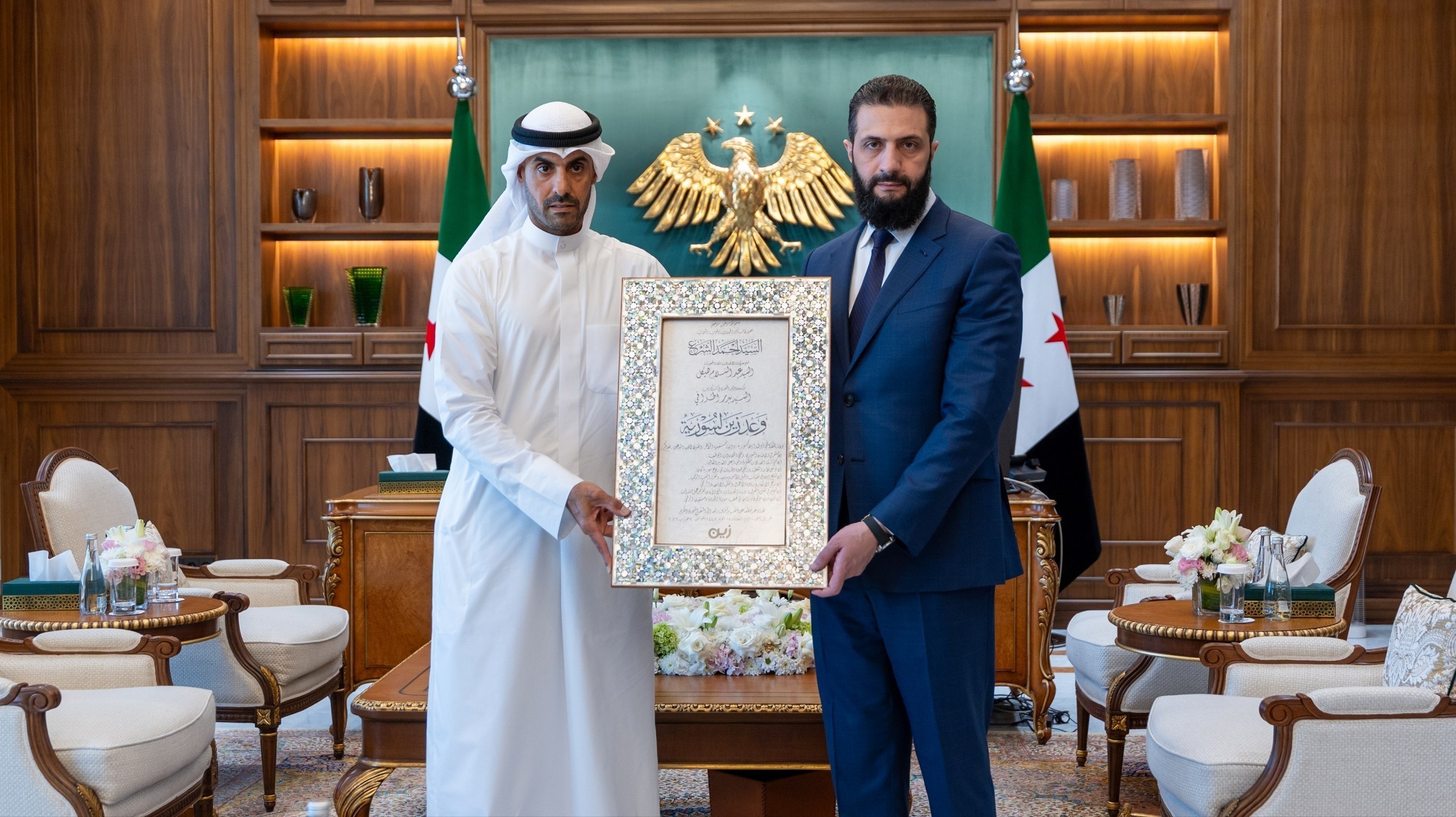
Syria’s telecommunications market is opening to major foreign investment for the first time since the fall of the Assad regime, after Kuwait’s Zain Group secured a 20-year license to operate a national mobile network.
Under the agreement, Zain will invest more than $1.5 billion and hold a 75 percent stake in the new operation, with Syria’s sovereign wealth fund retaining 25 percent. The company will take over the infrastructure of MTN Syria, the South African-owned operator that wound down its operations in 2021 and formalized its exit earlier this year.
President Ahmad al-Sharaa received Zain’s vice chairman and chief executive, Bader al-Kharafi and his delegation at the People’s Palace in Damascus, where he welcomed the agreement as a step toward modernizing the country’s digital infrastructure. Foreign Minister Asaad al-Shaibani, Communications and Information Technology Minister Abdul Salam Haykal, Investment Authority head Talal al-Hilali, and the sovereign fund’s telecom director Wasim Sabri attended.
Closing the Assad-Era Chapter
The deal is among the most significant foreign investments in post-Assad Syria and a notable vote of confidence from Gulf capital in a sector long shaped by the previous regime‘s networks of control. MTN entered Syria in 2002 under a license tied to Rami Makhlouf, a cousin of Bashar al-Assad whose business empire extended across much of the economy. After a 2019 falling-out between the two men, control of the operator passed to entities linked to the presidential palace. Zain’s entry effectively closes that chapter and resets one of Syria’s most strategic industries around an established international operator.
From Monopoly to Competition
For ordinary users, the change introduces competition into a market dominated by the state-linked incumbent Syriatel. Officials at the sovereign fund have framed the opening as a deliberate move against monopoly. Sabri said the fund sought a global operator capable of upgrading service quality and transferring expertise rather than a temporary fix, and described the entry of a serious competitor alongside Syriatel as a way to push performance and efficiency across the sector. He also said the fund had resolved the outstanding MTN file in a way that protected the company’s rights, presenting it as a signal that the new Syria intends to honor investor commitments.
The agreement follows an international tender opened earlier this year for a new 20-year mobile license, part of a broader effort to draw foreign capital into infrastructure weakened by years of war, sanctions and underinvestment. Whether it delivers the promised upgrades will depend on execution in a market still rebuilding its regulatory footing, but as a statement of intent, Syria’s return to the radar of major regional investors is now harder to dismiss.