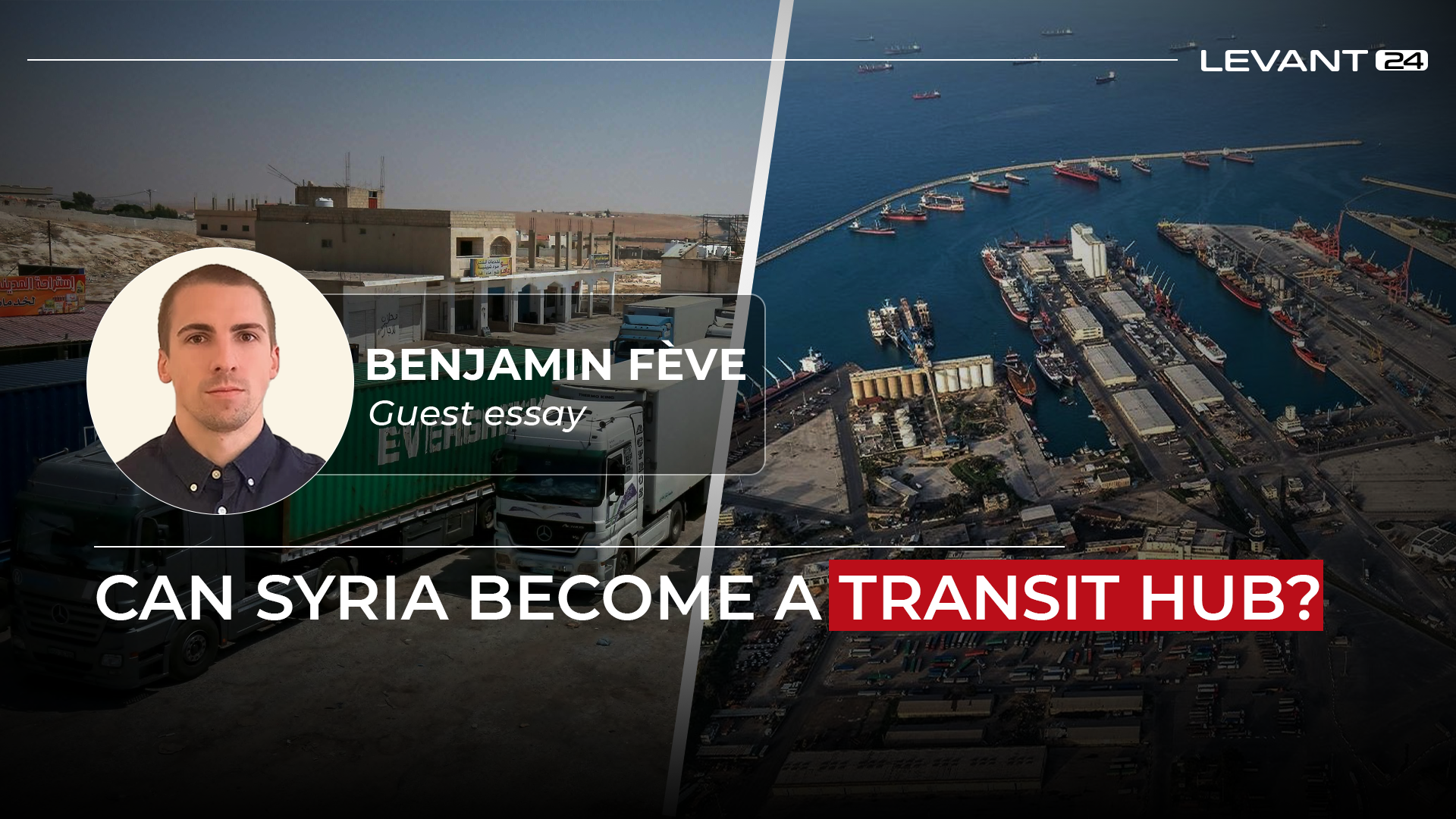
Benjamin Fève is a Syria-focused analyst whose work examines the intersection of regional politics, economic development, and international engagement. He specialized in the relationship between the EU and Syria during his Master of Research in European Studies at the University of Aix-Marseille. Fève currently serves as Senior Consultant at Karam Shaar Advisory Limited and is the founder of The Syria Dispatch, where he provides analysis on Syria’s evolving political economy and regional positioning.
In this article for Levant24, Fève explores one of the new government’s most ambitious economic narratives: the revival of Syria as a regional transit and connectivity hub. Revisiting the Assad-era Four Seas concept, he assesses whether Syria can leverage its geography to become a strategic corridor for trade, energy, logistics, and digital infrastructure. Fève posits that success depends on practicality, and Syria’s establishment of reliable infrastructure, predictable institutions, and the demonstration that key transit routes can function effectively. The piece offers a measured assessment of both the opportunities and constraints shaping Syria’s connectivity ambitions.
_______________________________
Syria is once again trying to turn geography into strategy.
Yet before becoming a full-fledged transit hub, the strongest case for Syria’s transit ambitions rests on redundancy. In a region where maritime chokepoints, war risk, insurance costs, and political disruption have made alternative routes more valuable, and given its position, Syria does not need to prove that it can become the region’s next great hub overnight. First, it needs to show that selected routes through its territory can work.
That makes recovery the starting point. Rebuilding ports, roads, border crossings, electricity links, pipelines, and telecommunications networks is not separate from Syria’s transit ambition. It is the condition for it. If these systems become safer, cheaper, and more predictable, Syria could gradually position itself as a supplementary corridor for trade, energy, logistics, and data. Hub status, if it comes, would not emerge from geography alone.
Syria cannot replace the Suez Canal, the Strait of Hormuz, or Bab al-Mandab. Nor can it assume that it will simply displace Israel-linked routes in Western and Gulf connectivity planning. Its value lies elsewhere: offering additional options in a region where redundancy has become strategically important. The more Syria rebuilds the infrastructure it needs for its own recovery, the more it may organically become useful to others.
An Old Idea, New Conditions
Such a vision is not new. In the late 2000s, deposed dictator Bashar al-Assad promoted a “Four Seas” vision that sought to turn Syria into a regional intersection for investment, transport, and energy linking the Mediterranean, the Gulf, the Caspian, and the Black Sea. At the time, the concept was tied to Syria’s rapprochement with Turkey and its attempt to escape isolation through infrastructure and regional connectivity. War, sanctions, institutional collapse, and political isolation threw that idea into the abyss.
Today, Damascus is trying to revive this idea under new political conditions: Syria as an economic transit hub. President Ahmad al-Sharaa has already made that pitch abroad. At the Antalya Diplomacy Forum in April, and later at an informal summit with European leaders in Cyprus, he presented the “Four Seas” and “Nine Corridors” initiative, a vision for linking the Gulf, the Mediterranean, the Caspian, and the Black Sea through Syrian territory.
Syrian diplomats in Washington are also carrying the message. Muhammad Qanatari, chargé d’affaires in Washington, recently said Syria was entering a new phase of positive relations with Iraq, focused on bilateral cooperation and regional economic connectivity. He framed Syria’s geography as a permanent strategic asset, placing the country at the intersection of the Caspian Sea, the Mediterranean, the Persian Gulf, and the Black Sea. Crucially, he also described the initiative not as a replacement for existing trade routes, but as an alternative framework to strengthen connectivity through energy networks, electricity grids, railways, and communications links.
This should be the core of Syria’s strategy: prove that specific corridors can work before claiming hub status. That is already beginning to happen through reconstruction itself.
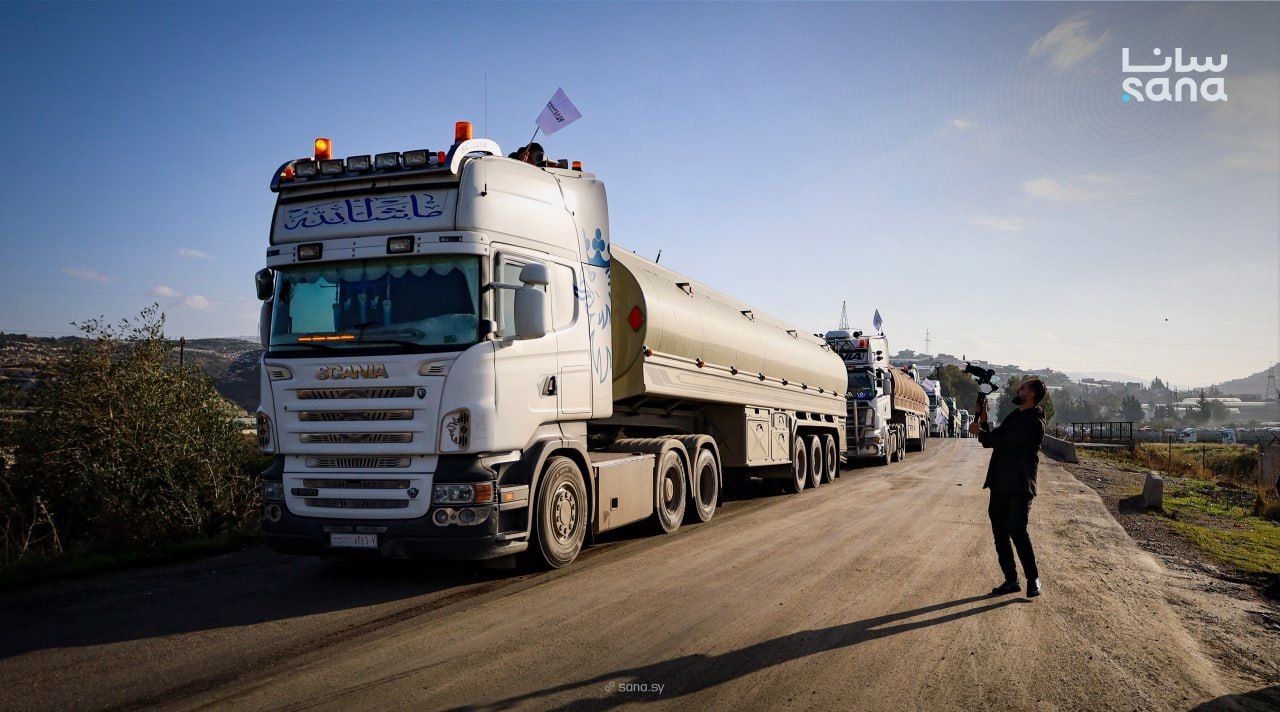
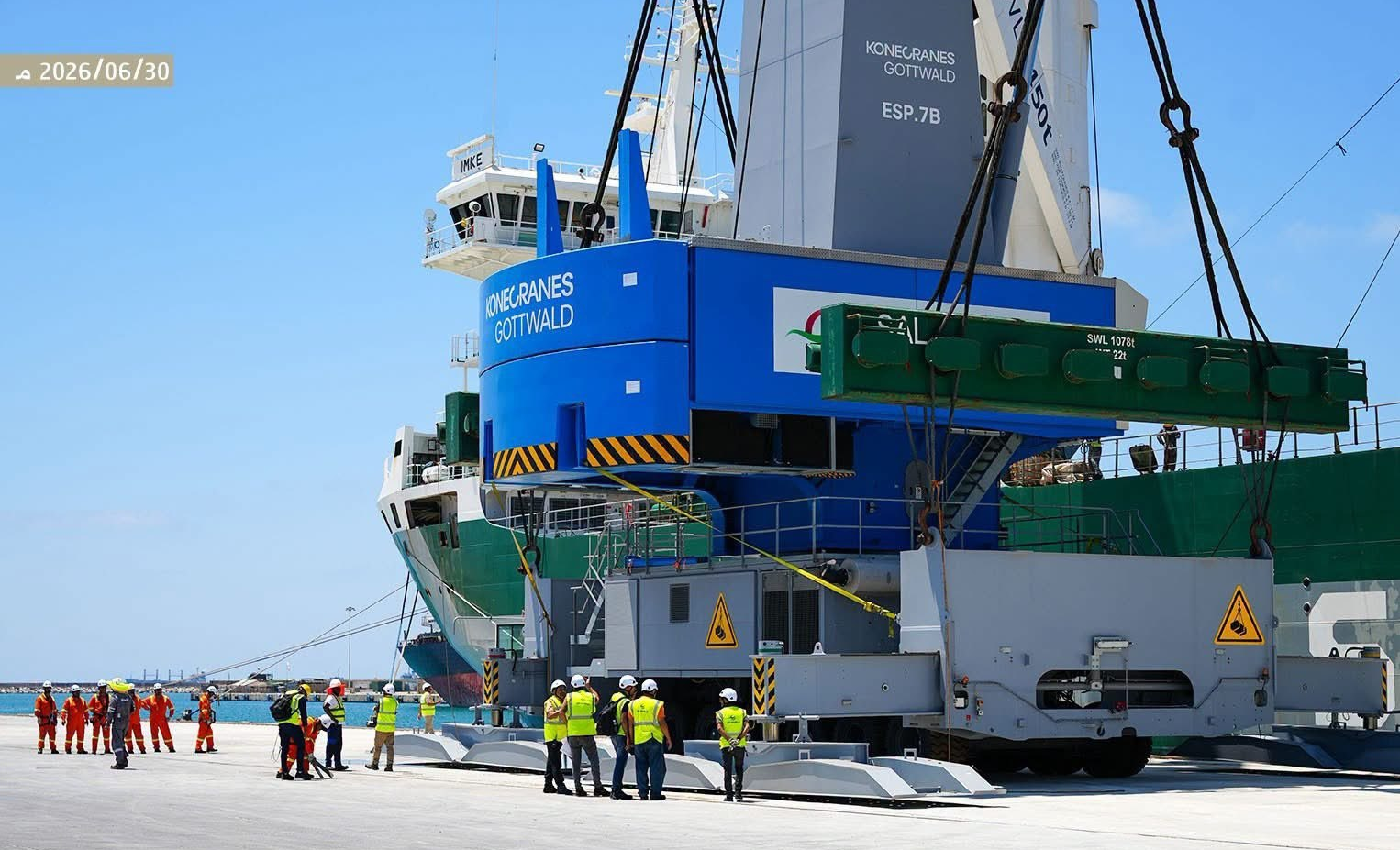
In transport, Syria, Jordan, and Turkey have moved to strengthen north-south connectivity toward the Gulf. In logistics, CMA CGM’s Latakia port agreement and dry port plans for Adra and Aleppo, alongside DP World’s Tartous project, point toward better links between seaports and inland markets. Iraq is also testing Syria’s redundancy potential through the reopened Rabia-Yarubiyah crossing, fuel oil trucking, and discussions over the Kirkuk-Baniyas pipeline. In telecommunications, SilkLink could position Syria as a future digital corridor.
None of this makes Syria a hub yet. But it shows how rebuilding the systems Syria needs for itself could gradually make the country useful to others.
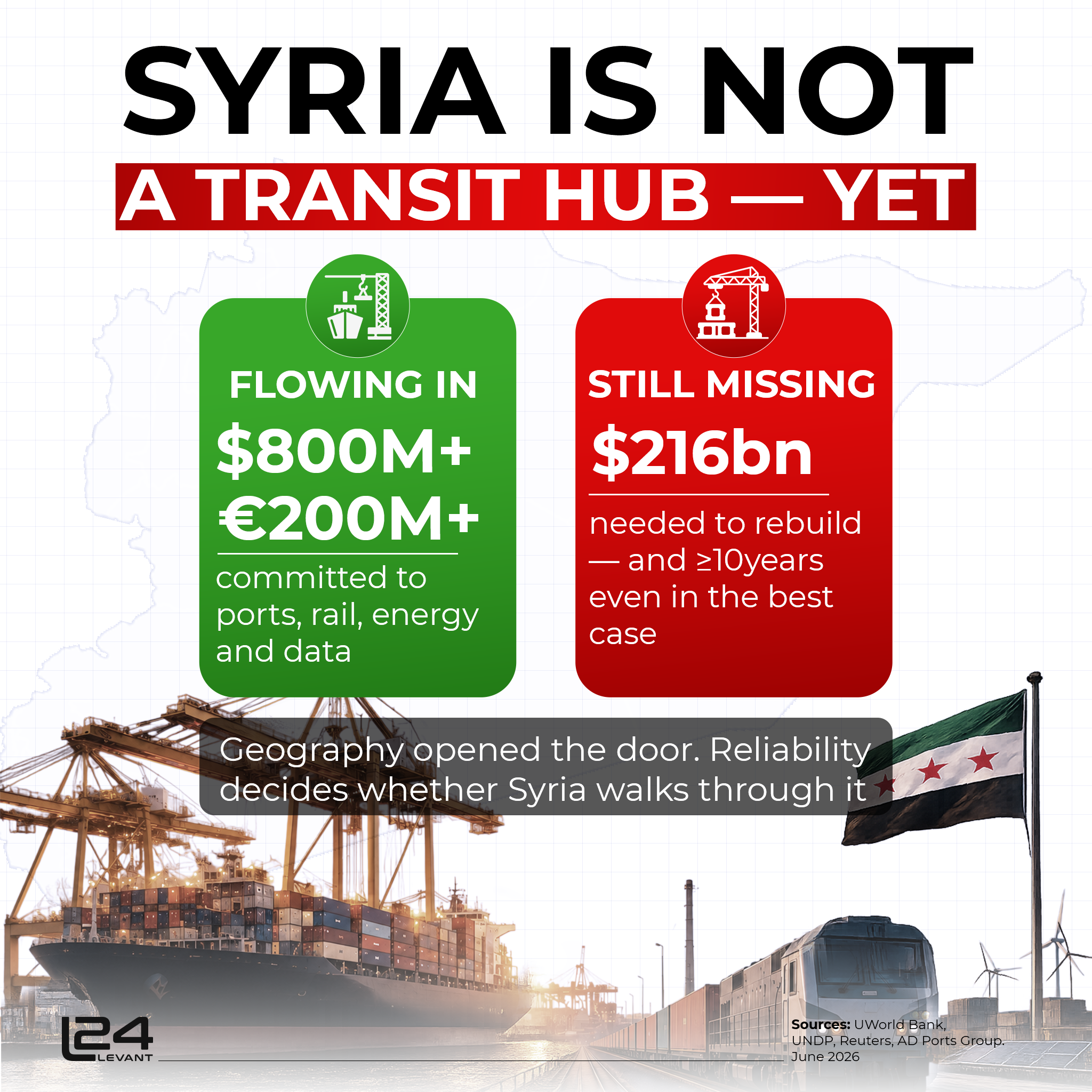
Through recovery rather than grand design, Syria is already moving toward a transit role. Gas, ports, dry ports, oil trucking, and telecom investment all respond first to Syria’s own reconstruction needs. If those systems become reliable, regional actors will have more reason to use them too. That is why the path to hub status starts at home. Syria’s long-term role cannot depend only on crisis conditions or disrupted maritime routes. It has to become commercially useful in normal times, not merely strategically useful when other corridors are under pressure.
The Reliability Test
Still, while the direction of travel is encouraging, the path is fraught with challenges, with the main constraint being reliability at all levels. Physical reliability remains weak: much of the transport network still needs repair, from railways and roads to border facilities and port connections. Legal and operational reliability is also incomplete: customs rules, transit fees, dispute settlement, banking channels, insurance, and security guarantees also remain unclear or incomplete. For traders, logistics firms, and energy companies, a route is only useful if it is predictable.
Politics will be just as important as infrastructure. Turkey may benefit from faster access to Jordan and the Gulf. Iraq may want another route to the Mediterranean. Gulf states may want alternatives to vulnerable maritime chokepoints. Europe may value more resilient trade, energy, and data routes. But shared interests do not automatically create shared guarantees, and spoilers could easily interfere.
Israel is the clearest complication. A Syrian route can be drawn on a map as an alternative or supplement to other east-west connectivity projects, including the India-Middle East-Europe Economic Corridor. The original IMEC logic relied heavily on a route through the Gulf, Jordan, Israel, and Europe. Still, recent analysis has already raised the need for alternative or wartime redesigns of the corridor. But that does not mean it would be politically accepted. Israel would likely view any project that strengthens the Syrian state, deepens Syria’s ties with Turkey and the Gulf, and turns Syrian territory into strategic infrastructure through a security lens.
Other spoilers could come from Syria’s own partners. Gulf engagement is positive, but it is not automatically stabilizing. Saudi Arabia, the United Arab Emirates, and Qatar are all expanding their portfolios in Syria, with their approaches well-defined and sometimes conflicting, particularly regarding reconstruction, governance, and regional alignment. Competition between Gulf capitals could bring money and political attention, but it could also reproduce rival networks of influence inside Syria if investments become tied to competing interests.
The U.S. track is more encouraging, but it also raises a durability question. Under President Donald Trump, the direction of travel is clearly positive, with Washington doing all it can to support the Syrian transition. But long-term infrastructure investors will still ask whether this policy survives the next U.S. political cycle. A corridor that depends on U.S. political cover cannot be built only on today’s White House position.
At the end of the day, Syria’s transit ambitions should be measured by reliability above anything else. The Four Seas framework can help attract investment and situate Syria’s recovery within a broader regional logic, but only if it is tied to implementation, which is still lacking today. Let us first make Syria usable: open borders, predictable customs, functioning ports and dry ports, clearer investment rules, workable banking channels, and security arrangements that lower risk before declaring it a hub.
If Syria gets this right, its role as a corridor can emerge from reconstruction itself. Ports rebuilt for Syrian trade can serve neighboring markets; energy links restored for Syrian households can connect to wider networks; digital infrastructure upgraded for Syria’s economy can eventually carry regional data. Geography gives Syria an opening, but it does not move goods, finance projects, or keep routes open. Redundancy only matters if the backup route works. For Syria, the path to becoming a transit hub begins with focusing on itself.