
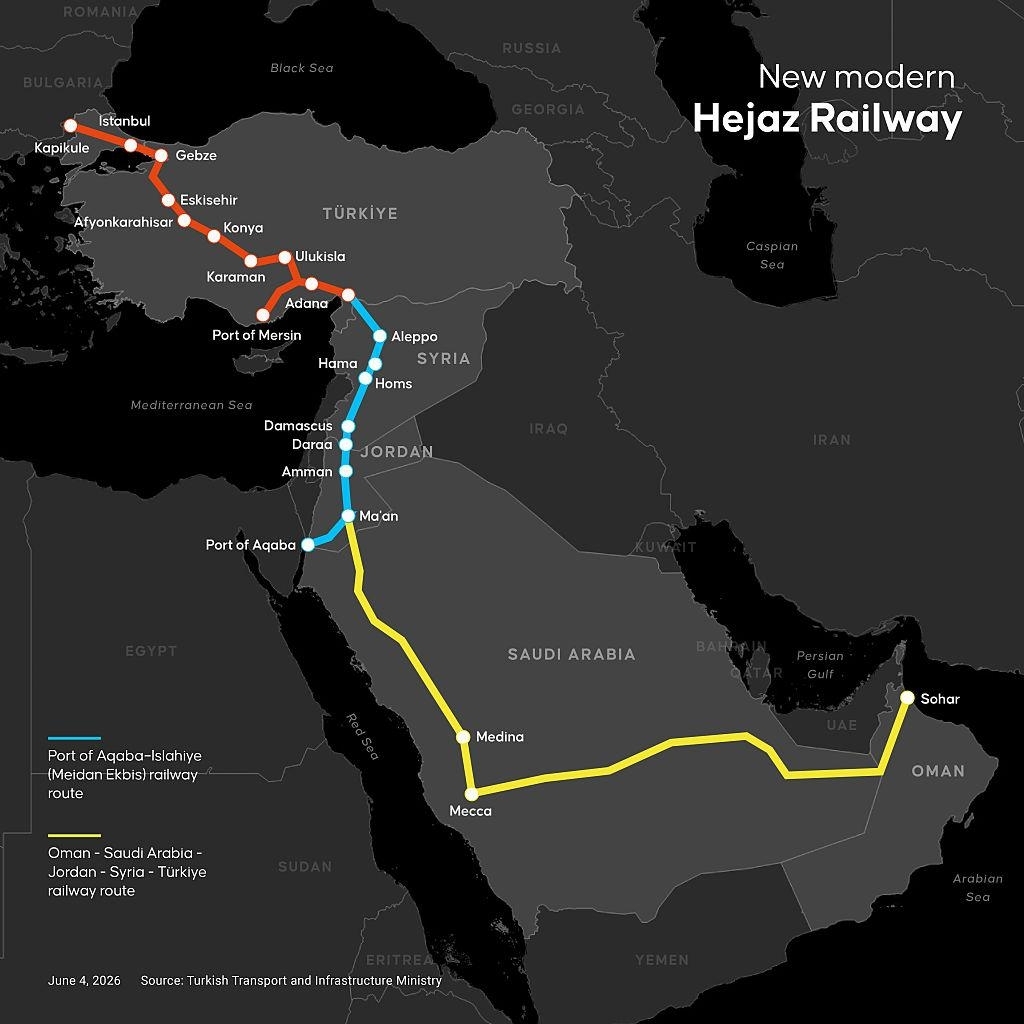
The Middle East is witnessing rapid developments in transportation and trade infrastructure as countries seek safer and more stable alternatives to maritime routes which face growing security risks. In this context, Israel’s Yedioth Ahronoth newspaper reported on a Turkish-Saudi initiative to establish a land corridor linking the Gulf states with Europe through Syria and Jordan before reaching Turkey. According to the newspaper, the project would directly compete with the India-Middle East-Europe Economic Corridor (IMEC), a route that Israel strongly supports.
Alternative Route Connects Gulf Markets to Europe
The proposed project centers on the development of an integrated transportation and logistics network allowing goods to move from the Gulf region to Europe through Syria, Jordan and Turkey. The route would bypass Israeli territory and eliminate reliance on the Port of Haifa, a key component of the competing corridor promoted by Israel.
Interest in the project has increased as global trade faces mounting challenges along traditional maritime routes, particularly through the Strait of Hormuz and the Bab al-Mandab Strait. Repeated security threats and regional conflicts have encouraged governments to explore alternative land-based networks that can maintain supply chain stability while reducing exposure to disruptions at sea.
The initiative gained additional momentum in June 2026 when Turkish Minister of Transport and Infrastructure Abdulqadir Uraloğlu and Saudi Minister of Transport and Logistic Services Saleh al-Jasser signed two memoranda of understanding covering railway and logistics cooperation during a meeting in Riyadh.
Hejaz Railway Revival at the Center of Plans
One of the project’s most significant components involves reviving sections of the historic Hejaz Railway, which the Ottoman Empire built between 1900 and 1908 to connect Damascus and Medina. At the time, the railway ranked among the region’s most important infrastructure projects, facilitating the movement of pilgrims while strengthening economic and political ties.
Today, participating countries seek to modernize that legacy and transform it into a contemporary trade corridor linking the Gulf region with Turkey and, ultimately, Europe. As part of this effort, Syria aims to position itself as a regional logistics hub by capitalizing on its strategic geographic location and a series of transportation and railway agreements signed recently with Turkey and Jordan.
Regional Competition and Strategic Stakes
Israeli interest in the IMEC project reflects concerns about its potential impact on regional trade patterns. If successful, the corridor could reduce the importance of routes passing through Israel, weakening its political and economic influence as a major gateway connecting Asian and European markets.
For Turkey, the initiative carries significant geopolitical and economic value. Ankara seeks to strengthen its position as a logistics hub linking Asia, Europe and the Middle East while also reducing transportation costs and accelerating the movement of goods between Arab and European markets.
As challenges affecting traditional maritime trade routes continue, competition among regional connectivity projects is likely to intensify. The growing rivalry reflects a broader effort to reshape trade networks and define the future economic and strategic roles of countries across the region.