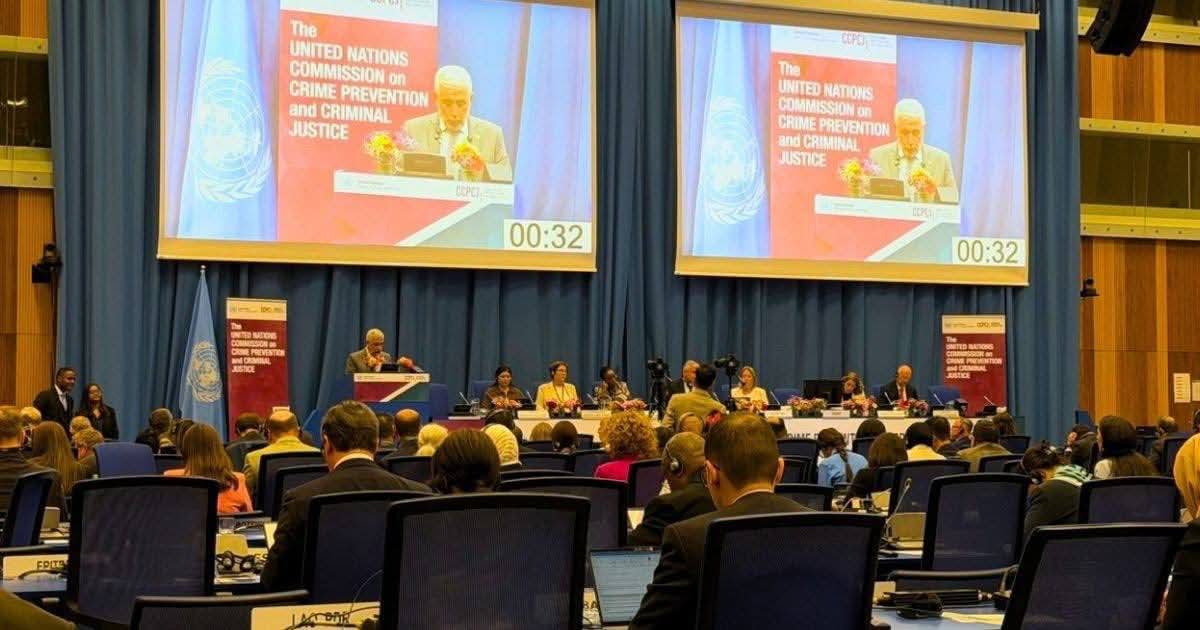
 Syria participated in the 35th session of the Commission on Crime Prevention and Criminal Justice (CCPCJ), with a delegation led by Deputy Minister of Justice Mustafa al-Qasim attending meetings at the UN headquarters in Vienna, Austria.
Commitment to Judicial Reform
During his address to the commission, Qasim said Syria is entering a new phase focused on rebuilding state institutions and strengthening the principles of justice, accountability and the rule of law. He reaffirmed Syria’s support for the commission’s work and announced the delegation’s endorsement of the Asia-Pacific Group statement, as well as a joint statement addressing Islamophobia. The participation comes as Syria seeks to expand international cooperation and exchange expertise in criminal and transitional justice during the post-liberation period.
Qasim said the justice system experienced a severe decline during the rule of the deposed Assad regime, accompanied by widespread human rights violations and serious crimes. He cited torture, extrajudicial killings, arbitrary detention and enforced disappearances among the abuses committed during that period.
According to Qasim, those violations weakened judicial institutions and fostered an environment characterized by impunity, fear and social division. He stated that Syria is now working to strengthen the judiciary and law enforcement institutions through a legal framework designed to protect public rights and freedoms.
He added that ongoing reforms include restructuring judicial institutions, increasing judicial independence, abolishing exceptional courts and reinforcing transparency, public hearings and the right to legal defense.
Transitional Justice and International Cooperation
Qasim emphasized the government continues efforts uncovering the truth, holding perpetrators accountable and delivering justice to victims through both criminal and transitional justice mechanisms. He said these measures support national unity, civil peace and societal reconciliation. He also stressed effective crime prevention and long-term stability depend on stronger international cooperation.
Qasim called for greater collaboration in the exchange of information, expertise and technical resources, while highlighting the importance of cooperation with INTERPOL in pursuing individuals wanted for cross-border crimes. In addition, he urged the development of mechanisms to recover looted assets and funds, describing such efforts as an important component of broader justice initiatives.
Role of the UN Commission
Concluding his remarks, Qasim said building justice is a shared national and international responsibility that requires sustained commitment to the rule of law, human dignity and constructive cooperation.
The 35th session of the CCPCJ will continue through June 5. The commission serves as the UN’s principal policymaking body on crime prevention and criminal justice. Established in 1992 by the UN Economic and Social Council at the request of the General Assembly, it operates as one of ECOSOC’s functional commissions and is headquartered in Vienna.