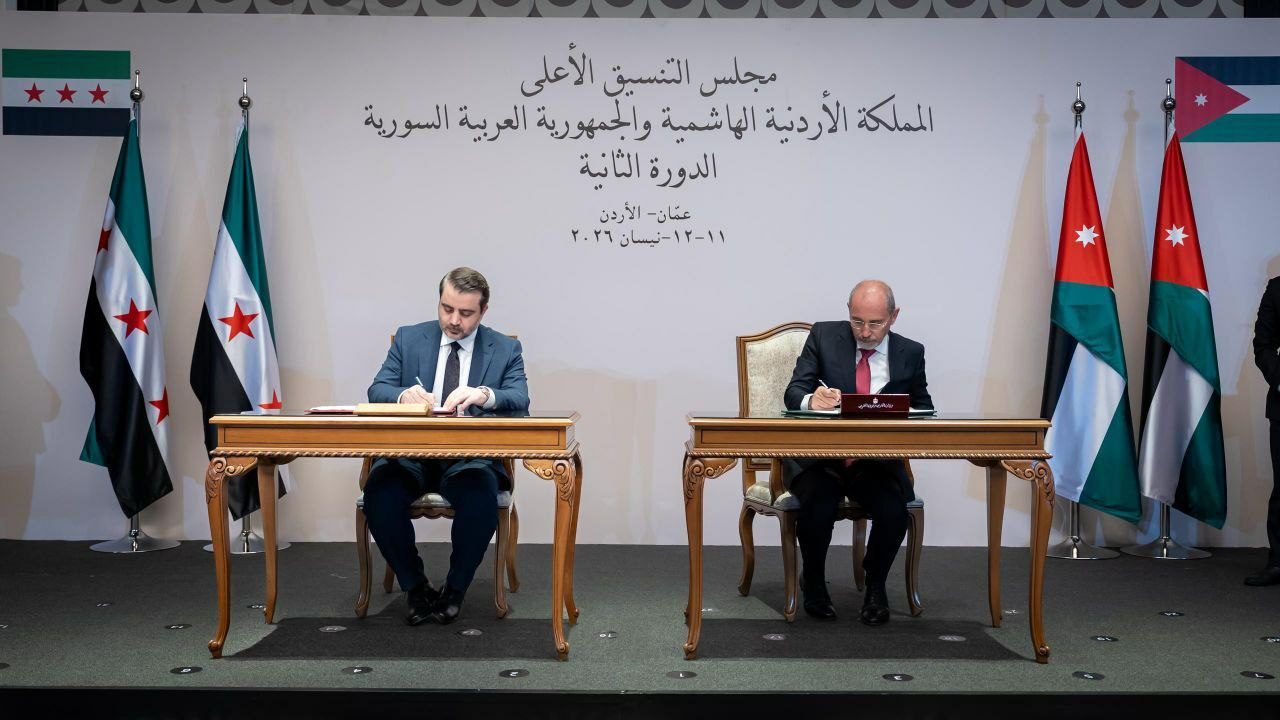
 Syria and Jordan opened a new chapter in bilateral relations during the second session of the Syrian-Jordanian Higher Coordination Council in Amman. The meeting, co-chaired by Syrian Foreign Minister Asaad al-Shaibani and Jordanian Deputy Prime Minister and Foreign Minister Ayman Safadi, brought together over 30 ministers from both countries, making it one of the largest official bilateral gatherings in their shared history.
The session concluded with the signing of nine agreements and memorandums of understanding spanning key sectors. The deals covered industry and trade, health, social affairs, religious endowments, higher education, justice, media, tourism, postal services, and electronic payments. The breadth of the agreements underscored a coordinated effort to move cooperation beyond diplomacy and into institutional frameworks.
Border Access and Infrastructure Plans Advance
The talks also produced several practical measures designed to strengthen economic and logistical ties. A new reciprocal import mechanism is set to take effect April 10, 2026, while the Nassib-Jaber crossing has been upgraded to meet international border standards, a move expected to streamline trade and travel.
In addition, Syria and Jordan, alongside Turkey, established a trilateral memorandum of understanding to activate land corridors linking regional markets. Officials also discussed reviving the Hijaz Railway, restarting the Arab Gas Pipeline, and developing electricity interconnection projects, all of which could improve regional transit and energy cooperation.
Water infrastructure also remained high on the agenda, particularly plans involving the Yarmouk basin. In social sectors, the two countries agreed that 40 Syrian cancer patients will receive treatment in Jordan each year, while academic scholarship exchanges are set to expand.
Political Alignment on Security and Regional Stability
Shaibani described Jordan as one of the first countries to engage with Syria after the political changes of December 2024, saying stability in one country directly reinforces the other. He said the council now serves as a central mechanism for organizing cooperation across government institutions.
Safadi called the meeting a historic milestone that reflects the political direction of King Abdullah II and Ahmad al-Sharaa, turning longstanding ties into structured state action. Shaibani added that Jordan remains Syria’s gateway to the Gulf and Red Sea, while Syria provides Jordan with access to Turkey and Europe.
Security coordination featured prominently in the discussions, with both sides emphasizing stronger military and intelligence cooperation to combat drug and weapons smuggling networks. Officials also reaffirmed the importance of implementing the roadmap for Suwayda and southern Syria as part of wider efforts to preserve stability.
Reconstruction Shapes the Next Phase
Reconstruction emerged as the defining long-term priority. Shaibani said rebuilding Syria after the fall of the former regime remains the country’s greatest challenge and requires close coordination with regional and international partners, including Jordan, Turkey, Saudi Arabia, and the European Union.
He also said preparations are underway again for an international donor conference after earlier delays, with Syria seeking to use its geographic position to attract investment and support regional connectivity. The council’s latest outcomes suggest both countries are moving toward a more structured and pragmatic partnership centered on recovery, infrastructure, and regional security.