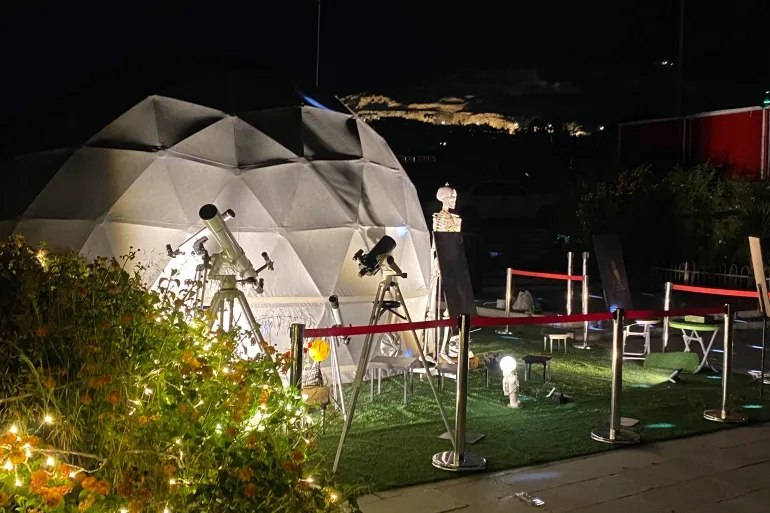
 A distinctive youth-led initiative is capturing attention across Damascus as the “Knowledge Dome” travels through the city’s neighborhoods, offering residents an immersive journey into space. More than a mobile cinema, the project introduces children and adults to astronomy through interactive visual experiences rarely available in Syria.
The initiative was founded by Syrian entrepreneur Saeed al-Khouli, who recently returned to the country after spending years abroad. Inspired by educational projects he encountered overseas, Khouli sought to bring a similar experience to Damascus, creating an opportunity for young people to engage with science through modern technology.
At the center of the project is a portable dome theater equipped with advanced projection systems capable of displaying 360-degree visual presentations. Visitors entering the dome are surrounded by images of planets, stars and distant galaxies, creating the sensation of traveling through outer space without leaving the ground.
Speaking to Syria Now, Khouli said he chose Damascus as the starting point because he wanted the initiative to serve as a message of creativity and hope. He described the project as a way to encourage curiosity and inspire children to explore the world around them.
Making Science More Accessible
The Knowledge Dome focuses primarily on astronomy and space science, presenting educational content through an engaging visual format. Organizers hope the experience will help bridge gaps in traditional learning environments, where access to interactive educational tools remains limited.
By combining education and entertainment, the initiative offers children a different way to learn about scientific subjects that can often seem distant or difficult to understand. The immersive format allows visitors to experience concepts visually rather than relying solely on textbooks or classroom instruction.
The project attracted interest from families looking for educational activities which encourage learning while keeping children engaged. Organizers believe the approach can help foster a stronger interest in science and discovery among younger audiences.
Challenges and Future Expansion
Despite the positive response, the initiative faces several obstacles. One of the most significant challenges is obtaining films and educational content compatible with 360-degree projection technology. Because few companies in the region produce this specialized material, organizers often depend on costly international sources and complex import arrangements.
Even with these difficulties, the team plans to expand beyond the capital. Khouli said preparations are underway to bring the Knowledge Dome to other Syrian provinces in the coming months, allowing children in areas outside major urban centers to experience the program.
The project’s first presentations have received positive feedback from visitors. One participant told a Syria Now correspondent watching planets and celestial objects alongside family members created a memorable experience that felt remarkably realistic.
Many visitors also highlighted the broader value of educational entertainment. They noted interactive activities centered on science and exploration can provide meaningful alternatives to excessive screen time while helping children develop curiosity and critical thinking skills.
As the Knowledge Dome continues its journey across Syria, organizers hope it will demonstrate how innovative educational projects can open new horizons for young people and make scientific discovery more accessible to communities throughout the country.