
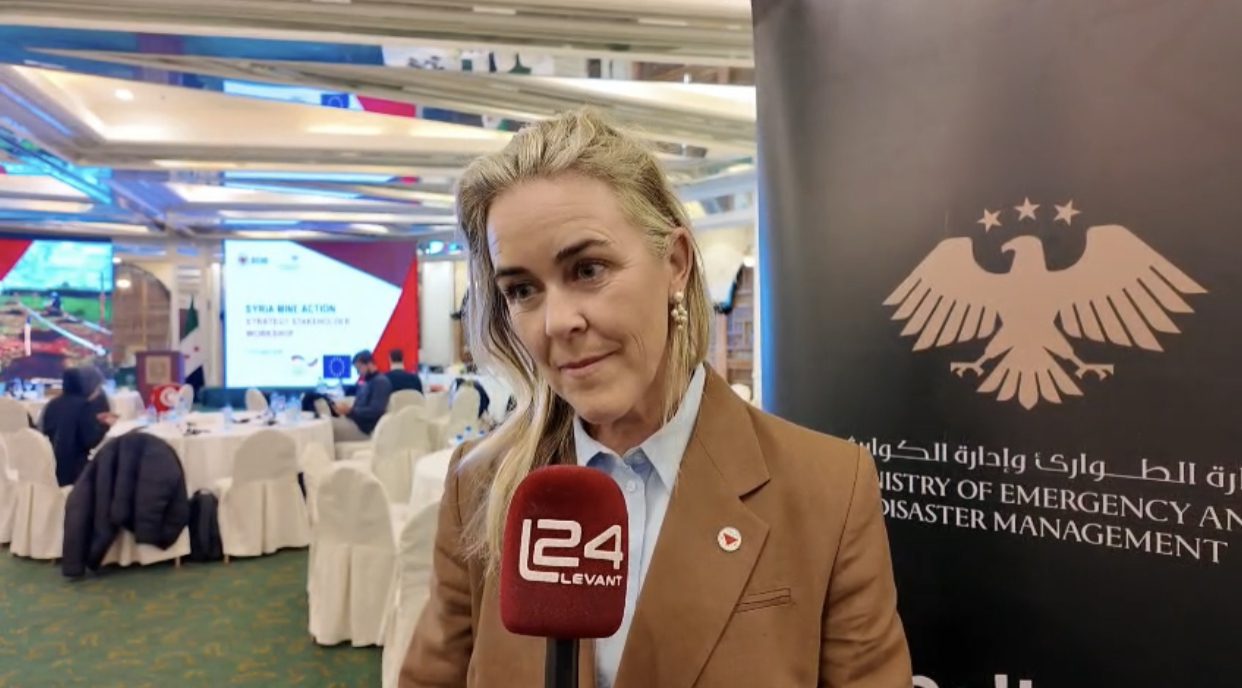
The National Mine Action Center (NMAC), in collaboration with the Geneva International Centre for Humanitarian Demining, opened a three-day workshop Monday in Damascus focused on strengthening Syria’s mine action strategy.
The workshop brings together national and international partners to discuss a strategic framework for addressing landmines and explosive ordnance. Efforts aim to improve community safety while supporting the country’s broader recovery and reconstruction process.
Participants are reviewing Syria’s mine action landscape, including strategic planning for clearance operations, best practices, information management for contaminated areas and public risk awareness related to unexploded ordnance. Discussions are designed to help shape a realistic national plan implementable across sectors and regions.
Farmland and Recovery Efforts at Risk
Emergency and Disaster Management Minister Raed al-Saleh said landmines and war remnants remain the main obstacle to launching recovery and investment projects across Syria. He noted contamination extends across much of the country, making response efforts more difficult due to the wide range of explosive devices and lack of precise maps and statistics.
Saleh said over 60% of Syria’s agricultural land remains unusable because of mine-related threats, resulting in direct economic and humanitarian consequences. He added current demining efforts remain limited and progress has been modest relative to the scale of contamination.
He called for a comprehensive national strategy prioritizing residential areas, farmland and forests, alongside a clear implementation roadmap capable of delivering measurable progress in 2026 and 2027. At minimum, he said, the strategy should establish basic safety conditions in the most affected areas.
International Support and National Priorities
Speaking to Levant24, Asa Massleberg, program manager and senior strategic planning adviser at the Geneva center, emphasized ongoing cooperation with Syrian authorities and international partners to develop a practical and actionable plan.
Massleberg said mine clearance remains essential for the safe return of internally displaced people and refugees, linking demining directly to rehabilitation and reconstruction efforts. She maintains international expertise is most effective when aligned with Syria’s national priorities and operational realities.
Coordinating Across Provinces and Ministries
NMAC Director Fadi al-Saleh told Levant24 the workshop is intended to launch a participatory process drawing on the expertise of all relevant stakeholders while ensuring the final strategy remains feasible and nationally grounded.
He stressed the importance of forming teams in every Syrian province supporting surveying, clearance, risk education and victim assistance. He also said contamination continues to block progress in agriculture, infrastructure and the return of displaced communities.
For that reason, he called for closer coordination with the ministries of agriculture, energy, environment and defense. As Syria moves from emergency response toward reconstruction, officials say a unified national approach to mine action will be critical to creating a safer environment for long-term recovery.