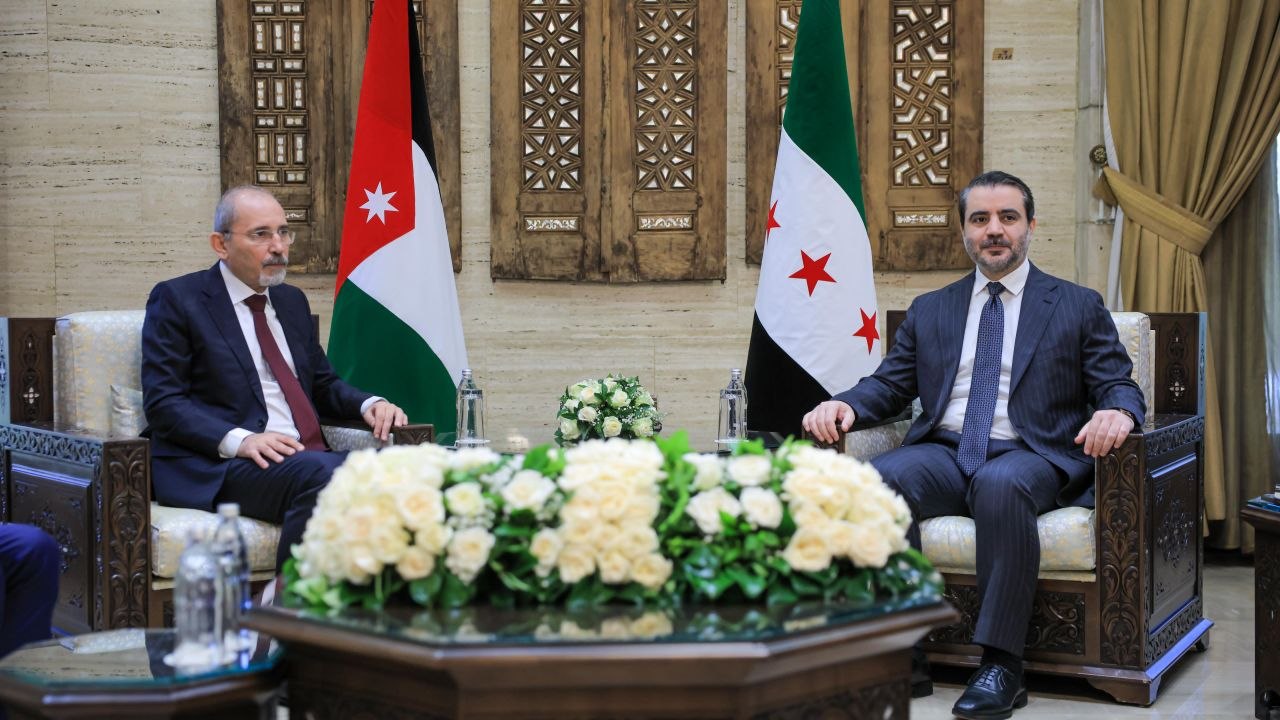
 Syrian Foreign Minister Asaad al-Shaibani met in Damascus with a high-level Jordanian delegation led by Deputy Prime Minister and Foreign Minister Ayman Safadi. The discussions focused on the outcomes of the second session of the Syrian-Jordanian Supreme Coordination Council, held in Amman on April 12.
A joint statement issued after the meeting said both ministers welcomed the continued development of Syrian-Jordanian relations. They reaffirmed their commitment to expanding coordination and cooperation across multiple sectors, emphasizing mutual benefit and the strong fraternal ties between the two countries.
On the economic front, both sides stressed the importance of continued cooperation between relevant ministries to achieve greater integration while addressing existing obstacles. The Syrian side welcomed Jordan’s decision to resume imports from Syria and implement the new trade mechanism beginning May 1, in accordance with agreements reached during the council’s second session.
The ministers also reviewed progress in air, land, maritime, and rail transport. They discussed measures facilitating truck movement between and through both countries and agreed on practical steps to strengthen bilateral and transit trade. In the water sector, both sides examined the outcomes of the third meeting of the Joint Water Committee, which took place in Amman following the council session.
They emphasized the importance of implementing the committee’s recommendations and ensuring equitable water distribution. The ministers also welcomed the activation of the Syrian-Jordanian joint water platform and the launch of studies related to the development of the Yarmouk Basin.
Regional Stability and Bilateral Engagement
Shaibani and Safadi later held expanded talks on bilateral relations, regional developments, and efforts to promote security and stability. Their discussions covered consultation mechanisms between the two foreign ministries, cooperation on strategic projects, institutional development, capacity building, training, international cooperation, energy, health, and investment.
The two sides agreed to hold the third session of the Syrian-Jordanian Supreme Coordination Council in Damascus in October. Shaibani praised Jordan’s supportive position regarding Syria’s reconstruction efforts. Safadi, in turn, reaffirmed Jordan’s support for Syria’s recovery on foundations that preserve its unity, security, stability, sovereignty, territorial integrity, and the rights of its people.
The ministers also stressed the importance of fully implementing the Suwayda roadmap and stabilizing southern Syria. In addition, they condemned repeated Israeli incursions and attacks on Syrian territory, describing them as violations of international law, Syrian sovereignty, and the 1974 Disengagement Agreement.
New Framework for Air Connectivity
The visit also included the signing of a new agreement aimed at enhancing air transport services and expanding air connectivity between Syria and Jordan. Omar al-Hasari, head of the General Authority for Civil Aviation and Air Transport, said the agreement updates the original 1976 accord. He explained that it seeks to increase competitiveness among airlines, allow additional carriers to operate routes between the two countries, and regulate code-sharing arrangements.
Hasari added the agreement provides for enhanced technical and navigational coordination between the area control centers in Damascus and Amman. He said the measures will improve air traffic flow and operational efficiency while maintaining aviation safety standards and compliance with the Chicago Convention on International Civil Aviation.