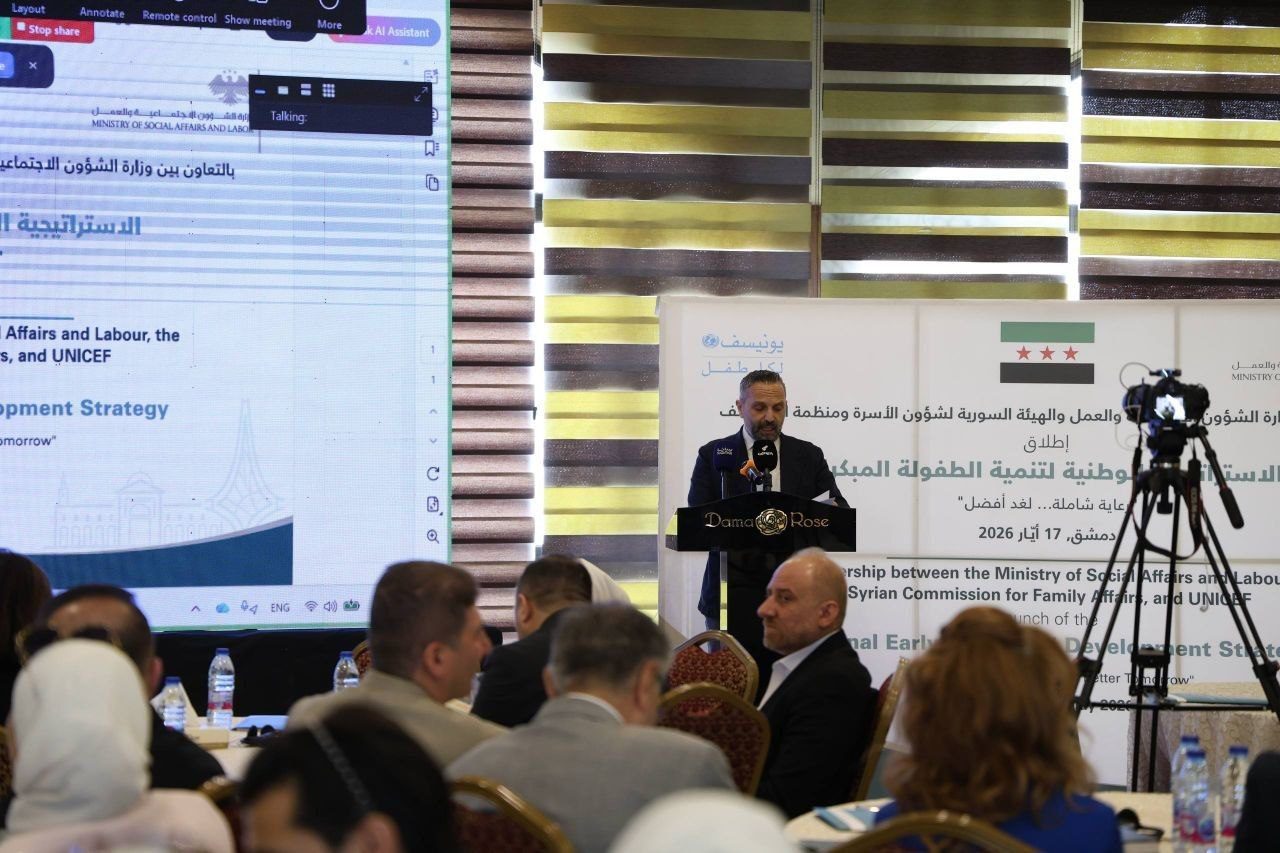
The Ministry of Social Affairs and Labor, the Syrian Commission for Family and Population Affairs, and the UNICEF launched Syria’s National Strategy for Early Childhood Development for 2026 to 2030, outlining a national framework aimed at improving conditions for children during their formative years.
The launch event included a presentation introducing the strategy, a documentary focused on childhood in Syria and a panel discussion featuring officials and specialists. Participants stressed the need for clear and carefully planned policies to protect children, particularly those with disabilities, while emphasizing cooperation among government institutions, private organizations and local communities.
Focus on Access and Inclusion
The strategy targets children from birth to age 8 through comprehensive interventions intended to coordinate efforts between governmental and nongovernmental institutions. Officials said the framework is built around principles including equitable access to services, inclusivity for children with disabilities, sustainability and data-driven policymaking.
The plan also prioritizes empowering families and caregivers while improving the quality of services related to education, health and child protection. Bahjat Hajjar, a representative of the Ministry of Social Affairs and Labor, said the strategy reflects Syria’s commitment to investing in early childhood development as the stage plays a central role in shaping children’s cognitive, psychological, social and physical growth.
He cited figures showing that 5.5% of children under age 5 in Syria suffer from acute malnutrition, while 17.3% experience stunting. He also noted that school dropout rates in basic education exceed 30% in some provinces.
Hajjar said the strategy aims to support a more equitable future by ensuring children have access to safety, education and opportunities. He added the framework includes measurable indicators and coordination mechanisms across sectors covering nutrition, health care, education and social protection.
Strategy Based on Research and Cooperation
Zainab Adam, UNICEF deputy representative in Syria, described early childhood development and education as an urgent necessity rather than a long-term option. She said the launch represents a collective commitment to improving conditions for Syrian children, especially vulnerable groups and children with disabilities.
According to Adams the strategy adopts an integrated approach combining nutrition, health care, early learning, social protection, water and sanitation services while also supporting families and local communities.
Haifa Ismail, head of the Syrian Commission for Family and Population Affairs, told SANA the strategy was developed through cooperation among the ministry, the commission and UNICEF, with contributions from relevant ministries, NGOs and community representatives. She said the framework was shaped through studies and assessments of current conditions in Syria and is intended to serve as a binding national reference for future implementation.
According to Ismail, the strategy focuses on strengthening families, improving caregiver training, updating legislation related to early childhood and expanding community partnerships. She said those efforts support long-term investment in children and contribute to sustainable development.
The Ministry of Social Affairs and Labor has also continued work on broader sector reforms. In March of last year, the ministry launched its 2026 to 2028 national strategic plan aimed at ensuring equitable access to social services across Syria.