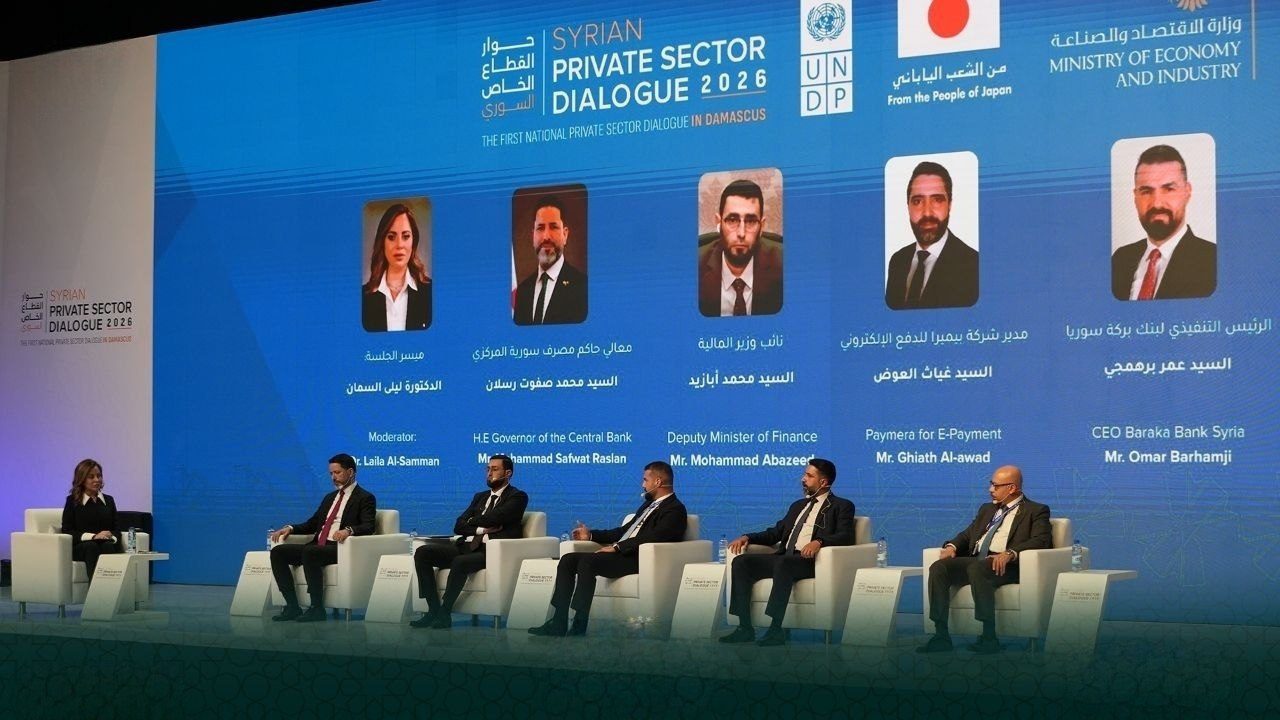
Under the slogan From Dialogue to Implementation, the Conference Palace in Damascus hosted the National Conference for the Syrian Private Sector, organized by the Ministry of Economy and Industry in partnership with the United Nations Development Program, with support from Japan and implementation by the Syrian Forum Foundation.
Minister of Economy and Industry Dr. Nidal al-Shaar led the event, which drew decision-makers, experts and business leaders from across Syria. Participants sought to develop a roadmap that strengthens the investment environment and reinforces the private sector’s role as a key partner in economic development and recovery.
The conference opened with discussions focused on establishing a new partnership between the public and private sectors. Participants emphasized the importance of improving the legislative and regulatory environment while addressing obstacles that have constrained economic activity for decades. They also highlighted the need to align reforms with the government’s stated commitment to a free-market economy and stronger governance frameworks.
On the sidelines of the conference, organizers launched the National System of Syrian Joint Business Councils through a charter and procedural guide based on Ministerial Decree No. 25. The initiative aims to create a unified institutional framework supporting exports and attracting investment, reflecting broader efforts to strengthen Syria’s regional and international economic engagement.
Rouad Ramadan, head of the Syrian Council for the Coordination of Business Councils, explained the significance of the initiative. “Working within a single national system gives a cohesive institutional voice before partner countries, transforming scattered individual relationships into an organized economic presence that can be measured and followed up on.”
Reconstruction and Investment Opportunities
Conference sessions also examined the private sector’s contribution to economic growth and production, particularly as it remains the primary driver of market activity. In an exclusive statement to Levant24, Mohammad Said Sheikh al-Kar, head of the Aleppo Chamber of Commerce, highlighted the sector’s role in the country’s recovery efforts.
“The private sector constitutes over 65% of the Syrian economy and has remained steadfast as a cornerstone in the face of crises. Today, with the onset of the recovery phase, the new government’s orientation toward a free economy, and the issuance of the new investment law, it will play an even greater role in reconstruction and in attracting investors and returning businessmen.”
Addressing Financial and Regulatory Obstacles
Despite the positive outlook, conference discussions also focused on persistent challenges facing businesses. Participants raised concerns about taxation, access to financing and the restoration of value chains in sectors such as textiles, agriculture and renewable energy. They also discussed measures to support women entrepreneurs and small businesses.
Speaking to Levant24, businessman Kamal al-Harash stressed the need for structural reforms. “The Syrian economy has an active private sector that represents the main lever for business, but it needs reorganization and rehabilitation. To overcome high investment risks and seize available opportunities, it is necessary to update laws, combat corruption, provide a stable legal vision, as well as reform the banking system by securing financing and an electronic payment infrastructure.”
Ihab Zakour, director of the Small and Medium Enterprises Development Authority, said the conference aimed to move beyond discussion and toward implementation. “The private sector holds the largest share of implemented projects in Syria, and this conference seeks to overcome the legacy of previous laws that hindered investment. We meet today to listen to the real needs of investors, amend procedures, and translate the outcomes of this event directly from dialogue to immediate implementation.”