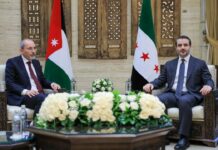
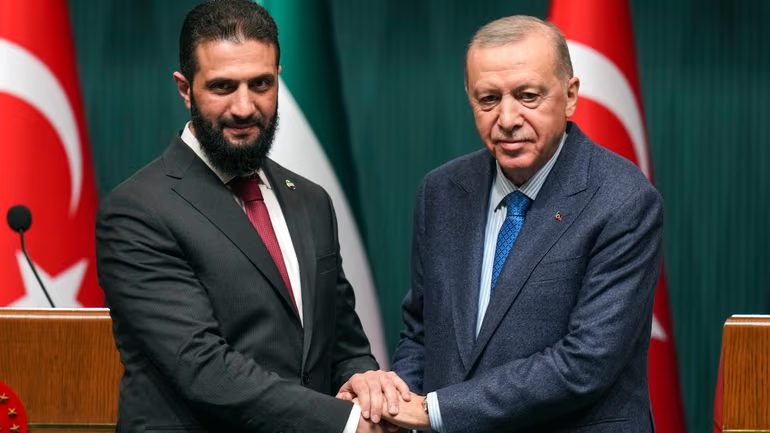
Syrian President Ahmad al-Sharaa met Turkish Foreign Minister Hakan Fidan Thursday, April 16, on the sidelines of the fifth Antalya Diplomatic Forum, marking a new phase in expanding bilateral coordination across political, economic and security fronts.
According to the Syrian Ministry of Foreign Affairs, the meeting included Syrian Foreign Minister Asaad al-Shaibani and intelligence chief Hussein al-Salameh, alongside Turkish intelligence head Ibrahim Kalin. The talks reflected a growing alignment between Ankara and Damascus following years of regional instability.
Sharaa also held a separate meeting with US Special Envoy to Syria Tom Barrack, where both sides discussed regional developments and ways to enhance cooperation to strengthen security and stability, the ministry said.
The Antalya forum, held under the patronage of Turkish President Recep Tayyip Erdogan, runs from April 17 to April 19 under the theme “Dealing with Uncertainties in Shaping the Future,” bringing together global leaders and diplomats at a time of shifting alliances.
Economic Integration Gains Momentum
Beyond diplomacy, economic cooperation has emerged as a central pillar of Syrian-Turkish relations. Sharaa described the partnership as essential to reconstruction efforts, emphasizing joint projects aimed at transforming Syria into a regional economic hub.
Among the proposals discussed are plans for a Syrian-Turkish free zone in Idlib, expansion of industrial cities and infrastructure development led in part by Turkish companies. Sharaa told Anadolu Agency such initiatives could position Syria as a bridge between East and West.
Financial cooperation is also accelerating. The Central Bank of Syria (CBS) confirmed it is in the final stages of establishing a correspondent banking relationship with Turkey’s central bank, a move expected to ease cross-border payments and facilitate trade.
CBS said the two countries are exploring a currency swap arrangement supporting trade flows, noting the lack of a formal payment systems forces many transactions into cash-based channels, limiting growth.
Official data indicates the rapid expansion of trade. Turkish exports to Syria rose 60% to $3.5 billion last year, while Syrian imports reached $235 million. Both countries aim to increase total trade volume to $10 billion in the medium term.
Increased financial integration, says the CBS, includes regulated trade finance frameworks and potential entry of Turkish banks such as Ziraat Bank and Aktif Bank into Syria, will be key to sustaining that growth.
Security Cooperation and Regional Stability
Security coordination remains a cornerstone of the relationship. Sharaa said Syria’s transition from what he called a “state of crisis” to a period of opportunity depends heavily on cooperation with Turkey.
He pointed to progress in integrating armed factions into state institutions, including steps toward incorporating the Syrian Democratic Forces and the closure of the last foreign base in northeastern Syria. These measures, he said, have contributed to internal stability.
Sharaa also addressed ongoing tensions with Israel, stating that Syria is pursuing diplomatic channels to avoid escalation despite continued disputes over territory near the Golan Heights. He warned that instability in southern Syria and neighboring Lebanon could threaten broader regional security.
Energy and Connectivity Drive Strategic Vision
Energy cooperation is emerging as another area of shared interest. Sharaa said Syria could serve as a secure route for oil and gas flows, citing an agreement with Iraq to export oil through Syrian ports and ongoing coordination with Turkey and Gulf states.
He also referenced the Four Seas project, a regional integration framework linking the Mediterranean, Caspian, Red Sea and Arabian Gulf through interconnected infrastructure. In parallel, Syria is exploring partnerships beyond the region, including with Ukraine in agriculture and energy, with plans to use Syrian ports as a re-export hub for food products.
A Shift From Crisis to Opportunity
Sharaa framed the evolving relationship with Turkey as part of a wider transformation. “Syria has transformed from a state of crisis into a very great historical opportunity towards stability, construction and reconstruction,” he said in remarks during the forum.
For Turkey, continued engagement offers both strategic and economic benefits, reinforcing its influence in regional diplomacy while opening new markets. As discussions in Antalya continue, the growing alignment between Ankara and Damascus suggests a recalibration of regional dynamics, with economic integration and diplomatic mediation at the forefront of a changing Middle East landscape.