
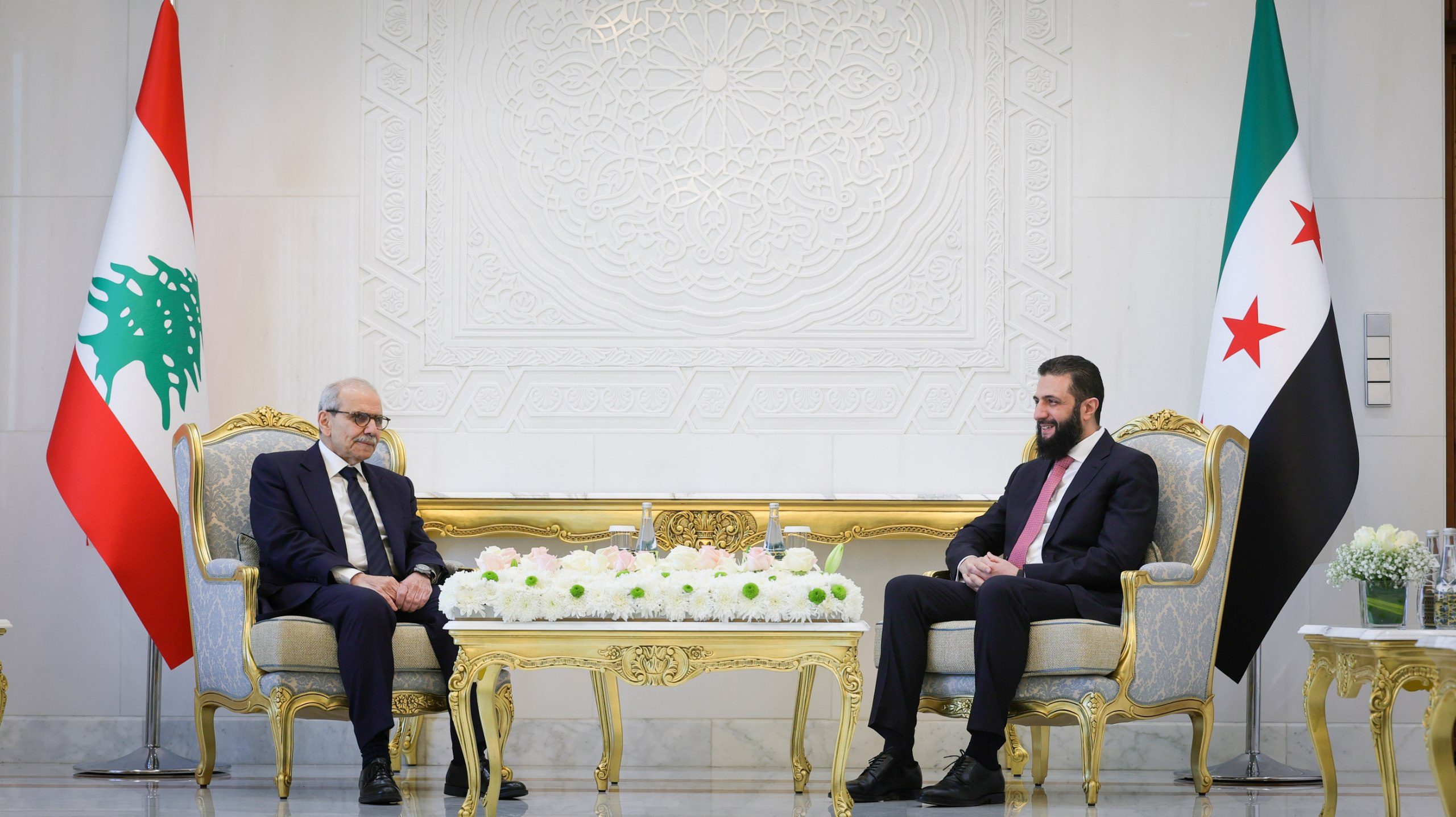
 Lebanese Prime Minister Nawaf Salam’s visit to Damascus on May 9 marked a new stage in reestablishing relations between Syria and Lebanon, with both sides advancing discussions on economic coordination, border security and regional cooperation. The visit, Salam’s second since April 2025, concluded with broad understandings on political, security and economic issues.
Salam met Syrian President Ahmad al-Sharaa at the People’s Palace in Damascus alongside ministerial delegations from both countries. Officials said the talks focused on addressing longstanding issues through cooperation based on mutual respect for sovereignty and shared interests.
Joint Committees and Economic Coordination
Before departing Damascus, Salam announced an agreement to establish joint technical committees tasked with following cooperation files across several sectors. The two sides also agreed to accelerate the formation of a Joint Lebanese-Syrian Business Council, which is expected to hold its first meeting in Damascus in the coming weeks.
At the ministerial level, Syrian Economy and Industry Minister Nidal al-Shaar met Lebanese Economy Minister Amer al-Bisat to discuss expanding trade exchange and strengthening industrial cooperation. Discussions included improving cross-border trade mechanisms and increasing coordination between chambers of commerce and industry in both countries. Officials said the measures aim to support regional economic integration and facilitate commercial activity between the neighboring states.
Border Security and Prisoner Transfers
Security cooperation remained central to the discussions, particularly efforts to strengthen control over the Syrian-Lebanese border and combat smuggling activities. Syrian Interior Minister Anas Khattab met Lebanese Deputy Prime Minister Tariq Mitri to discuss security coordination and the work of the Joint Security Committee.
The talks also addressed mechanisms for continued cooperation between security agencies on both sides of the border. The two governments also reviewed progress on prisoner transfer agreements. Officials confirmed the recent transfer of about 300 Syrian detainees from Lebanon as part of an agreement involving roughly 2,500 prisoners.
Humanitarian issues also featured in the talks, including efforts to determine the fate of missing and forcibly disappeared persons in both countries. Salam said Lebanon would not allow its territory to be used in ways that harm Syria or other Arab states.
Infrastructure and Energy Cooperation
The discussions extended to infrastructure and public services directly affecting citizens in both countries. Officials examined plans to improve land transport routes, railway links and border crossings to ease the movement of goods and travelers.
In the energy sector, the two sides agreed to improve electricity grid connections and facilitate power transfers to Lebanon. They also discussed accelerating negotiations on natural gas transmission agreements.
The issue of displaced Syrians in Lebanon remained a key topic. Both governments said they would continue dialogue aimed at supporting the safe and dignified return of Syrians while regulating Syrian labor in Lebanon through legal frameworks. The meetings reflected growing efforts by both governments to rebuild cooperation after years of political tension and regional instability.