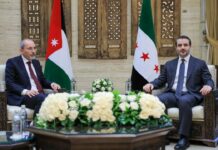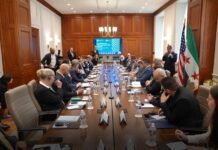
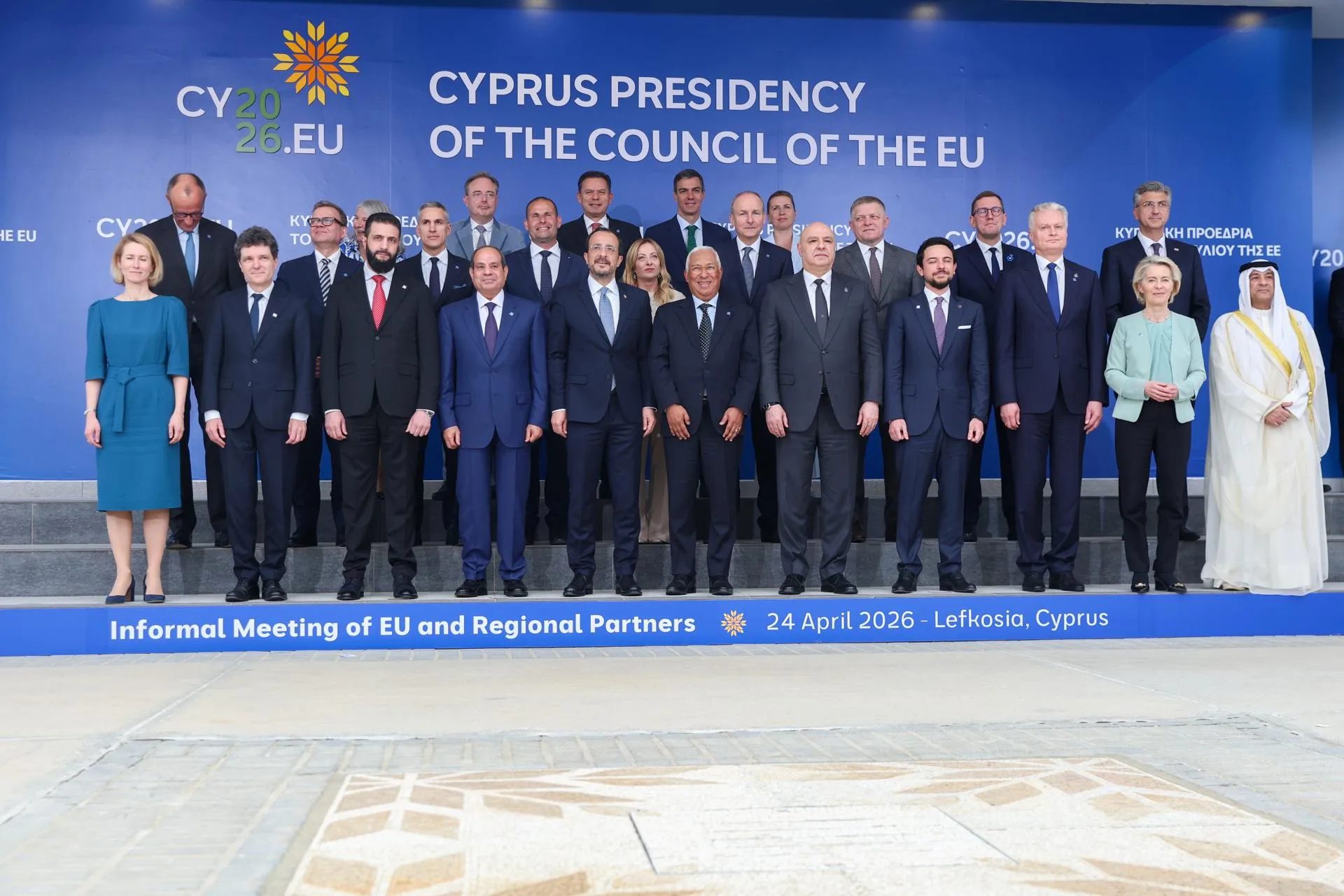
Syrian President Ahmad al-Sharaa arrived in Nicosia Friday, April 24 to take part in an emergency EU summit focused on mounting energy and security challenges. The meeting, titled “Saving the Summer,” comes amid rising tensions in the Strait of Hormuz and growing concern over global energy supplies.
According to Agence France-Presse, the summit brought together EU leaders and regional counterparts, including Egyptian President Abdel Fattah al-Sisi, Lebanese President Joseph Aoun and Jordan’s Crown Prince Hussein bin Abdullah. Gulf Cooperation Council Secretary-General Jassem al-Budaiwi also attended.
European leaders framed the gathering as an effort to coordinate policy responses and limit the economic fallout of the crisis. French President Emmanuel Macron said, “Europe must be more involved,” adding that stability in the region remains a shared priority. The European Commission reported energy costs surged by 24 billion euros in recent weeks, demonstrating the urgency of the discussions.
Sharaa Stresses Interdependence of Security
During the summit and a subsequent press conference, Sharaa emphasized the strategic link between European and Middle Eastern security. “The security of the European continent and our region represents an indivisible geopolitical balance,” he said.
Sharaa argued cooperation between the EU and regional states is essential to maintaining energy stability and safeguarding trade routes. He warned any closure of the Strait of Hormuz would pose “a grave danger” to global supply chains.
The Syrian president also called on the EU to take a firmer stance on what he described as Israeli violations of Syrian territory. He said such actions undermine stability and reconstruction efforts, adding that “protecting the political process begins with protecting the land upon which it rests.” Sharaa framed Syria’s role as evolving, saying the country seeks to move from a conflict zone to “a bridge to security.”
EU Signals Renewed Engagement With Syria
European officials used the summit to signal a willingness to deepen engagement with Damascus. European Council President Antonio Costa said the EU “supports the efforts and acknowledges and appreciates the important steps taken to rebuild Syria.”
European Commission President Ursula von der Leyen confirmed plans for a high-level meeting between Syria and the EU, expressing hope for renewed cooperation. The announcement follows the recent resumption of a 1978 cooperation agreement between the two sides.
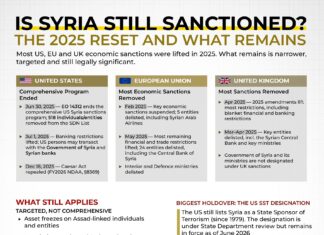
Cypriot President Nikos Christodoulides also called for expanded dialogue, noting that existing sanctions on Syria require “a gradual approach” to address. The summit included discussions on diversifying energy sources and strengthening regional partnerships to prevent further economic disruption.
New Initiatives and Next Diplomatic Steps
Sharaa presented what he described as the Four Seas and Nine Passages initiative, aimed at positioning Syria as a transit hub linking Central Asia and the Gulf with Europe. He said the proposal could provide a secure alternative route for trade and energy flows.
He described the Nicosia meeting as “a confident beginning” to a broader diplomatic phase. Officials confirmed a follow-up session will take place in Brussels on May 11, launching a high-level Syrian-European political dialogue.
As the summit concluded, leaders emphasized the need for continued coordination. While challenges remain, the meeting highlighted a shift toward closer engagement between Syria and European partners at a time of shared economic and security concerns.